Global Firepower | Military Industrial Complex | Second World War History
Home | Military Pay Scale Chart | Aircraft | Infantry Weapons | Military Vehicles | Navy Ships | Military Education | French Military Victories | Military Ranks | WW2 Weapons
Military Factory Latest from Military Factory
Thumbnail picture of the Dardo infantry fighting vehicle
Dardo IFV
Thumbnail picture of the Supermarine Scimitar fighter
Supermarine Scimitar
Thumbnail picture of the Centauro B1 8x8 tank killer
Centauro 8x8
Thumbnail picture of the Novi Avion fighter
Novi Avion
Thumbnail picture of the FR F2 bolt-action sniper rifle
FR F2
Thumbnail picture of the Lebel Model 1886 bolt-action rifle
Lebel Model 1886
2009 Military Pay Scale Chart - for Army, Navy, Air Force and Marines
  BY DECADE
    · 1900 to 1909
    · 1910 to 1919
    · 1920 to 1929
    · 1930 to 1939
    · 1940 to 1949
    · 1950 to 1959
    · 1960 to 1969
    · 1970 to 1979
    · 1980 to 1989
    · 1990 to 1999
    · 2000 to 2009
    · 2010 to 2019
    · View All Aircraft
  BY TYPE
    · Attack Helicopters
    · Bombers
    · Close-Support
    · Commercial
    · Dive Bombers
    · Experimental
    · Fighters
    · Floatplanes
    · Flying Boats
    · Fuel Tankers
    · Helicopters
    · Interceptors
    · Multi-Role
    · Navy Aircraft
    · Night-Fighters
    · Recon Aircraft
    · Recon Helos
    · Special Purpose
    · Torpedo Bombers
    · Trainer Aircraft
    · Transport Aircraft
    · Transport Helos
    · UAVs
  WORLD WAR 2
    · Full List
    · 1939
    · 1940
    · 1941
    · 1942
    · 1943
    · 1944
    · 1945
    · Australia
    · Battle of Britain
    · Bombers
    · Britain
    · Dive Bombers
    · Canada
    · Fighters
    · China
    · France
    · Germany
    · German Fighters
    · German Jets
    · Italy
    · Japan
    · Mitsubishi Bombers
    · Poland
    · USA Aircraft
    · USA Bombers
    · Soviet Union
    · Torpedo Bombers
  WORLD WAR 1
    · Full List
    · 1914
    · 1915
    · 1916
    · 1917
    · 1918
    · Aces
    · Austria-Hungary
    · Bombers
    · Britain
    · Fighters
    · France
    · Germany
    · Italy
    · Recon Aircraft
    · Russia
    · USA
  KOREAN WAR
    · Full List
    · Aces
    · Australia
    · USA
    · North Korea
  VIETNAM WAR
    · Full List
    · United States
    · North Vietnam

Military Factory > Military Aircraft > Sukhoi Su-17 / Su-20 / Su-22 (Fitter)
 
 
More Pictures Cockpit View 3 View Plan QuickGraphs StatsCentral

Sukhoi Su-17 / Su-20 / Su-22 (Fitter)

The Su-17 Fitter - and its export derivatives, the Su-20 and Su-22 - were swing-wing developments of the original Su-7 Fitter fixed-wing design.
By Captain Jack

Bookmark and Share

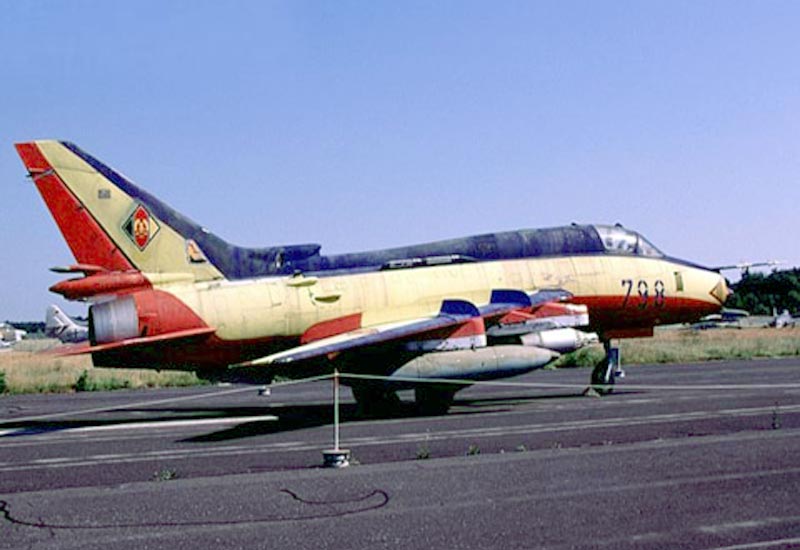
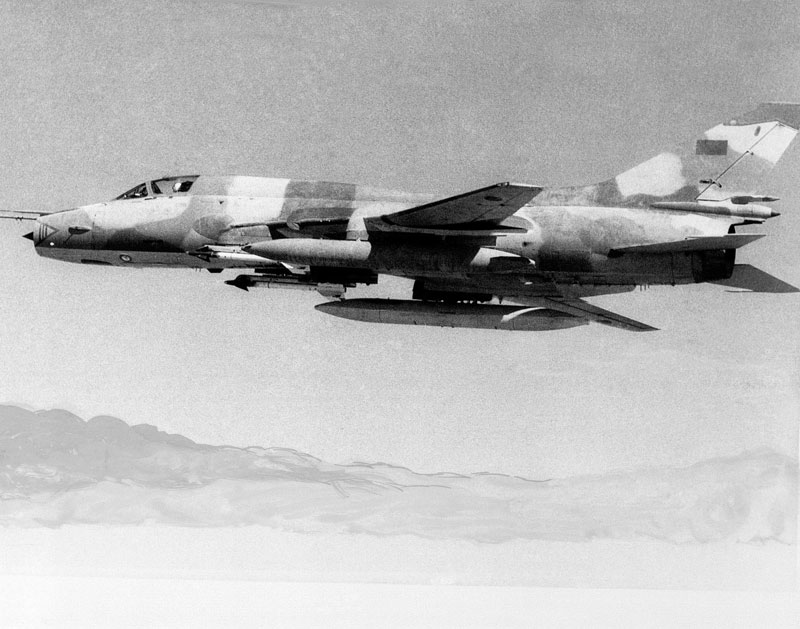
The Mach 2-capable Sukhoi Su-17 "Fitter" was a further development of the successful Su-7 "Fitter-A" fighter/fighter-bomber family line detailed elsewhere on this site. The aircraft incorporated a partial variable geometry wing ("swing wing") system and improved upon the former's take-off and landing attributes as well as performance at the low-level as required of it during ground attack runs. The swing-wing element added to the aircraft's stability at low-speeds and altitudes while improving overall range and ordnance loads by featuring large-area fixed wing "gloves". Beyond its new wing arrangement, the Su-17 also differed from its Su-7 origins in that it featured a newly-designed canopy and nose assembly as well as an identifiable raised fuselage spine, giving the new aircraft a more stout appearance than the pencil-thin Fitter-A. The type served the Soviet Union well and was heavily exported to Warsaw Pact nations and trusted Third World allies alike. The Su-17 was developed into the export Su-20 and Su-22 Fitter models of varying avionics, engines and weapons. In all, some 2,867 Su-17/Su-20/Su-22 Fitters were produced with almost half of these made available to Soviet export customers. Over a dozen nations took delivery of the type, making it a staple fighter-bomber throughout the Cold War. Some air forces continue to fly the aircraft - nearly forty years after it was introduced.

Development - Fitter-B

The Su-7 (NATO codename of "Fitter-A") was a capable aircraft in its own right. However, there were glaring deficiencies in its operational range - no thanks to a thirsty powerplant - and ordnance-carrying capabilities. Sukhoi and Soviet authorities sought other improvements that would make the Fitter series a much more capable and versatile battlefield component. As such, a Su-7BM production model served as the demonstrator for the testing of a new swing-wing variable geometry system development. The new wing would essentially be made up of two parts - a fixed wing root/wing glove and the positional swing-wing portion making up half of the wing (at about mid-wing span). The new prototype became the Su-7IG ("IG" for "Izmenyaemaya Geometriya", also internal designation of "S-22I"). First flight was achieved on August 2nd, 1966. The working prototype/technology demonstrator showed enough promise during this testing phase, improving on both field performance and range of the Su-7, that it was selected for production.

A two-seat Su-7U long-fuselage trainer was then revised. The rear instructor's cockpit would make way for additional avionics and fuel while housing the new wing component. The swing-wing configuration was devised as a way to increase the Su-7's inherent range while at the same time allowing the aircraft to carry more weaponry along its fixed wing portion without the need to implement heavy and complex swiveling weapon stations to maintain aerodynamic integrity in full sweep. A limited production run appeared under the base "Su-17" designation, these being fitted with the Lyulka AL-7F-1 turbojet powerplant of 22,046lbs thrust. Production of this early Fitter-B would run from 1969 to 1973.

The Su-17K became the export version of this base Su-17, though this was only received by the Egyptian Air Force. NATO assigned the new aircraft design the codename of "Fitter-B", sequentially relating this new design with that of the original Su-7 it originated from.

The Rest of the Su-17 Fitter Variants - Beginning with Fitter-C

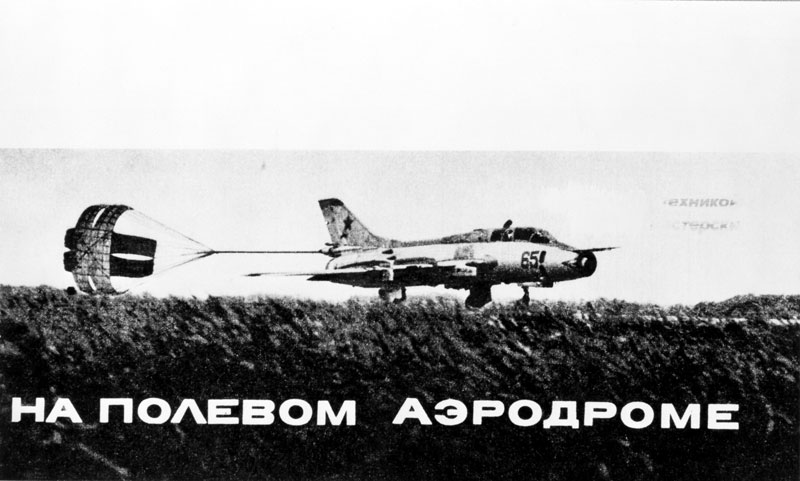
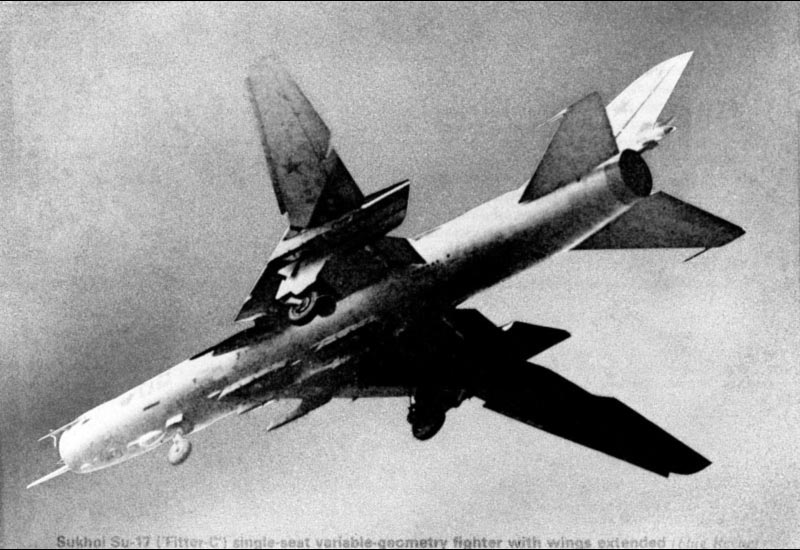
The Su-17M (S-32M) became the first quantitative production version of note and was known to NATO as "Fitter-C". The aircraft was fitted with an afterburning Lyulka AL-21F-3 engine of 24,800lbs output and was given an onboard SRD-5M range-finding radar (same as the one found on the Su-7BMK production models). A new navigation and attack system was installed for her intended ground attack role. The fuselage was also given a pair of forward-mounted pitot pressure measurement tubes. An Angle-of-Attack (AoA) vane was affixed as was a rear brake parachute, the latter promoting shorter landing runs. First flight was achieved on December 28th, 1971. In addition to her primary battlefield roles, some Su-17s were developed into a limited-production - though still capable - reconnaissance variant under the Su-17R designation featuring reconnaissance pods with applicable equipment. Production of the improved Fitter-C began in 1972 with official introduction occurring in 1973. Production ceased in 1975.

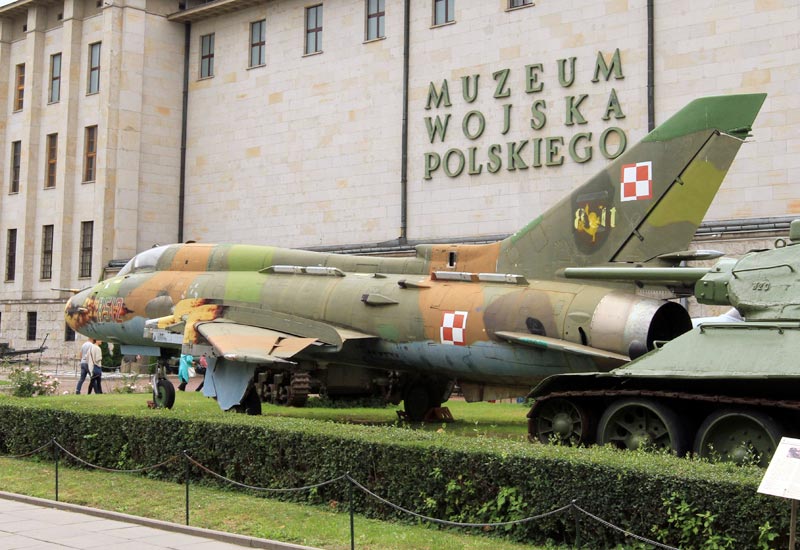
The export version of this ground attack model became the Su-20. The prototype Su-20 first flew on December 15th, 1972. Egypt, Poland and Syria were the primary export customers of this new aircraft. The Su-20R was the export reconnaissance equivalent of the base Su-20 line.

Fitter-D

The Su-17M2 was the next definitive development and was assigned the NATO codename of "Fitter-D". She was essentially an improved production form of the former types and was known internally at Sukhoi as S-32M2. The nose assembly was extended by 15 inches and revised to incorporate more of a downward slope to improve the pilot's "out-of-the-cockpit" forward visibility - a plus in the low-level strike role. This new Fitter also deleted the ranging radar but incorporated the Fon-1400 laser rangefinder as well as additional combat-related avionics. A DISS-7 Doppler navigation radar was installed into a fairing under the nose and first flight of the aircraft was achieved on December 20th, 1973. Production began in 1974, lasting until 1977, and the Su-17M2 officially entered Soviet service in 1975. The Su-17M2 featured a fixed shock cone.

The Su-17M2D was another Fitter-D development but fitted with a Tumansky R-29BS-300 series engine of 25,335lbf with afterburning in a revised rear fuselage (this being a defining feature of the variant) and shorter overall fuselage. The engine offered little in the way of improved performance and limited range so was therefore only offered in forthcoming export deliveries. First flight was achieved on January 31st, 1975 and production lasted from 1977 to 1978.

Fitter-E - the Trainer

The Su-17UM was the two-seat trainer form developed from the S-52U prototype and given the NATO codename of "Fitter-E". Production began in 1976, with the aircraft entering service that same year. Production lasted until 1978. This new aircraft featured a deeper revised airframe to make room for the addition of the second cockpit for the instructor. This also resulted in the deletion of some internal fuel space thus limiting the aircraft's range. The original avionics of the production model were maintained while the portside cannon was omitted. The vertical tail fin was enlarged to counteract the effects of longitudinal instability (when in a high AoA). First flight was achieved on August 15th, 1975.

The two-seat Su-17UM went under the export designation of Su-22U and fitted a Tumansky R-29 series powerplant.

Fitter-F

The Su-17M2D export model became the Su-22 which fell under the internal Sukhoi designation of S-32M2K. The Su-22 was afforded the same K-36D ejection seat system as found on the modern-day MiG-29 "Fulcrum" and Sukhoi Su-27 "Flanker" jet aircraft series and was powered by a Tumansky R-29 engine. The Su-22 also featured a fixed shock cone, laser rangefinder and Doppler radar.

Fitter-G

The Lyulka-powered Su-17UM3 (S-52UM3, NATO codename of "Fitter-G") was a revised conversion trainer with the deeper fuselage and revised vertical tail fin. It fitted the avionics suite of the Su-17M3 and achieved first flight on September 21st, 1978. Production lasted from 1978 until 1982.

The export form was offered as the Su-22UM3 and the Su-22UM-3K, each differing by their use of the Tumansky R-29 and Lyulkin AL-21 series engines respectively.

Fitter-H

The Su-17UM two-seat trainer airframe was also used in the development of the S-52, becoming the Su-17M3 ("Fitter-H"). The instructor's cockpit position was naturally removed and made way for additional avionics and fuel stores, the latter benefitting range. The external Doppler radar fairing was moved into an internal position and provision for AA-2 "Atoll and AA-8 "Aphid" along two hardpoints under the wing gloves were added. First flight was achieved on June 30th, 1976. Production lasted from 1976 until 1981. The Su-17M3 (and its related export derivatives) model became the most quantitative Su-17 Fitter development of the series, numbering nearly 1,000 production examples in whole.

Fitter-J

A downgraded export version of the Su-17M3 became the Su-22M ("Fitter-J", S-52K internal Sukhoi designation). The prototype Su-22M was first flown on May 24th, 1977 with production beginning in 1978 and lasting to 1984. An upgraded export version fell under the designation of Su-22M3 (internal designation of S-52MK).

Fitter-K

The Su-17M4 (internal designation of S-54 and NATO codename of "Fitter-K") became the final Fitter production form. First flight was achieved on June 19th, 1980. The avionics were vastly improved and the Su-17M4 featured the "Sirena" SPO-15LE radar-warning system as well as the Lyulka AL-21F-3 engine. Engine cooling was addressed through the implementation of fuselage- and vertical tail-mounted air inlets to help promote better cooling airflow around the engine and jet pipe, a prime consideration for an afterburning powerplant. The shock cone was fixed into position and provisions were added to support both anti-radiation and air-to-surface missiles. Production lasted from 1981 into 1988.

The Su-17M4 was offered to export customers under the Su-22M4 designation (internal designation of S-54K). Production lasted from 1983 to 1990. The Su-17M4 was given a top speed of 1,155 miles per hour (Mach 1.7) at altitude with a combat range of 715 miles (1,430 miles ferry). The service ceiling was limited to 46,590 feet while the rate-of-climb was listed at 45,275 feet per minute.
Modernized Export Su-22 Fitters

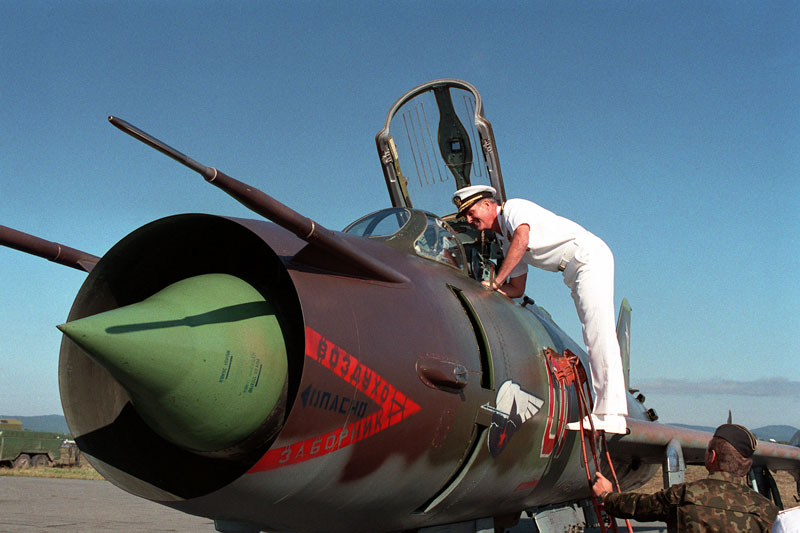
The Su-22 line was later offered a modernization package making these Fitters Su-22M5s. This upgrade incorporated Russian- and French-based systems consisting of an all-new digital cockpit with Hands-On Throttle and Stick (HOTAS), a Phazotron/Thomson-CSF "Phathom" radar system, GPS navigation and an overall improved avionics suite as well as compatibility with TV and laser-guided munitions. Lahav of Israel installed Elta synthetic aperture radar systems and new digital computers into Polish Su-22s.

One-Off Su-17 Fitter Developments

The Su-17 was used in a few "one-off" developmental projects as well, these becoming the Su-17M-28 and the Su-17MKG. The Su-17M-28 was used in the testing of the AS-9 "Kyle" anti-radiation missile whilst the Su-17MKG became the development platform for the testing of the AS-10 "Karen" and AS-14 "Kedge" air-to-surface missiles. Both aircraft platforms would lend themselves well into expanding the lethality of the Su-17 Fitter line as a whole, particularly in its ability to acquire and destroy ground-based targets with a good level of success.

Walk-Around

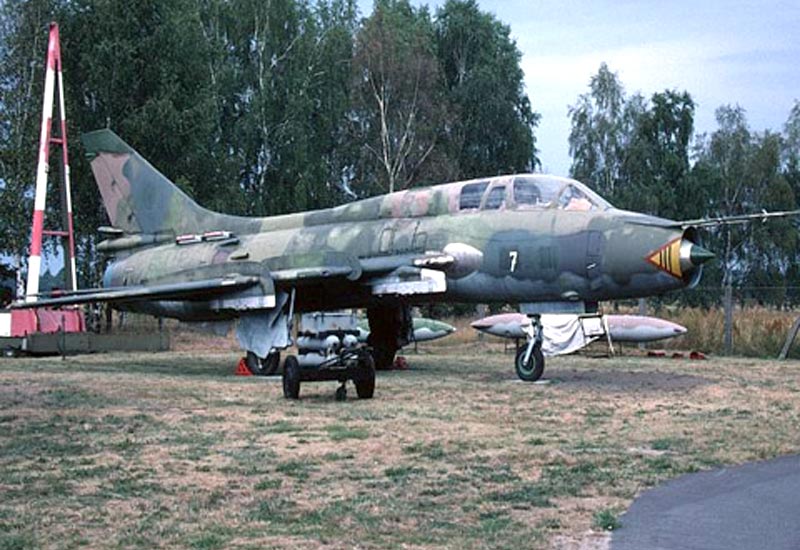
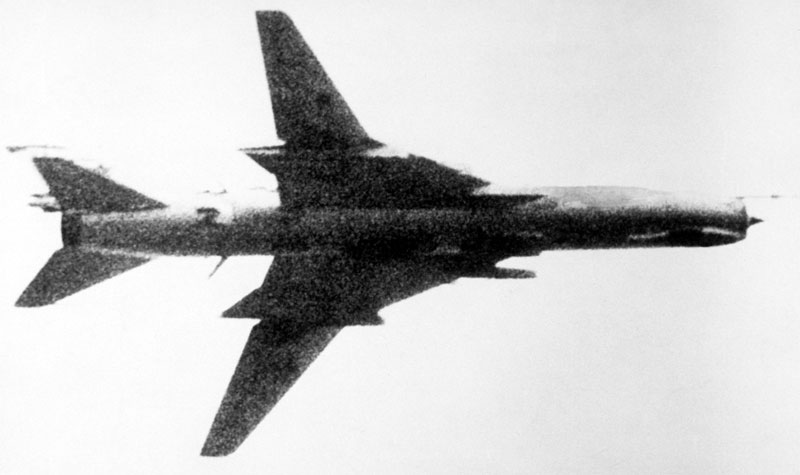
To the casual observer, the Su-17 series appeared externally similar to the preceding Su-7 Fitter line. The most obvious change was its use of a swept fixed-wing area housing the swing-wing portion of the wing assembly. This would allow the new Su-17 to carry more ordnance around its center of gravity while leaving the rest of the wings the freedom to provide for better range and performance through the various intended flight actions (take-off/landing/low-performance flight, cruise and high-performance flight). Wing sweep positions were set at 28-, 45- and 62-degrees respectively. Wings were low-mounted with slight anhedral (downward slope) along the cylindrical fuselage and fitted with a pair of large boundary layer fences running longitudinally from leading edge to trailing edge (the fences were affixed on the static portion of each wing glove and not the sweeping wing portions).

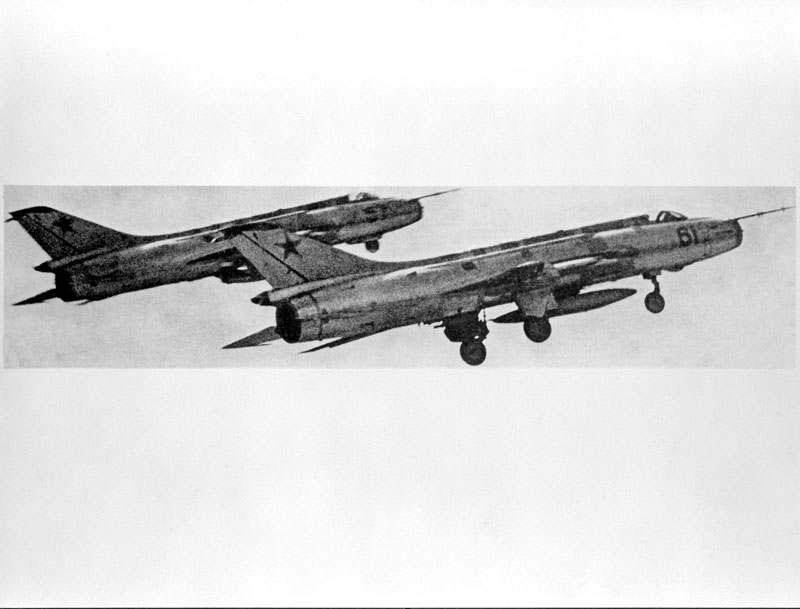
The fuselage featured a cut-off nose assembly housing an integral shock cone. Air was drawn through the nose-mounted inlet and around the shock cone to feed the single engine buried within the fuselage. The pilot's seating position was placed well-forward in the design, affording him good views of the action to all sides with the exception of the rear, this being partially blocked by the raised fuselage spine. The spine ran from the rear of the canopy base to the base of the single vertical tail fin topping the empennage. The empennage featured highly-swept horizontal tailplanes complimenting the swept wing gloves and vertical tail fin. The horizontal planes straddled either side of the single engine exhaust ring. The undercarriage (retained from the original Su-7 construction) was fully-retractable and made up of two single-wheeled main landing gear legs (retracting inwards toward centerline) and a single-wheeled nose landing gear leg (retracting forward).

Armament

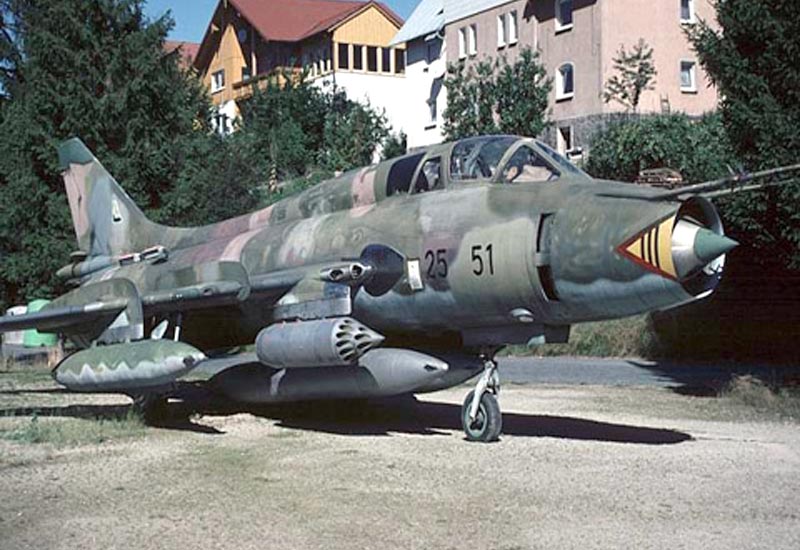
Standard armament (Su-17M4) was a pair of 30mm Nudel'man-Rikhter NR-30 series cannons (80 rounds of ammunition to a gun). The Fitter was given twelve total hardpoints (in later production models) for which to affix a variety of air-to-air and air-to-ground stores (two underwing hardpoints were reserved for self-defense air-to-air missiles while four hardpoints were positioned along the underfuselage sides and three hardpoints were given to each underside wing glove area). In the air-to-ground role, the Fitter was cleared to carry AS-7 "Kerry", AS-10 "Karen", AS-11 "Kilter", AS-12 "Kegler" and the AS-14 "Kedge" air-to-surface missiles as well as conventional drop bombs, laser-guided/electro-optical bombs, napalm, drag chute bombs, cluster bombs, gun pods (GSh UPK-23 and the traversable GSh SPPU-22)) and rocket pods. The Fitter was cleared to carry the AA-2 "Atoll", AA-8 "Aphid" and AA-11 "Archer" air-to-air missiles (mainly in a self-defense role). External armament was limited to 8,820lbs.

Operators

Beyond the Soviet/Russian use of the Su-17 fitter and its related export developments, the new design was shipped off to nations across Asia, North Africa and the Middle East with some ending up in southern Africa and Western South America (Peru). Operators included Armenia, Afghanistan, Algeria, Angola, Azerbaijan, Belarus, Bulgaria, Czech Republic, Czechoslovakia, East Germany (later Germany), Egypt, Hungary, Iraq, Iran, Libya, North Korea, Peru, Poland, Slovakia, Syria, Turkmenistan, Ukraine, Uzbekistan, Vietnam and Yemen. Some of these air forces still use their Su-20/Su-22 Fitters in an operational capacity. Perhaps of note in this listing was use of the Su-17 by Peru. Russia has since withdrawn their Su-17s from operational service beginning in 1998, these final forms being of the reconnaissance type.

Su-17 Fitters Over Afghanistan

The Soviet invasion of Afghanistan in the 1980s put the Su-17 fitter into action (the earlier Su-7 was also fielded in the conflict as was the Mikoyan-Gurevich MiG-23 "Flogger" and Sukhoi Su-25 "Frogfoot"). While achieving solid results in the early going, the tough operating conditions of the South Asian desert inevitably took their toll on the sensitive internal components of the Fitter. However, the Fitter was available in quantity and seemed to tolerate these conditions best when compared to the comparable close-support air-based weapons on hand. However, its low-level attack prowess were done in somewhat by the aircraft's inherent operating speed. The inclusion of shoulder-based SAM systems (such as the American-based Stinger missile systems into the conflict) forced the Fitters to higher operating altitudes and thusly degrading combat effectiveness. The arrival of the dedicated ground-attack MiG-27 "Flogger" (a fighter-bomber development of the air superiority-minded MiG-23 "Flogger") forced the Su-17s to more secondary roles by the end of the conflict.

Miscellaneous

The Su-17 was unofficially known as the "Martlet" (or "Strizh" in Russian).

Two Sukhoi Fitters of Libyan origin were shot down by US Navy Grumman F-14 Tomcats in the much publicized Gulf of Sidra incident (August 19th, 1981).

The USAF could lay claim to at least six Sukhoi Fitters during the 1991 Gulf War.

Text ©2003-2009 www.MilitaryFactory.com • All Rights Reserved • No Reproduction Without Permission • Corrections / Comments to MilitaryFactory at Gmail dot com

Last Revision: 10/19/2009


  Specifications for the Sukhoi Su-17M4 (Fitter-K)
arrow downDimensions:
Length: 62.40ft (19.02m)
Width:44.88ft (13.68m)
Height: 16.80ft (5.12m)

arrow downPerformance: About MACH
Max Speed: 718mph (1,155kmh; 624kts)
Max Range: 889miles (1,430km)
Rate-of-Climb: 45,275ft/min (13,800m/min)
Service Ceiling: 49,869ft (15,200m; 9.4miles)

arrow downStructure:
Accommodation: 1
Hardpoints: 12
Empty Weight: 26,808lbs (12,160kg)
MTOW: 42,990lbs (19,500kg)

arrow downPowerplant:
Engine(s): 1 x Lyulka AL-21F-3 turbojet engine generating 24,802lbs.
arrow downArmament Suite:
STANDARD:
2 x 30mm Nudelman-Rikhter NR-30 cannons in leading edge wing roots.

OPTIONAL:
10 to 12 hardpoints for up to 9,000lbs of mixed ordnance including conventional drop bombs, napalm, drag chute bombs, runway-defeating bombs, TV/Laser-guided bombs, rocket pods, gun pods, air-to-surface missiles and air-to-air missiles.

  Pictures of the Sukhoi Su-17 / Su-20 / Su-22 (Fitter)
     
Picture of Sukhoi Su-17 / Su-20 / Su-22 (Fitter)
Picture of the Sukhoi Su-17 / Su-20 / Su-22 (Fitter)
Image of the Sukhoi Su-17 / Su-20 / Su-22 (Fitter)
     
arrow upView All 12 Images

CompareX2 CompareX4 Conversions Dictionary Acronyms

Compare and Contrast Military Aircraft Specifications

  Special Aircraft Collections
Aircraft by Conflict:
Falklands War
Indo-Pak War
Operation Allied Force
Operation Desert Storm
Six Day War
Yom Kippur War

Special Collections:
American X-Planes
Classic US Warbirds
Grumman "Cats"
Indian Air Force
Israeli Air Force
Mikoyan-Gurevich
V-Bombers


Korean Air War:
Korean War Aircraft
Aces
Australia
United States
North Korea

Vietnam Air War:
Vietnam War Aircraft

Cold War
Cold War Aircraft
United States
Soviet Union
Soviet Bombers of the Cold War

Modern Aircraft
Modern Military Aircraft
United States

Miscellaneous
MiG-15 Versus Sabre
Top 10 Fighters of All Time


  Recent Military Aircraft Additions
Thumbnail picture of the Supermarine Scimitar fighter
Supermarine Scimitar
Thumbnail picture of the Novi Avion fighter
Novi Avion
Thumbnail picture of the Arado Ar TEW 16/43-23 jet-powered fighter
Arado TEW 16/43

  Contacting MilitaryFactory.com
We can only get better if you tell us how. You can contact MilitaryFactory.com at MilitaryFactory at gmail dot com (replace "at" with "@" and "dot with ".") with any questions, comments or corrections. We also accept related military imagery that you approve for us to use on our website. Keep in mind, however, that due to volume, we may not directly respond to your inquiry. Please add us to your list of non-blocked recipients!
Flying Boats

  Aircraft Quick Profile


Picture of the Sukhoi Su-17 / Su-20 / Su-22 (Fitter)
Image courtesy of the United States Department of Defense.

flag of Soviet Union
1970

Designation: Sukhoi Su-17 / Su-20 / Su-22 (Fitter)
Classification Type: Ground Attack / Strike Fighter
Contractor: Sukhoi - Soviet Union / Russia

Country of Origin: Soviet Union
Production Total: 2,867

Operators: Armenia; Afghanistan; Algeria; Angola; Azerbaijan; Belarus; Bulgaria; Czech Republic; Czechoslovakia; East Germany; Egypt; Germany; Hungary; Iraq; Iran; Libya; North Korea; Peru; Poland; Russia; Slovakia; Soviet Union; Syria; Turkmenistan; Ukraine; Uzbekistan; Vietnam; Yemen


  Variants
Su-7 (Fitter-A) - Base Fixed-Wing Interceptor Model on which the Su-17 is based on.

Su-7IG/ S-22I (Fitter-B) - Based on the Su-7BM production model; used in testing the swing-wing component.

Su-17 (Fitter-B) - Base production model; limited production; extended fuselage based on the Su-7U two-seat trainer; revised airframe with dorsal fuselage spine; increased internal fuel capacity; fitted with Lyulka AL-7F-1 engine; production from 1969 to 1973.

Su-17K (Fitter-B) - Egyptian Export Model Designation of the base Su-17.

Su-17M (Fitter-C) - Initial Production Model of note; fitted with Lyulka AL-21F-3 engine; revised nav-attack system; implementation of dual pitot vanes as well as AoA vane; brake parachute; positional shock cone; production from 1972 to 1975.

Su-20 (Fitter-C) - Export Designation of Su-17M production model.

Su-17M-28 - Developmental Airframe for testing AS-9 "Kyle" anti-radar missile.

Su-17MKG - Developmental Airframe for testing AS-10 "Karen" and AS-14 "Kedge" air-to-surface missiles.

Su-17R (Fitter-C) - Limited Production Reconnaissance Variant of the Su-17M production model.

Su-20R (Fitter-C) - Export Designation of Su-17R reconnaissance model.

Su-17M2 (Fitter-D) - Redesigned and extended nose assembly; undernose Doppler radar; laser rangefinder; improved and expanded avionics; production from 1974 to 1977.

Su-17M2D (Fitter-D) - Fitted with Tumansky R-29BS-300 series engine of 25,335lbf; revised rear fuselage; production from 1977 to 1978.

Su-22 / S-32M2K (Fitter-F) - Export Designation of Su-17M2D production model.

Su-17UM / S-52U (Fitter-E) - Two -Seat Conversion Trainer; based on the Su-17M2 production model; revised deeper fuselage; deletion of internal fuel capacity; portside cannon removed; enlarged vertical tail fin for improved longitudinal control at high AoA; production from 1976 to 1978.

Su-22U - Export Model Designation of Su-17UM two-seat trainer; fitted with Tumansky R-29 series engine.

Su-17M3 / S-52 (Fitter-H) - Additional fuel and avionics equipment; based on two-seat trainer sans the second cockpit; improved range; internal Doppler radar system; launch rails installed for AA-2 and AA-8 missiles; production from 1976 to 1981.

Su-22M / S-52K (Fitter-J) - Export Model Designation of the Su-17M3; fitted with Tumansky R-29 series engine; downgraded avionics.

Su-22M3 / S-52MK (Fitter-J) - Export Model Designation of Su-17M3 with Soviet Su-17M3 avionics in place.

Su-17UM3 / S-52UM3 (Fitter-G) - Improved Two-Seat Trainer; Su-17M3 avionics; production from 1978 to 1982.

Su-22UM3 (Fitter-G) - Export Model Designation of Su-17UM3 trainer; fitted with Tumansky R-29 engine.

Su-22UM3K (Fitter-G) - Export Model Designation of Su-17UM3 trainer; fitted with Lyulka AL-21 engine.

Su-17M4 - Upgraded avionics suite; improved laser rangefinder; Sirena radar-warning receiver; fuselage and dorsal air inlets for improved engine cooling; fixed shock cone; TV-guided ordnance compatibility; production from 1981 to 1988.

Su-22M4 / S-54K - Export Model Designation of Su-17M4 production model; production from 1983 to 1990.

Su-22M5 - Modernized Fitters with French/Russian-based equipment and systems; HOTAS; glass cockpit; improved avionics suite; Phazotron/Thomson-CSF radar system; sans laser rangefinder.

  Collections
  • Sons of Empire - WW2 Aircraft of Japan
  • Aircraft of the Battle of Britain
  • X-Planes Throughout History
  • French Aircraft of the Great War
  • The German Luftwaffe in World War 2
  • Nightfighters - In a Class All Themselves
  • The Top Ten Fighters of All Time
  • Carrier "Born" Aircraft - Navy Mounts
  • If Boats Could Fly - Flying Boat Aircraft


Free GI Bill Guide

Top MF Stuff: Military Pay Scale Chart | Military Ranks | World War 2 Weapons | Sniper Rifles | Conversion Calculators


©2009 www.MilitaryFactory.com • Content ©2003-2009 MilitaryFactory.com • All Rights Reserved • Disclaimer Privacy Policy Site Map Origins
Most photographic images appearing on this site are courtesy of the United States Department of Defense and are approved for public use.
Other images acquired through the public domain. Digital art work courtesy of Dan Alex.
Business Consulting by Kyle Williams

Material presented throughout this website is for historical and entertainment value and should not to be construed as usable for
hardware restoration, maintenance or general operation. Please consult manufacturers for such information.

Site Contact: militaryfactory at gmail dot com (replace "at" with "@" and "dot" with ".") eXTReMe Tracker