Military Factory
Military Pay Chart
Global Firepower
Military Industrial Complex
Second World War
Home
Military Pay Scale
Military Ranks
Small Arms
Aircraft
Land Systems
Navy
Education
Military Factory Facebook Logo
flag of France

Nieuport 27 Biplane Fighter (1917)

Authored By Staff Writer | Last Updated: 3/24/2013

The Nieuport 27 was a continuation of the Nieuport 17 fighter line of 1916.

Find a School Near You
Follow Military Factory on Facebook:
Trending on Military Factory:
Recent Articles:
The Nieuport Nie.27 (or simply Nieuport 27) was designed by Gustave Delage and became an advanced trainer and frontline fighter, serving with units of the Aeronautique Militaire of France, the Royal Flying Corps of Britain and the Corpo Aeronatico Militaire of Italy during World War 1. Service for the type began in 1917 with production handled by both Nieuport of France and Nieuport-Macchi of Italy. Despite it being categorized as a fighter, the aircraft was generally utilized as an advanced trainer for most of her war-time career. The design was, in essence, a continuation of the successful Nieuport 17 of 1916 attempting to build upon the successes of the former.

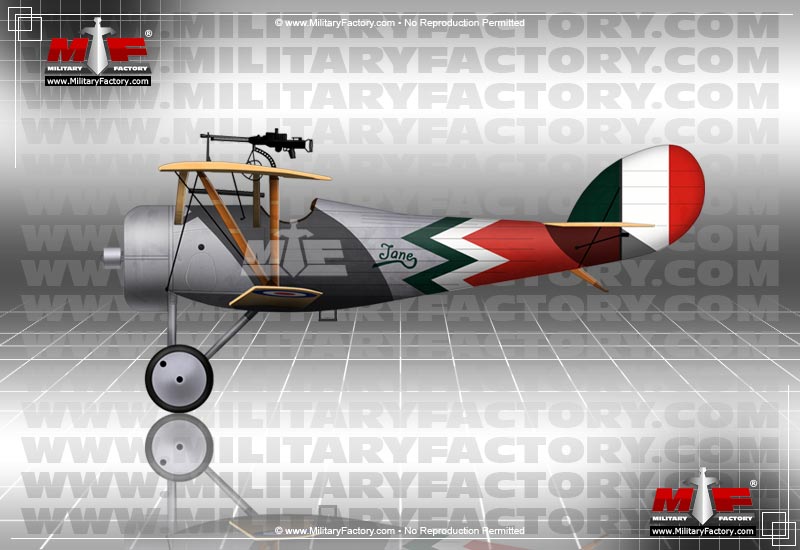
Design of the Nie.27 ran in line with the smattering of offerings found throughout World War 1. As a biplane fighter, the Nie-27 made use of a staggered and equal-span wing assembly with the upper surface area noticeably larger than that of the lower. The lower wings were connected to the lower fuselage just below and aft of the engine mount. The upper wing sat some distance above the engine mount and was braced to the upper forward fuselage via four main struts. The wings themselves were set between the engine and the cockpit when viewed in the profile and featured V-struts in a single-bay arrangement. Nie-27s were the last Nieuport fighters to feature this type of wing strut. The engine was fitted to the extreme forward portion of the fuselage complete with a curved cowling and powered a two-blade propeller. The pilot sat in an open-air cockpit with reasonably good views. The empennage was conventional and sported a single vertical tail fin with applicable horizontal planes, all with rounded edges. The undercarriage was fixed and featured two main landing gears and a simple skid at the base of the tail.

When armed, Nie.27s were fielded with Vickers (French and Italian Nie.27s) or Lewis machine guns (British Nie.27s). If a Vickers was used, a single machine gun was fitted to the forward fuselage over the engine compartment just forward of the pilot's windscreen and synchronized, via an interrupter gear, to fire through the spinning propeller blades. If a Lewis-type machine gun was utilized, the weapon was fitted to a special Foster Mount arranged atop the upper wing assembly. It was not uncommon to two machine guns on an Nie.27, though at the expense of some performance. Trainer Nie.27 mounts were unarmed.

General performance for the Nie.27 resulted in a maximum speed of 116 miles per hour with a service ceiling of approximately 18,200 feet. A rate-of-climb to 16,400 feet could be achieved in 22 minutes with an operational range of about 150 miles. Power was initially from a Le Rhone Rotary engine of 130 horsepower (as found on the Nie.24bis series) but this was oft-replaced in the trainer role by lower-rated 110- or 120-horsepower versions.

Most all Nieuport fighters still utilizing the "V-strut" wing supports were given up for good during the spring fighting of 1918, eventually replaced by more able-bodied types - such was the short-lived service life of the Nieu.27.

Operators of the aircraft included France, Italy, Japan, Poland, Russia (later overtaken by the new powered governing the now-Soviet Union), the United Kingdom, the United States and Uruguay. For the United Kingdom, the Nie.27 served with Nos. 1, 14, 17, 29, 40, 60, 67, 111, and 113 Squadrons of the Royal Flying Corps. Poland operation of the aircraft resulted in only a single example being procured. The United States fielded the aircraft as a training mount through the American Expeditionary Force as well as the later United States Army Air Service (1918).
Text ©2003-2013 www.MilitaryFactory.com • All Rights Reserved • No Reproduction Permitted
MilitaryFactory.com does NOT sell equipment/weaponry. Material presented throughout this website is for historical and entertainment value and should not to be construed as usable for hardware restoration, maintenance or general operation. Please consult manufacturers for such information. Our disclaimer. Email corrections / Comments to MilitaryFactory at Gmail dot com.
Picture of Nieuport 27
View All Images (1)

Specifications for the
Nieuport 27
Biplane Fighter


Country of Origin: France
Manufacturer: Societe Anonyme des Etablissements Nieuport - France / Nieuport-Macchi - Italy
Initial Year of Service: 1917
Production: 1,000


Focus Model: Nieuport 27
Crew: 1


Length: 19.19ft (5.85m)
Width: 26.90ft (8.20m)
Height: 7.94ft (2.42m)
Weight (Empty): 838lbs (380kg)
Weight (MTOW): 1,290lbs (585kg)


Powerplant: 1 x Le Rhone 9J rotary engine generating 130 horsepower.


Maximum Speed: 115mph (185kmh; 100kts)
Maximum Range: 155miles (250km)
Service Ceiling: 18,209ft (5,550m; 3.4miles)
Rate-of-Climb: 0 feet per minute (0m/min)


Hardpoints: 0
Armament Suite:
STANDARD:
1 x 7.7mm Vickers machine gun in fixed, forward-firing mounting on fuselage OR 1 x 7.7mm Lewis machine gun in fixed, forward firing position on Foster mounting over upper wing assembly (sometimes installed along with fuselage 7.7mm Vickers).


Variants:
Nie.17 - Airframe on which the Nieuport 27 is developed from.


Nie.21 - Regarded as most successful of the Type 17 off-shoots; fitted with 80hp powerplant; enlarged ailerons.

Nie.23 - Fitted with either 80hp or 120hp engine; based off of the Type 17 but heavier weight.

Nie.24 - Training variant; featured circular-section fuselage construction; aerodynamic refinements throughout; fixed vertical fin assembly.

Nie.27 - Featured redesigned tailplane assembly; redesigned tail skid.


Operators: Bulgaria; France; Greece; Italy; Japan; Poland; Russia; Serbia; Soviet Union; Thailand; Turkey; United Kingdom; United States; Uruguay; Yugoslavia

ALL AIRCRAFT CATEGORIES

BY DECADE:


1900 to 1909
1910 to 1919
1920 to 1929
1930 to 1939
1940 to 1949
1950 to 1959
1960 to 1969
1970 to 1979
1980 to 1989
1990 to 1999
2000 to 2009
2010 to 2019
2020 to 2029
VIEW ALL
Compare Aircraft


BY TYPE:


Anti-Submarine Warfare (ASW)
Attack Helicopters
Bomber Aircraft
Medium Bombers
Heavy Bombers
Close-Air Support (CAS)
Commercial Aircraft
Dive Bombers
Electronic Warfare Aircraft (EWA)
Experimental / X-Planes
Fighter Aircraft
Floatplane Aircraft
Flying Boat Aircraft
Aerial Refueling Tankers
Helicopters (ALL)
Interceptor Aircraft
Multi-Role Aircraft
Navy Carrier Aircraft
Night Fighters
Reconnaissance / Scout
Search & Rescue (SAR)
Scout Helicopters
Special Purpose
Torpedo Bombers
Trainer Aircraft
Transport Aircraft
Transport Helicopters
Unmanned Aerial Vehicles (UAVs)
Unmanned Combat Air Vehicles (UCAVs)


COLLECTIONS:


4th Generation Fighter Aircraft
5th Generation Fighter Aircraft
US X-Planes
Classic US Warbirds
French Military Helicopters
Grumman "Cats"
Howard Hughes Aircraft
Indian Air Force
Israeli Air Force
Libyan Aircraft
Modern Chinese Aircraft
Modern Chinese Fighters
Modern Military Aircraft
Modern North Korean Aircraft
Modern Trainer Aircraft
Modern US Aircraft
Mikoyan Aircraft
Sukhoi Aircraft
Syrian Aircraft
Top 10 Fighter Aircraft of All Time


AIRCRAFT BY CONFLICT:


Arab-Israeli War (1948)
Cuban Missile Crisis (1959-1962)
Falklands War (1982)
Indo-Pak War (1965, 1971)
Iran-Iraq War (1980-1988)
Lebanon War (1982)
Operation Allied Force (1999)
Operation Desert Storm (1991)
Six Day War (1967)
Spanish Civil War (1936)
Soviet-Afghan War (1979-1989)
Yom Kippur War (1973)


MISCELLANEOUS:


Aircraft Cockpits
Aircraft Manufacturers List
Aircraft Timeline

WORLD WAR 2:


1939 Aircraft
1940 Aircraft
1941 Aircraft
1942 Aircraft
1943 Aircraft
1944 Aircraft
1945 Aircraft
1946 Aircraft
Australian Aircraft
Battle of Britain Aircraft
Bombers
Four-Engine Bombers
British Aircraft
British Bombers
British Transports
Dive Bombers
Canadian Aircraft
Fighters
Chinese Aircraft
French Aircraft
German Aircraft
German Fighters
German Flying Boats
German Jets
Secret Weapons of the Luftwaffe
Italian Aircraft
Imperial Japanese Aircraft
Imperial Japanese Fighters
Mitsubishi Bombers
Navy Aircraft
Pearl Harbor
Polish Aircraft
Romanian Aircraft
US Aircraft
US Bombers
US Navy Aircraft
Soviet Aircraft
Torpedo Bombers
Trainer Aircraft
Transport Aircraft
Tuskegee Airmen Aircraft
W.A.S.P. Aircraft
WW2 Aircraft Ranked by Speed
VIEW ALL


WORLD WAR 1:


1914 Aircraft
1915 Aircraft
1916 Aircraft
1917 Aircraft
1918 Aircraft
Aircraft Timeline
Austro-Hungarian Aircraft
Bomber Aircraft
British Aircraft
Fighters
Flying Boats
French Aircraft
Imperial German Aircraft
Italian Aircraft
Scout Aircraft
Russian Empire Aircraft
US Aircraft
WW1 Aircraft Ranked by Speed
VIEW ALL


KOREAN WAR:


Australian Aircraft
Korean War Aces
Korean War Jets
North Korean Aircraft
US Military Aircraft
VIEW ALL


VIETNAM WAR:


Helicopters
North Vietnam Air Force
US Airpower
VIEW ALL


COLD WAR:


1950s French Aircraft
British V-Bombers
Cold War Bombers
Soviet Aircraft
Soviet Bombers
Soviet Interceptors
Soviet Helicopters
Strategic Air Command
US Aircraft
US Bombers
US Interceptors
VIEW ALL

Site Disclaimer | Privacy Policy | Site Map | MF Origins


©2013 www.MilitaryFactory.com • Content ©2003-2013 MilitaryFactory.com • All Rights Reserved • Site Contact Email: militaryfactory at gmail dot com. The "Military Factory" name and MilitaryFactory.com logo are registered ® trademarks and protected by all applicable domestic and international intellectual property laws.


Top MF Stuff: 2013 Military Pay Scale | Military Ranks | WW2 Weapons | Sniper Rifles | Kts to Mph | WW1 Aircraft | Automatic Rifles | Aircraft Cockpits | Vietnam War Weapons | Main Battle Tanks | Submachine Guns | Shotguns | French Military Victories


Most photographic images appearing on this site are courtesy of the United States Department of Defense and are approved for public use. Other images acquired through the public domain. Digital art work courtesy of Dan Alex. Business Consulting by Kyle Williams. Material presented throughout this website is for historical and entertainment value and should not to be construed as usable for hardware restoration, maintenance or general operation. Please consult manufacturers for such information.


eXTReMe Tracker