Military Factory
Military Pay Chart
Global Firepower
Military Industrial Complex
Second World War
Home
Military Pay Scale
Military Ranks
Small Arms
Aircraft
Land Systems
Navy
Education
Military Factory Facebook Logo
flag of Russia

Kamov Ka-60 (Orca) / (Killer Whale) Transport / Reconnaissance / Multi-Role Helicopter (2004)

Authored By Staff Writer | Last Updated: 7/16/2010

The Kamov Ka-60 series is a new Russian helicopter design beginning to enter operational service.

Find a School Near You
Follow Military Factory on Facebook:
Trending on Military Factory:
Recent Articles:
The Kamov Ka-60 series of medium transport multi-role helicopters is intended to replace the aged Mil Mi-8 series. The Ka-60 (Kasatka or "Orca") was designed with multi-role capabilities in mind as well as survivability and adaptability so various forms of the type are being planned. These forms include a training model, reconnaissance platform (this could branch into an anti-tank and anti-helicopter form), a civilian passenger transport model and a navalized version. The Ka-60 will also be made available to foreign purchasers in the marketplace, extending the types reach considerably. A Western model complete with General Electric T700/CT7-2D1 series engines and a five-blade main rotor is also in the works (this as the Ka-62M model).

As with most helicopter types in this class, the Ka-60 features a two-seat cockpit with side-by-side seating for the pilot and co-pilot. The pilot mans the right-side seat position while the copilot is seated to his left. Dual controls are available for either position. The separate crew cabin can hold some 16 combat-ready personnel or six medical litters (with three medical personnel).

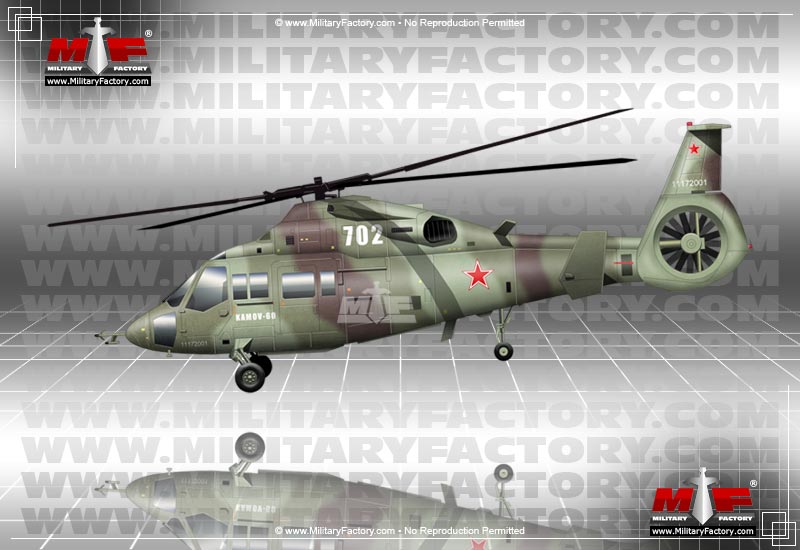
Externally, this Kamov design appears much more like its Western counterparts and is not so much in line with previous Kamov offerings. The nose assembly appears as a finely developed "snout" with a sloped front windshield and large windowed doors for the base crew (including windowed floor panels to either side of the nose). Passenger entry is accomplished through two large windowed cabin doors to either side of the fuselage. Engines are mounted above and behind the main cabin area in a contoured assembly. The overall airframe ends with a somewhat shortened tail section housing the tail rotor and applicable horizontal tail surfaces. Vertical fins protrude from the empennage sides.

The airframe is coated with an infrared adsorbent material for detection evasion, allowing for some level of "stealth" to be achieved, at least with a smaller radar signature. Construction is mostly of composite works while the fan blades feature Kevlar with carbon reinforcement. For added survivability, the fuel tanks feature polyurethane foam so direct hits are not as fatal. Interestingly, the Ka-60 features a fully-retractable tricycle landing gear system though the main gears are positioned at the front of the design (just aft of the pilot seating area) and a single rear landing gear is positioned at the base of the tail unit. The main rotor consists of four blades with swept back ends and sits tightly atop and between the engine housing. The blades are also of composite material and is touted as being able to resist the hit of a 23mm shell. The tail rotor is encased in a ring for added survivability and features a full-eleven blade arrangement. In terms of internal systems, the Ka-60 features the Arbalet millimeter wave radar, Otklik laser warning and Pastel radar warning receiver. The Arbalet system is located in the nose assembly while the other two systems make up the meat of the helicopters electronic warfare suite. Systems redundancy is achievable through duplicated systems on either side of the aircraft. The helicopter is expected to be able to mount a variety of light munitions in the form of rocket pods and various suppression-effect machine gun systems.

The Ka-60 was unveiled in July of 1997 at Lyubertsy and first flew on December 10th, 1998. Production began in 2003 at the RSK MiG LAPIK plant in Lukhovitsky. as of this writing, only some 7 or 8 systems have been delivered though an order of 200 is in place.
Text ©2003-2013 www.MilitaryFactory.com • All Rights Reserved • No Reproduction Permitted
MilitaryFactory.com does NOT sell equipment/weaponry. Material presented throughout this website is for historical and entertainment value and should not to be construed as usable for hardware restoration, maintenance or general operation. Please consult manufacturers for such information. Our disclaimer. Email corrections / Comments to MilitaryFactory at Gmail dot com.
Picture of Kamov Ka-60 (Orca) / (Killer Whale)
View All Images (1)

Specifications for the
Kamov Ka-60 (Orca) / (Killer Whale)
Transport / Reconnaissance / Multi-Role Helicopter


Country of Origin: Russia
Manufacturer: Kamov - Russia
Initial Year of Service: 2004
Production: 8


Focus Model: Kamov Ka-60 (Orca) / (Killer Whale)
Crew: 2 + 16


Length: 51.18ft (15.6m)
Width: 44.29ft (13.50m)
Height: 13.78ft (4.20m)
Weight (Empty): 0lbs (0kg)
Weight (MTOW): 14,881lbs (6,750kg)


Powerplant: 2 x Rybinsk RKBM RD-600V turboshaft engines developing 1,282shp each and powering a four- OR five-blade main rotor with an eleven-blade tail rotor in a Fenestron shroud.


Maximum Speed: 186mph (300kmh; 162kts)
Maximum Range: 382miles (615km)
Service Ceiling: 54,888ft (16,730m; 10.4miles)
Rate-of-Climb: 2,047 feet per minute (624m/min)


Hardpoints: 2
Armament Suite:
Mission-specific. Can include any of the following as optional:

2 x 7-shot 80mm rocket pods
2 x 7.62mm machine guns
2 x 12.7mm machine guns


Variants:
Ka-60 - Base Multi-Role Production Model


Ka-60U - Training Variant

Ka-60K - Transport Variant

Ka-60R - Reconnaissance Variant

Ka-62 - Civilian Transport Model

Ka-62M - Standard Model fitted with 2 x General Electric T700/CT7-2D1 engines; 5 x blade main rotor system.

Ka-64 "Sky Horse" - Navalized Version; 4 x blade main and tail rotor systems.


Operators: Russia

ALL AIRCRAFT CATEGORIES

BY DECADE:


1900 to 1909
1910 to 1919
1920 to 1929
1930 to 1939
1940 to 1949
1950 to 1959
1960 to 1969
1970 to 1979
1980 to 1989
1990 to 1999
2000 to 2009
2010 to 2019
2020 to 2029
VIEW ALL
Compare Aircraft


BY TYPE:


Anti-Submarine Warfare (ASW)
Attack Helicopters
Bomber Aircraft
Medium Bombers
Heavy Bombers
Close-Air Support (CAS)
Commercial Aircraft
Dive Bombers
Electronic Warfare Aircraft (EWA)
Experimental / X-Planes
Fighter Aircraft
Floatplane Aircraft
Flying Boat Aircraft
Aerial Refueling Tankers
Helicopters (ALL)
Interceptor Aircraft
Multi-Role Aircraft
Navy Carrier Aircraft
Night Fighters
Reconnaissance / Scout
Search & Rescue (SAR)
Scout Helicopters
Special Purpose
Torpedo Bombers
Trainer Aircraft
Transport Aircraft
Transport Helicopters
Unmanned Aerial Vehicles (UAVs)
Unmanned Combat Air Vehicles (UCAVs)


COLLECTIONS:


4th Generation Fighter Aircraft
5th Generation Fighter Aircraft
US X-Planes
Classic US Warbirds
French Military Helicopters
Grumman "Cats"
Howard Hughes Aircraft
Indian Air Force
Israeli Air Force
Libyan Aircraft
Modern Chinese Aircraft
Modern Chinese Fighters
Modern Military Aircraft
Modern North Korean Aircraft
Modern Trainer Aircraft
Modern US Aircraft
Mikoyan Aircraft
Sukhoi Aircraft
Syrian Aircraft
Top 10 Fighter Aircraft of All Time


AIRCRAFT BY CONFLICT:


Arab-Israeli War (1948)
Cuban Missile Crisis (1959-1962)
Falklands War (1982)
Indo-Pak War (1965, 1971)
Iran-Iraq War (1980-1988)
Lebanon War (1982)
Operation Allied Force (1999)
Operation Desert Storm (1991)
Six Day War (1967)
Spanish Civil War (1936)
Soviet-Afghan War (1979-1989)
Yom Kippur War (1973)


MISCELLANEOUS:


Aircraft Cockpits
Aircraft Manufacturers List
Aircraft Timeline

WORLD WAR 2:


1939 Aircraft
1940 Aircraft
1941 Aircraft
1942 Aircraft
1943 Aircraft
1944 Aircraft
1945 Aircraft
1946 Aircraft
Australian Aircraft
Battle of Britain Aircraft
Bombers
Four-Engine Bombers
British Aircraft
British Bombers
British Transports
Dive Bombers
Canadian Aircraft
Fighters
Chinese Aircraft
French Aircraft
German Aircraft
German Fighters
German Flying Boats
German Jets
Secret Weapons of the Luftwaffe
Italian Aircraft
Imperial Japanese Aircraft
Imperial Japanese Fighters
Mitsubishi Bombers
Navy Aircraft
Pearl Harbor
Polish Aircraft
Romanian Aircraft
US Aircraft
US Bombers
US Navy Aircraft
Soviet Aircraft
Torpedo Bombers
Transport Aircraft
Tuskegee Airmen Aircraft
W.A.S.P. Aircraft
WW2 Aircraft Ranked by Speed
VIEW ALL


WORLD WAR 1:


1914 Aircraft
1915 Aircraft
1916 Aircraft
1917 Aircraft
1918 Aircraft
Aircraft Timeline
Austro-Hungarian Aircraft
Bomber Aircraft
British Aircraft
Fighters
Flying Boats
French Aircraft
Imperial German Aircraft
Italian Aircraft
Scout Aircraft
Russian Empire Aircraft
US Aircraft
WW1 Aircraft Ranked by Speed
VIEW ALL


KOREAN WAR:


Australian Aircraft
Korean War Aces
Korean War Jets
North Korean Aircraft
US Military Aircraft
VIEW ALL


VIETNAM WAR:


Helicopters
North Vietnam Air Force
US Airpower
VIEW ALL


COLD WAR:


1950s French Aircraft
British V-Bombers
Cold War Bombers
Soviet Aircraft
Soviet Bombers
Soviet Interceptors
Soviet Helicopters
Strategic Air Command
US Aircraft
US Bombers
US Interceptors
VIEW ALL

Site Disclaimer | Privacy Policy | Site Map | MF Origins


©2013 www.MilitaryFactory.com • Content ©2003-2013 MilitaryFactory.com • All Rights Reserved • Site Contact Email: militaryfactory at gmail dot com. The "Military Factory" name and MilitaryFactory.com logo are registered ® trademarks and protected by all applicable domestic and international intellectual property laws.


Top MF Stuff: 2013 Military Pay Scale | Military Ranks | WW2 Weapons | Sniper Rifles | Kts to Mph | WW1 Aircraft | Automatic Rifles | Aircraft Cockpits | Vietnam War Weapons | Main Battle Tanks | Submachine Guns | Shotguns | French Military Victories


Most photographic images appearing on this site are courtesy of the United States Department of Defense and are approved for public use. Other images acquired through the public domain. Digital art work courtesy of Dan Alex. Business Consulting by Kyle Williams. Material presented throughout this website is for historical and entertainment value and should not to be construed as usable for hardware restoration, maintenance or general operation. Please consult manufacturers for such information.


eXTReMe Tracker