Military Factory
Military Pay Chart
Global Firepower
Military Industrial Complex
Second World War
Home
Military Pay Scale
Military Ranks
Small Arms
Aircraft
Land Systems
Navy
Education
Military Factory Facebook Logo
flag of France

Bleriot XI Trainer / Reconnaissance Monoplane (1909)

Authored By Dan Alex | Last Updated: 9/9/2009

The Bleriot provided many firsts for aspiring pilots of the early 1900s, seeing time as a trainer in the early stages of World War 1.

Find a School Near You
Follow Military Factory on Facebook:
Trending on Military Factory:
Recent Articles:
The Bleriot XI was one of the first notable monoplanes to achieve any level of fame. Primitive by today's standards, the system became a standard all its own in the early 1900s. The type served in a limited capacity during the opening salvos of World War 1 and would achieve fame by crossing the English Channel under the direct control of Bleriot himself. The aircraft will forever be remembered for its stable design and its use of "wing-warping" to control roll. At any rate, the Bleriot XI served to cement the legacy of Louis Bleriot in the realm of aviation history.

Design of the Bleriot XI is credited to Louis Bleriot (7/1/1872 - 8/2/1936) and Raymond Saulnier. Saulnier went on to make his own name in the aviation business under the banner of Morane-Saulnier. Bleriot was an engineer by education and credited with the invention of the automobile headlight. Using funds from his successful headlight business venture, he began producing his own working studies of the concept of towed glider flights and began to forge his love of aviation in the process. After a short partnership with Gabriel Voisin (another aircraft engineer whose name preceded some World War 1 fighter design designations all their own), Bleriot took to start his own aviation firm, at first producing the unsuccessful Bleriot V. The Bleriot V became Louis Bleriot's first design to achieve sustained flight.

The VII, complete with its covered-over fuselage, soon followed and proved more in line with front mounted aircraft designs to come. The aircraft was primitive to the core, appearing as something out of a child's imaginary airplane built out of cardboard boxes. The fuselage was a near-perfect rectangular shape while the main wings were low-mounted with noticeable dihedral (upward angle from root to tip). Additional, this design carried a more conventional empennage (tail section) with a single low-fitted vertical tail fin and large area horizontal stabilizers with tailplane elevons. The pilot sat in an open-air cockpit directly behind the engine in the forward fuselage. The engine powered a four-blade paddle-type propeller with broad tapered blades. Power was supplied through a single Antoinette 50-horsepower 8-cylinder water-cooled piston engine. Cruising speed was listed at 50 miles per hour. Bleriot and his VII made a total of six flights before the machine was lost to accident in December of 1907.

The Bleriot IX was an experimental monoplane design fitting an Antoinette engine of 100 horsepower and an off-shoot of the VII but with tandem horizontal tail surfaces. This design succeeded in making a few short "hops" about the ground though never achieving sustained flight. The Bleriot X was another of Louis Bleriot's concept attempts and followed more the design path of the American Wright brothers featuring a "pusher" type propeller/engine arrangement and biplane wings. Construction of this design was never completed. However, the early attempts (and those all-important subsequent failures) proved to secure the foundation needed to produce the first serviceable monoplane in the Beriot XI, achieving first flight on January 23rd, 1909. The system was showcased at the December 1909 Exposition de la Locomotion Aerienne show in Paris.

Louis Bleriot helped to put his creation to the test by completing the first flight across the English Channel. The flight was part of a 1,000 pound prize as put forth through a competition arranged by the London Daily Mail. Matching up against two other would-be winners, Louis Bleriot and his XI took to the skies on July 13th, 1909 and spanned some 36 minutes and 55 seconds, setting the new European endurance record with a distance of 36.6 kilometers from Les Barraques, France to Dover, England. One competitor, Hubert Latham was forced into the sea after developing engine troubles while a test flight for the third entrant, Charles de Lambert, ended in a crash with injuries sustained. Bleriot landed his XI and earn the 1,000 pound prize, though foul weather played a role in the rough landing that caused damage to the propeller and undercarriage. Nevertheless, Bleriot's legacy was sealed as "The Man Who Crossed the Channel" for the rest of history.

Walk-Around

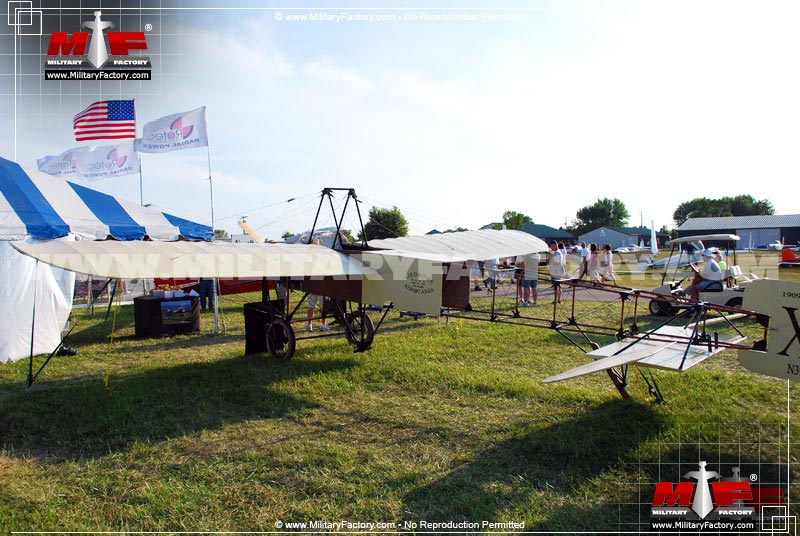
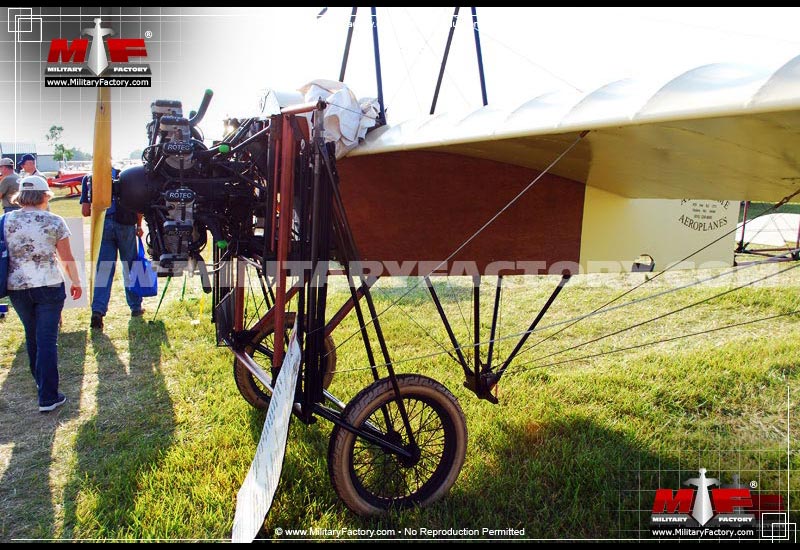
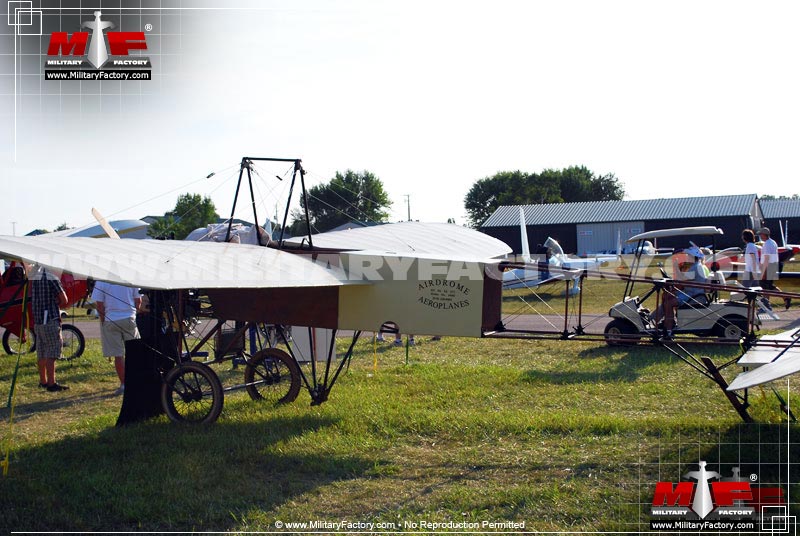
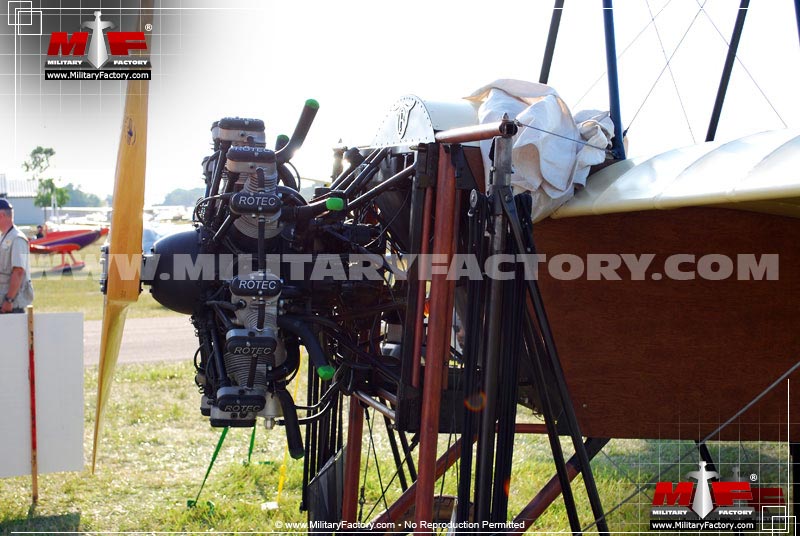
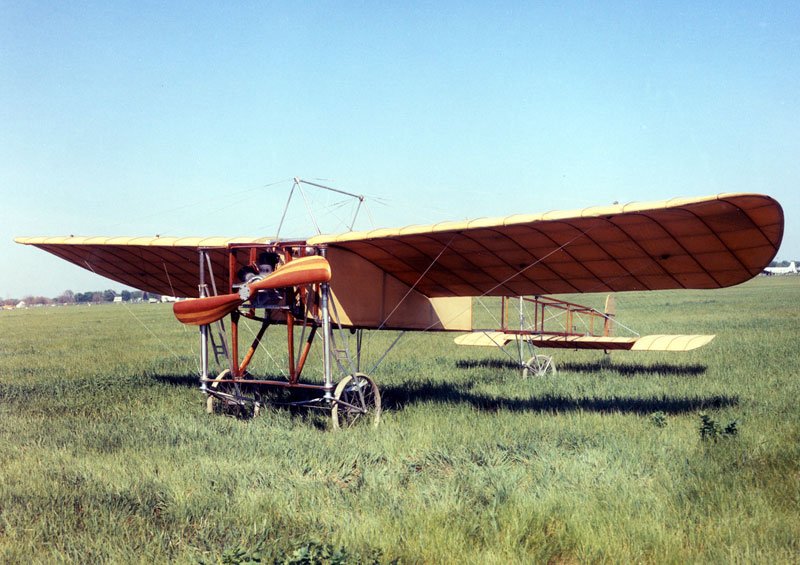
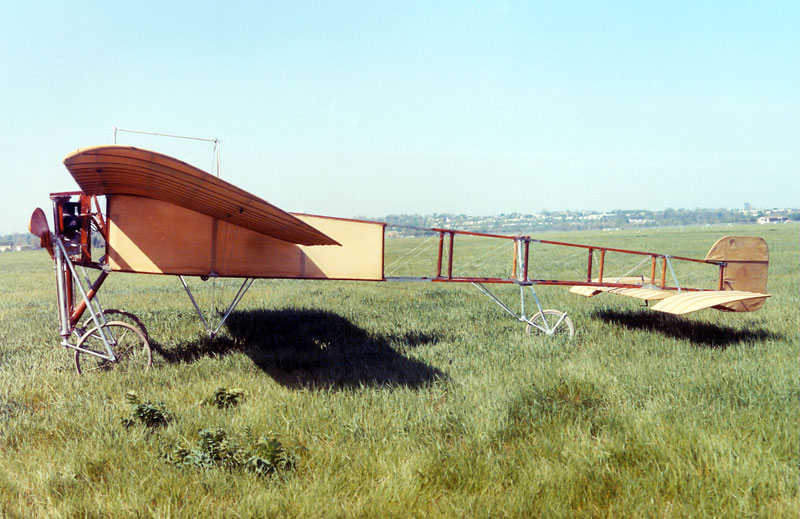
By today's standards, the design of the Bleriot XI seems downright archaic. By early 1900s terms, however, the system was one of the first true stable monoplane airframes available to burgeoning pilots. The pilot sat in an open-air cockpit just aft the engine mount, this set to the extreme forward of the fuselage and operating at between 25- and 140-horsepower depending on the powerplant used. The engine powered a simple-though-contoured Chauviere two-blade wooden propeller (a four-blade metal propeller was used in the original design but didn't match up well to the design).

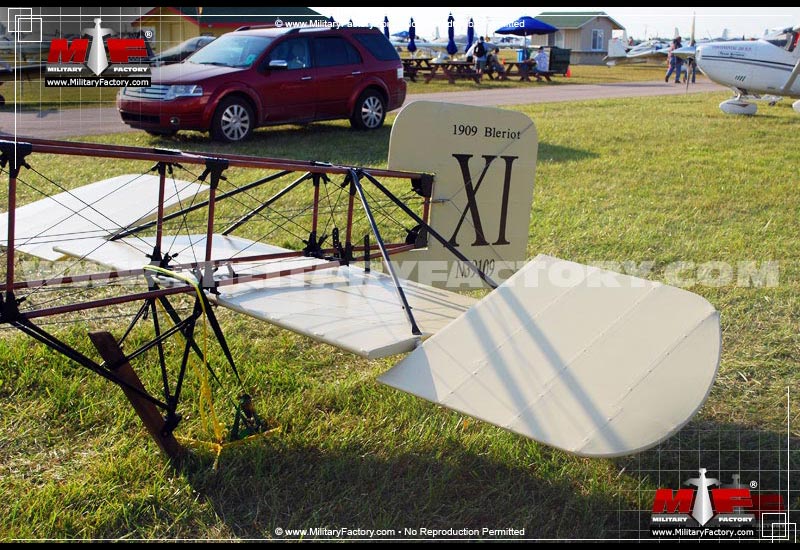
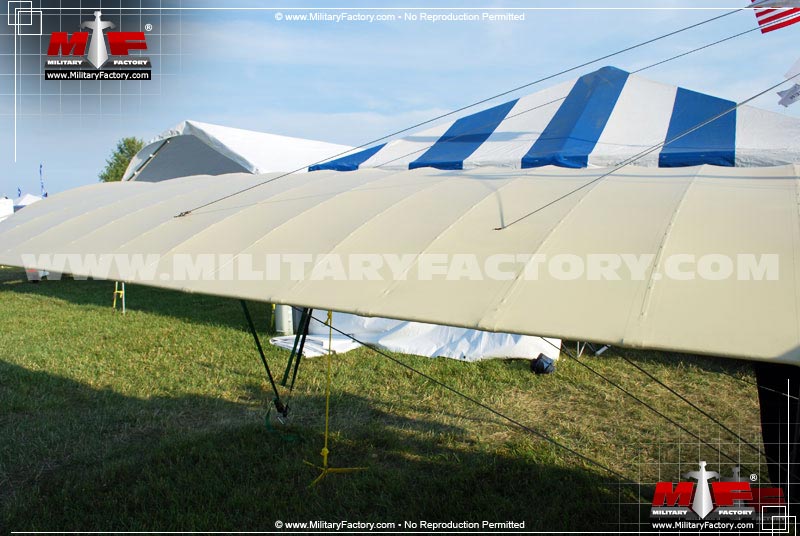
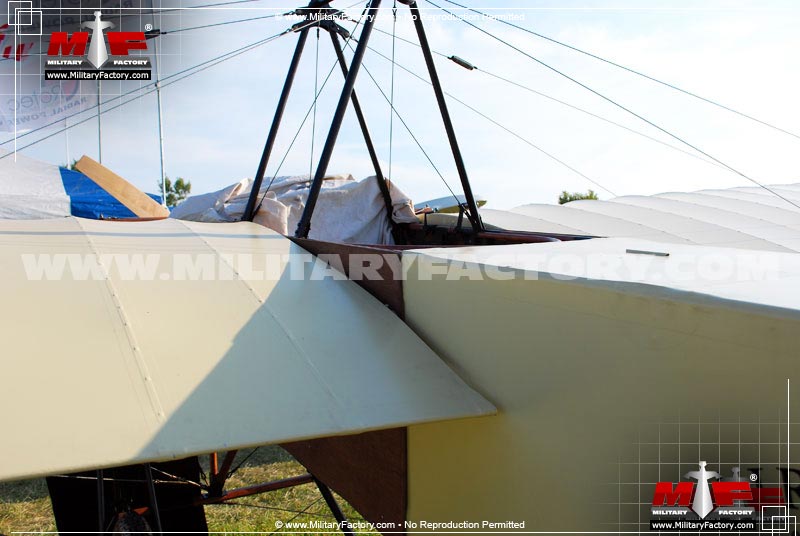
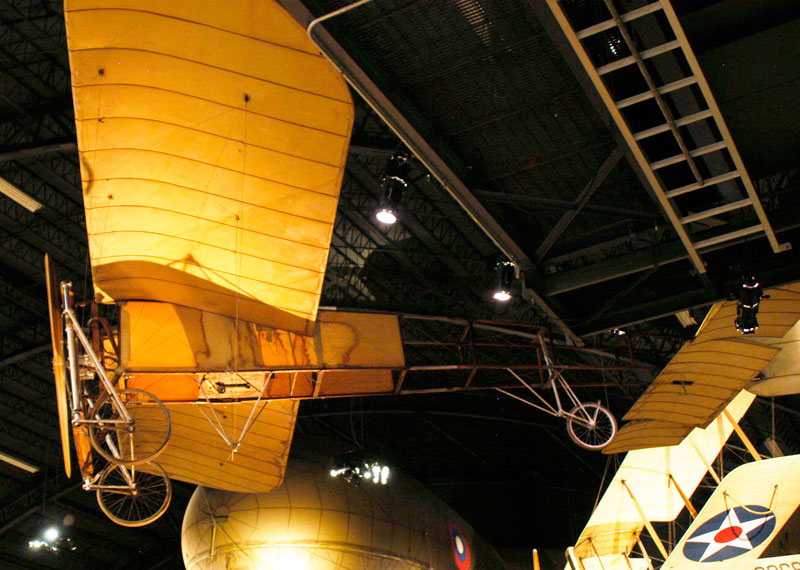
To the extreme forward underside of the fuselage were situated two bicycle-style wheels used as main landing gears. The undercarriage was compliment by either a skid or a third wheel set just aft of amidships. While the forward portion of the fuselage was covered over in cloth, the aft portion was completely exposed, showcasing the internal basic skeletal strut-and-cable arrangement and directly (though unintentionally) leading to improved lateral stability through added drag. The empennage was detailed by a single cloth-covered vertical tail plane acting as the rudder (though no vertical stabilizer was present) and a horizontal plane containing the stabilizer and elevator set alongside the bottom of the rear fuselage. The main wings were high-mounted on the cloth-covered portion of the fuselage body and featured a distinct airfoil - thicker at the leading edge and relatively thin at the trailing edge - utilizing "wing-warping" instead of ailerons to achieve roll. The wing system swooped down from front to rear (when viewed in side profile) in a naturally pleasing form. The cockpit was highly utilitarian with the operator essentially sitting inside of an open-topped box though his perspective could be described as excellent considering the lack of obstructions to his views. If there was anything beyond the main wings and engine blocking his all-around vision, it was the struts set just ahead of his position to help brace the main wings. General construction was of oak and poplar with cloth covering. In all, the Bleriot XI was a sign of the times, a time when aviation was just getting "off the ground" so to speak and its primitive yet practical approach to many of flights problems were dealt with in ingenious ways.

Wartime Service

Military service for the Bleriot XI began sometime in 1910 when the aircraft was accepted into the ranks of the French and Italian air services. The British began operation of their Bleriot XIs in 1912. By the time of World War 1, the Bleriot still retained some military value and was thusly pressed into service in their two-seat forms - albeit to a limited extent - serving primarily as observation and trainer aircraft (although some were utilized as "light" bombers). Observation became an important part of maintaining an "eye in the sky" on enemy troop movements, often times forcing these crews to operate their flimsy Bleriots over and behind the dangerous enemy front lines. As technology naturally progressed during wartime, the need for Bleriots became less and less to the point that the system was fully relegated to the training role.

Some Bleriot trainers had their wings clipped so as to prevent them from getting fully airborne. This allowed would-be pilots to concentrate on mastery of the rudder controls through short "hops" along the ground and focus on keeping the aircraft flying in a straight line - baby steps to be sure. Once graduated from these clipped-wing flightless birds, the aviators would be assigned to flyable aircraft as their reward.

Many-an-American aviator who had signed up for service in the French and British flying services (before America's direct involvement in the Great War) got their first taste of powered heavier-than-air flight in these machines. As America entered the war full-steam in 1918, US Air Service personnel also joined the ranks of these newborn aviators by training on Bleriots.

Miscellaneous

By 1913, Louis Bleriot eventually led the manufacturing consortium of Societe pour les Appareils Deperdussin, later becoming its president in 1914 and changing the name to Societe Pour L'Aviation et ses Derives (otherwise shortened to "SPAD"). SPAD would go on to produce some of the best war-winning fighter designs of the Great War, eventually helping to wrestle control of the skies from the Germans.

In a 1934 visit to Newark Airport in the United States, Louis Bleriot predicted commercial overseas flights by 1938. Unfortunately, he would not see this come to fruition as his death from a heart attack took his life on August 2nd, 1936 in Paris, France - bring an end to this French hero's legacy. The Louis Bleriot Medal, established in 1936, was aptly named in his honor and would be awarded to individuals involved in record-setting flights thereafter. The award is still handed out to this day.
Text ©2003-2013 www.MilitaryFactory.com • All Rights Reserved • No Reproduction Permitted
MilitaryFactory.com does NOT sell equipment/weaponry. Material presented throughout this website is for historical and entertainment value and should not to be construed as usable for hardware restoration, maintenance or general operation. Please consult manufacturers for such information. Our disclaimer. Email corrections / Comments to MilitaryFactory at Gmail dot com.
Picture of Bleriot XI
Pic of the Bleriot XI
Image of the Bleriot XI
View All Images (10)

Specifications for the
Bleriot XI
Trainer / Reconnaissance Monoplane


Country of Origin: France
Manufacturer: Louis Bleriot - France
Initial Year of Service: 1909
Production: 850


Focus Model: Bleriot XI
Crew: 1


Length: 25.00ft (7.62m)
Width: 25.56ft (7.79m)
Height: 8.83ft (2.69m)
Weight (Empty): 507lbs (230kg)
Weight (MTOW): 0lbs (0kg)

Powerplant: 1 x Anzani 3-cylinder fan-type engine OR 1 x 120-degree cylinder angle true radial engine of 22- to 25-horsepower.


Maximum Speed: 47mph (75kmh; 40kts)
Maximum Range: 0miles (0km)
Service Ceiling: 0ft (0m; 0.0miles)
Rate-of-Climb: 0 feet per minute (0m/min)


Hardpoints: 0
Armament Suite:
None.


Variants:
Bleriot V - First Bleriot design to achieve flight.


Bleriot VII - Front-mounted Antoinette 8-cylinder water-cooled engine of 50 horsepower powering a four-blade paddle-style propeller system; monoplane; tailplane elevons; completed six flights but lost to accident in 1907.

Bleriot IX - Based on the VII but utilized tandem horizontal tail surfaces.

Bleriot X - Experimental Airframe based on Wright Brothers design; biplane; never completed.

Bleriot XI (mod) - Developmental Racer

Bleriot XI Militaire - Single-Seat Military Model; fitted with Gnome engine of 50 horsepower.

Bleriot XI Artillerie - Single-Seat Military Model; charged with artilery observation.

Bleriot XI-2 - Tandem two-seat model; utilized in training and touring roles; fitted with 1 x Gnome 7B series rotary piston engine of 70 horsepower.

Bleriot XI-2 bis "cote-a-cote" - Similar to XI-2 but increase in overall size; two-seat side-by-side model.

Bleriot XI-2 Hyrdoaeroplane - Floatplane Model; increased wing surface area.

Bleriot XI-2 Artillerie - Artillery Spotter; fitted with 1 x Gnome rotary piston engine of 70 horsepower.

Bleriot XI-2 Genie - Militarized XI; designed from the outset for ease of portability allowing assembly in under 30 minutes.

Bleriot XI-2 BG - Twin-Seat Parasol (high wing mount) Variant.

Bleriot XI-3 - Three-Seat Monoplane fitting crew in tandem arrangement; fitted with 1 x Gnome engine of 140 horsepower.

Bleriot XI E1 - Single-Seat Trainer

Bleriot XI R1 "Rouler" - Ground Trainer; clipped wings ensured the aircraft would not become fully airborne but instead "hopped" along the ground, training pilots in rudder controls.


Operators: Argentina; Australia; Belgium; Bulgaria; Chile; Denmark; France; Greece; Guatemala; Italy; Japan; Mexico; Norway; New Zealand; Romania; Russia; Serbia; Sweden; Switzerland; Ottoman Empire; United Kingdom

ALL AIRCRAFT CATEGORIES

BY DECADE:


1900 to 1909
1910 to 1919
1920 to 1929
1930 to 1939
1940 to 1949
1950 to 1959
1960 to 1969
1970 to 1979
1980 to 1989
1990 to 1999
2000 to 2009
2010 to 2019
2020 to 2029
VIEW ALL
Compare Aircraft


BY TYPE:


Anti-Submarine Warfare (ASW)
Attack Helicopters
Bomber Aircraft
Medium Bombers
Heavy Bombers
Close-Air Support (CAS)
Commercial Aircraft
Dive Bombers
Electronic Warfare Aircraft (EWA)
Experimental / X-Planes
Fighter Aircraft
Floatplane Aircraft
Flying Boat Aircraft
Aerial Refueling Tankers
Helicopters (ALL)
Interceptor Aircraft
Multi-Role Aircraft
Navy Carrier Aircraft
Night Fighters
Reconnaissance / Scout
Search & Rescue (SAR)
Scout Helicopters
Special Purpose
Torpedo Bombers
Trainer Aircraft
Transport Aircraft
Transport Helicopters
Unmanned Aerial Vehicles (UAVs)
Unmanned Combat Air Vehicles (UCAVs)


COLLECTIONS:


4th Generation Fighter Aircraft
5th Generation Fighter Aircraft
US X-Planes
Classic US Warbirds
French Military Helicopters
Grumman "Cats"
Howard Hughes Aircraft
Indian Air Force
Israeli Air Force
Libyan Aircraft
Modern Chinese Aircraft
Modern Chinese Fighters
Modern Military Aircraft
Modern North Korean Aircraft
Modern Trainer Aircraft
Modern US Aircraft
Mikoyan Aircraft
Sukhoi Aircraft
Syrian Aircraft
Top 10 Fighter Aircraft of All Time


AIRCRAFT BY CONFLICT:


Arab-Israeli War (1948)
Cuban Missile Crisis (1959-1962)
Falklands War (1982)
Indo-Pak War (1965, 1971)
Iran-Iraq War (1980-1988)
Lebanon War (1982)
Operation Allied Force (1999)
Operation Desert Storm (1991)
Six Day War (1967)
Spanish Civil War (1936)
Soviet-Afghan War (1979-1989)
Yom Kippur War (1973)


MISCELLANEOUS:


Aircraft Cockpits
Aircraft Manufacturers List
Aircraft Timeline

WORLD WAR 2:


1939 Aircraft
1940 Aircraft
1941 Aircraft
1942 Aircraft
1943 Aircraft
1944 Aircraft
1945 Aircraft
1946 Aircraft
Australian Aircraft
Battle of Britain Aircraft
Bombers
Four-Engine Bombers
British Aircraft
British Bombers
British Transports
Dive Bombers
Canadian Aircraft
Fighters
Chinese Aircraft
French Aircraft
German Aircraft
German Fighters
German Flying Boats
German Jets
Secret Weapons of the Luftwaffe
Italian Aircraft
Imperial Japanese Aircraft
Imperial Japanese Fighters
Mitsubishi Bombers
Navy Aircraft
Pearl Harbor
Polish Aircraft
Romanian Aircraft
US Aircraft
US Bombers
US Navy Aircraft
Soviet Aircraft
Torpedo Bombers
Transport Aircraft
Tuskegee Airmen Aircraft
W.A.S.P. Aircraft
WW2 Aircraft Ranked by Speed
VIEW ALL


WORLD WAR 1:


1914 Aircraft
1915 Aircraft
1916 Aircraft
1917 Aircraft
1918 Aircraft
Aircraft Timeline
Austro-Hungarian Aircraft
Bomber Aircraft
British Aircraft
Fighters
Flying Boats
French Aircraft
Imperial German Aircraft
Italian Aircraft
Scout Aircraft
Russian Empire Aircraft
US Aircraft
WW1 Aircraft Ranked by Speed
VIEW ALL


KOREAN WAR:


Australian Aircraft
Korean War Aces
Korean War Jets
North Korean Aircraft
US Military Aircraft
VIEW ALL


VIETNAM WAR:


Helicopters
North Vietnam Air Force
US Airpower
VIEW ALL


COLD WAR:


1950s French Aircraft
British V-Bombers
Cold War Bombers
Soviet Aircraft
Soviet Bombers
Soviet Interceptors
Soviet Helicopters
Strategic Air Command
US Aircraft
US Bombers
US Interceptors
VIEW ALL

Site Disclaimer | Privacy Policy | Site Map | MF Origins


©2013 www.MilitaryFactory.com • Content ©2003-2013 MilitaryFactory.com • All Rights Reserved • Site Contact Email: militaryfactory at gmail dot com. The "Military Factory" name and MilitaryFactory.com logo are registered ® trademarks and protected by all applicable domestic and international intellectual property laws.


Top MF Stuff: 2013 Military Pay Scale | Military Ranks | WW2 Weapons | Sniper Rifles | Kts to Mph | WW1 Aircraft | Automatic Rifles | Aircraft Cockpits | Vietnam War Weapons | Main Battle Tanks | Submachine Guns | Shotguns | French Military Victories


Most photographic images appearing on this site are courtesy of the United States Department of Defense and are approved for public use. Other images acquired through the public domain. Digital art work courtesy of Dan Alex. Business Consulting by Kyle Williams. Material presented throughout this website is for historical and entertainment value and should not to be construed as usable for hardware restoration, maintenance or general operation. Please consult manufacturers for such information.


eXTReMe Tracker