Military Factory
Military Pay Chart
Global Firepower
Military Industrial Complex
Second World War
Home
Military Pay Scale
Military Ranks
Small Arms
Aircraft
Land Systems
Navy
Education
Military Factory Facebook Logo
flag of Imperial Germany

LVG C.II Reconnaissance Fighter / Light Bomber (1915)

Authored By Staff Writer | Last Updated: 5/15/2012

The LVG C.II became the first fixed-wing aircraft to bomb London, this coming in a strike on Victoria Railway Station.

The LVG C.II was a limited-production reconnaissance scout plane utilized by the German Empire during World War 1. She herself was developed from the unarmed LVG B-series, also a two-seat reconnaissance biplane and proved LVG's (Luft-Verkehrs-Gesellschaft) first original aircraft design. Prior to that, the firm had been responsible for work on dirigibles. The main difference between the two aircraft breeds was in pilot placement for the C.II (originally known as C.I) reversed the positions of both the pilot and observer/gunner - the pilot now held the forward cockpit while the observer manned the machine gun in a turret-ring held aft. The C.II was originally known under the designation of C.I and served in the visual and photographic reconnaissance/scout roles as well as a light bomber.

Up to this point, most reconnaissance-based aircraft fielded their observers and possible armament to the front of the fuselage. It was not until later designs that the position was settled to the rear of the aircraft. This allowed the pilot an unfettered view of the upcoming terrain (and perhaps any oncoming dangers) while supplying the observer with an unobstructed view across the rear (the critical "six" angle) and along the sides. This arrangement eventually proved the norm by the end of the war as all scout-type aircraft would make use of this tandem seating configuration.

The C.I proved a heavier aircraft design than the B.I series and, as such, she would require more output power from her engine. The solution was to fit the Benz Bz.III series engine of 160 horsepower to her forward fuselage. Production began with a few orders of the C.I model before the C.II overtook her on the assembly lines. The C.II - achieving first flight in 1915 - fitted a more powerful Mercedes D.III series, 6-cylinder, liquid-cooled, in-line engine of 160 horsepower as well as improvements to her underlying structure and went on to become the definitive production aircraft in the series. The C.III proved a "one-off" experimental test system with the observer and his machine gun moved to the front cockpit and the pilot at the rear. The C.IV, the last of the family line, was a slightly larger version of the C.II and now powered by a 220 horsepower Mercedes D.IV series engine. The C.IV made its appearance in 1916.

As it stood, the C.II benefitted from her Mercedes D.III with a top speed of 81 miles per hour with a service ceiling of approximately 13,000 feet (some sources go as high as 16,400 feet). Her endurance was listed at an excellent four hours of flight time, critical to scout plane operations.

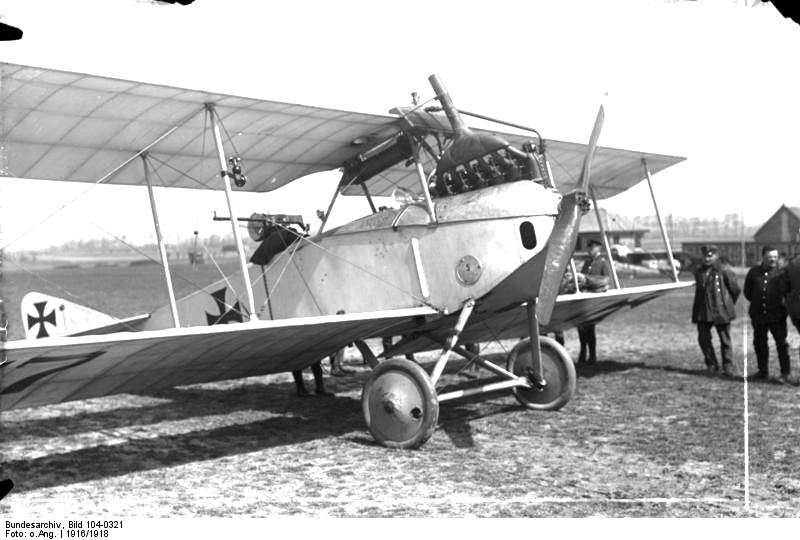
Design was very conventional for the time - the defining characteristic of course being the double-bay biplane wing assemblies. The fuselage took on a rather streamlined shape, particularly along the forward area where the engine was seated. The engine was nested within a light-skinned frame and powered a two-bladed wooden propeller. The radiator and fuel tank sat partially exposed along the top of the engine compartment thus obstructing the pilot's view to an extent. The fuselage was slab sided until tapering off into a conventional empennage featuring a small-area, rounded-tip vertical tail fin and applicable horizontal tailplanes at the base of the fin. The undercarriage was fixed in place and supported via struts and cabling. Each main leg held a large wheel and the rear of the fuselage was supported by a simple tail skid.

Armament centered around the 1 x 7.92mm Parabellum MG14 machine gun fitted to a trainable mounting at the rear. It was only in later production models that the pilot had access to a fixed forward-firing 7.92mm LMG 08/15 machine gun. As a light bomber, the C.II could call on 130lbs of externally-held ordnance.

The C.II held one "first" during the War to End All Wars - she was the first fixed-wing aircraft to drop her bombs on London proper. Up to that point, such attacks came from the lumbering Zeppelins. The first attack by a Zeppelin occurred on the morning of June 1st, 1915. An C.II followed on November 28th, 1915, in dropping at least six 22lb bombs on the capital city, these landing near the downtown Victoria Station railway. However, it should be noted that the exact target during this raid was, in fact, the Admiralty and not the station. This same aircraft went on to suffer engine failure on its route home and made a forced landing near Boulogne where her two-man crew were taken prisoner. Daring daylight raids involving C.IIs were not wholly uncommon.

It is estimate that 300 examples of this aircraft were ultimately delivered to the German Empire. Accounts held her as an "adequate" mount, serviceable for the role at hand. Introduction occurred sometime in 1915.
Text ©2003-2013 www.MilitaryFactory.com • All Rights Reserved • No Reproduction Permitted
MilitaryFactory.com does NOT sell equipment/weaponry. Material presented throughout this website is for historical and entertainment value and should not to be construed as usable for hardware restoration, maintenance or general operation. Please consult manufacturers for such information. Our disclaimer. Email corrections / Comments to MilitaryFactory at Gmail dot com.
Picture of LVG C.II
View All Images (1)

Specifications for the
LVG C.II
Reconnaissance Fighter / Light Bomber


Country of Origin: Imperial Germany
Manufacturer: Luft-Verkehrs-Gesellschaft - Germany
Initial Year of Service: 1915
Production: 300


Focus Model: LVG C.II
Crew: 2


Length: 26.57ft (8.1m)
Width: 42.16ft (12.85m)
Height: 9.61ft (2.93m)
Weight (Empty): 1,863lbs (845kg)
Weight (MTOW): 3,097lbs (1,405kg)


Powerplant: 1 x Mercedes D.III 6-cylinder liguid-cooled inline engine of 160 horsepower.


Maximum Speed: 81mph (130kmh; 70kts)
Maximum Range: 240miles (386km)
Service Ceiling: 13,123ft (4,000m; 2.5miles)
Rate-of-Climb: 0 feet per minute (0m/min)


Hardpoints: 6
Armament Suite:
STANDARD:
1 x 7.92mm forward-fixed LMG 08/15 machine gun.
1 x 7.92mm Parabellum MG14 machine gun on flexible mount in rear cockpit.

OPTIONAL:
Up to 130lbs of bombs.


Variants:
C.I - Initial Version; fitted with Benz Bz.III series engine of 160 horsepower.


C.II - Main Production Version

C.III - One-Off Developmental Airframe; observer position and armament moved to the forward portion of the fuselage.

C.IV - Enlarged frame; fitted with Mercedes D.IV series engine of 220 horsepower; appearing in 1916.


Operators:
Imperial Germany

ALL AIRCRAFT CATEGORIES

BY DECADE:


1900 to 1909
1910 to 1919
1920 to 1929
1930 to 1939
1940 to 1949
1950 to 1959
1960 to 1969
1970 to 1979
1980 to 1989
1990 to 1999
2000 to 2009
2010 to 2019
2020 to 2029
VIEW ALL
Compare Aircraft


BY TYPE:


Anti-Submarine Warfare (ASW)
Attack Helicopters
Bomber Aircraft
Medium Bombers
Heavy Bombers
Close-Air Support (CAS)
Commercial Aircraft
Dive Bombers
Electronic Warfare Aircraft (EWA)
Experimental / X-Planes
Fighter Aircraft
Floatplane Aircraft
Flying Boat Aircraft
Aerial Refueling Tankers
Helicopters (ALL)
Interceptor Aircraft
Multi-Role Aircraft
Navy Carrier Aircraft
Night Fighters
Reconnaissance / Scout
Search & Rescue (SAR)
Scout Helicopters
Special Purpose
Torpedo Bombers
Trainer Aircraft
Transport Aircraft
Transport Helicopters
Unmanned Aerial Vehicles (UAVs)
Unmanned Combat Air Vehicles (UCAVs)


COLLECTIONS:


4th Generation Fighter Aircraft
5th Generation Fighter Aircraft
US X-Planes
Classic US Warbirds
French Military Helicopters
Grumman "Cats"
Howard Hughes Aircraft
Indian Air Force
Israeli Air Force
Libyan Aircraft
Modern Chinese Aircraft
Modern Chinese Fighters
Modern Military Aircraft
Modern North Korean Aircraft
Modern Trainer Aircraft
Modern US Aircraft
Mikoyan Aircraft
Sukhoi Aircraft
Syrian Aircraft
Top 10 Fighter Aircraft of All Time


AIRCRAFT BY CONFLICT:


Arab-Israeli War (1948)
Cuban Missile Crisis (1959-1962)
Falklands War (1982)
Indo-Pak War (1965, 1971)
Iran-Iraq War (1980-1988)
Lebanon War (1982)
Operation Allied Force (1999)
Operation Desert Storm (1991)
Six Day War (1967)
Spanish Civil War (1936)
Soviet-Afghan War (1979-1989)
Yom Kippur War (1973)


MISCELLANEOUS:


Aircraft Cockpits
Aircraft Manufacturers List
Aircraft Production
Aircraft Timeline

WORLD WAR 2:


1939 Aircraft
1940 Aircraft
1941 Aircraft
1942 Aircraft
1943 Aircraft
1944 Aircraft
1945 Aircraft
1946 Aircraft
Australian Aircraft
Battle of Britain Aircraft
Bombers
Four-Engine Bombers
British Aircraft
British Bombers
British Transports
Dive Bombers
Canadian Aircraft
Fighters
Chinese Aircraft
French Aircraft
German Aircraft
German Fighters
German Flying Boats
German Jets
Secret Weapons of the Luftwaffe
Italian Aircraft
Imperial Japanese Aircraft
Imperial Japanese Fighters
Mitsubishi Bombers
Navy Aircraft
Pearl Harbor
Polish Aircraft
Romanian Aircraft
US Aircraft
US Bombers
US Navy Aircraft
Soviet Aircraft
Torpedo Bombers
Trainer Aircraft
Transport Aircraft
Tuskegee Airmen Aircraft
W.A.S.P. Aircraft
WW2 Aircraft Ranked by Speed
VIEW ALL


WORLD WAR 1:


1914 Aircraft
1915 Aircraft
1916 Aircraft
1917 Aircraft
1918 Aircraft
Aircraft Timeline
Austro-Hungarian Aircraft
Bomber Aircraft
British Aircraft
Fighters
Flying Boats
French Aircraft
Imperial German Aircraft
Italian Aircraft
Scout Aircraft
Russian Empire Aircraft
US Aircraft
WW1 Aircraft Ranked by Speed
VIEW ALL


KOREAN WAR:


Australian Aircraft
Korean War Aces
Korean War Jets
North Korean Aircraft
US Military Aircraft
VIEW ALL


VIETNAM WAR:


Helicopters (ALL)
Transport Helicopters
North Vietnam Air Force
US Airpower
VIEW ALL


COLD WAR:


1950s French Aircraft
British V-Bombers
Cold War Bombers
Soviet Aircraft
Soviet Bombers
Soviet Interceptors
Soviet Helicopters
Strategic Air Command
US Aircraft
US Bombers
US Interceptors
VIEW ALL

Site Disclaimer | Privacy Policy | Site Map | MF Origins


©2013 www.MilitaryFactory.com • Content ©2003-2013 MilitaryFactory.com • All Rights Reserved • Site Contact Email: militaryfactory at gmail dot com. The "Military Factory" name and MilitaryFactory.com logo are registered ® trademarks and protected by all applicable domestic and international intellectual property laws.


Top MF Stuff: 2013 Military Pay Scale | Military Ranks | WW2 Weapons | Sniper Rifles | Kts to Mph | WW1 Aircraft | Automatic Rifles | Aircraft Cockpits | Vietnam War Weapons | Main Battle Tanks | Submachine Guns | Shotguns | French Military Victories


Most photographic images appearing on this site are courtesy of the United States Department of Defense and are approved for public use. Other images acquired through the public domain. Digital art work courtesy of Dan Alex. Business Consulting by Kyle Williams. Material presented throughout this website is for historical and entertainment value and should not to be construed as usable for hardware restoration, maintenance or general operation. Please consult manufacturers for such information.


eXTReMe Tracker