Military Factory
Military Pay Chart
Global Firepower
Military Industrial Complex
Second World War
Home
Military Pay Scale
Military Ranks
Small Arms
Aircraft
Land Systems
Navy
Education
Military Factory Facebook Logo
flag of Italy

AgustaWestland AW159 Lynx Wildcat Anti-Submarine Warfare / Search and Rescue / Utility Helicopter (2014)

Authored By Staff Writer | Last Updated: 11/5/2012

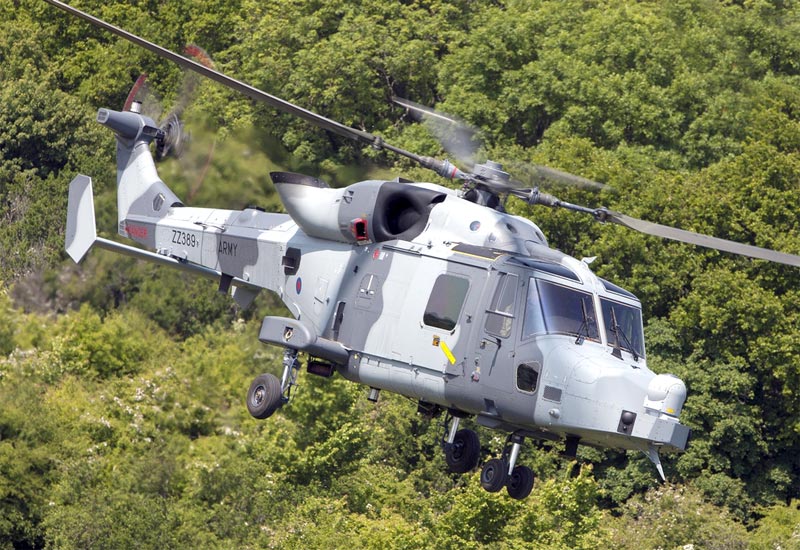
The AW159 Lynx Wildcat is designed as a direct replacement of existing Lynx helicopter systems for the British Army and Royal Navy.

Find a School Near You
Follow Military Factory on Facebook:
Trending on Military Factory:
Recent Articles:
The AgustaWestland AW159 "Lynx Wildcat" is an relatively new, thoroughly improved and modernized form of the successful "Lynx" series multi-role helicopter expected to enter service with the British military in a few years. The Wildcat itself is based on the "Super Lynx 300" and sports a new tailboom, cockpit, avionics and sensor suites and undercarriage. The Wildcat was initially known under the designation of "Future Lynx" before being renamed as Lynx Wildcat by AgustaWestland on April 24th, 2009. The British military will accept the Lynx Wildcat under the formal designation of AW159. First flight of the initial Wildcat was recorded on November 12th, 2009 out of Yeovil with a second prototype going airborne on October 14th, 2010. Deliveries of Wildcat systems to the British military are expected to begin sometime in 2011.

The initial Lynx helicopter first flew on March 21st, 1971 and was introduced some time later in 1978 and, even today, remains an active component of British Army and Navy operations. The Lynx was also purchased by the French and German navies. Since its inception, the Lynx has maintained a capable and prominent role on the battlefield, being utilized for its multi-role nature and effective service under a variety of conditions including operations over water. She proved versatile enough to be outfitted with an array of munitions options to tackle a variety of sortie needs.

Lynx Wildcat origins date back to 2002 which saw evaluation of a version of the Super Lynx 300 development. The Super Lynx sported BERP rotor blades, a tail rotor taken from the Westland 30 series, new engines and several nose-mounted radar and optical installation options. Royal Navy Lynx HAS.3 models were upgraded to the Super Lynx standard under Lynx HMA.8 while a Super Lynx 200 (LHTEC CTS800 engines) and a Super Lynx 300 (EH101 cockpit and avionics) were offered for export.

The new Lynx initiative was christened with the developmental name of "Future Lynx" and intended as a replacement for the aging fleet of base Lynx helicopters in British Army and Navy service. The requirements were specified under the Surface Combatant Maritime Rotorcraft (SCMR) and the Battlefield Light Utility Helicopter (BLUH) programs. The programs eventually evolved under a single acronym known as "BRH" for a "Battlefield Reconnaissance Helicopter". On June 22nd, 2006, the MoD gave AgustaWestland the green light with a 1 billion pound agreement and committed to procuring some 70 Future Lynxes for both service branches. However, in December of 2008, the MoD reduced their requirement to 62 examples.

Beginning in 2014, the British Army is set to receive delivery of 34 Wildcats while the Royal Navy will accept 28 examples the year following. The initial Wildcat squadron for the Royal Navy has already been established as 700W NAS (Naval Air Squadron) in May of 2009, a group with history dating as far back as 1940. Its first helicopters are expected to arrive in January of 2013 to begin evaluations and conversion training for pilots and crew.

Avionics are set to include Forward-Looking Infra-Red (FLIR), HUMS, electronic support measures, 360-degree AESA surveillance radar, data linking, a full color digital map, electronic countermeasures for self-defense, infrared suppression, an integrated surface automatic identification system (AIS), and anti-submarine warfare dipping sonar (naval variant only) and a weapons management system complete with a heads-up display (HUD) relaying pertinent mission and performance figures directly to the pilots.

Power to the AW159 will be supplied by a pair of LHTEC CTS800-4N series turboshaft engines, each rated at 1,362 shaft horsepower apiece and powering a four-bladed main rotor with a portside-mounted tail rotor system. Maximum speed is listed at 184 miles per hour with an operational range equal to 598 miles, up to 4.5 hours of flight time with optional fuel stores. Wildcat measures in at 50 feet in length with a rotor diameter of 42 feet and a height of 12.2 feet. Maximum take-off weight is 13,200lbs. The airframe for both the Army and Navy models will be based on the navalized Royal Navy Lynx. Externally, she will appear quite similar to her original Lynx sisters, sporting a wheeled undercarriage, large front windscreens and side sliding doors.

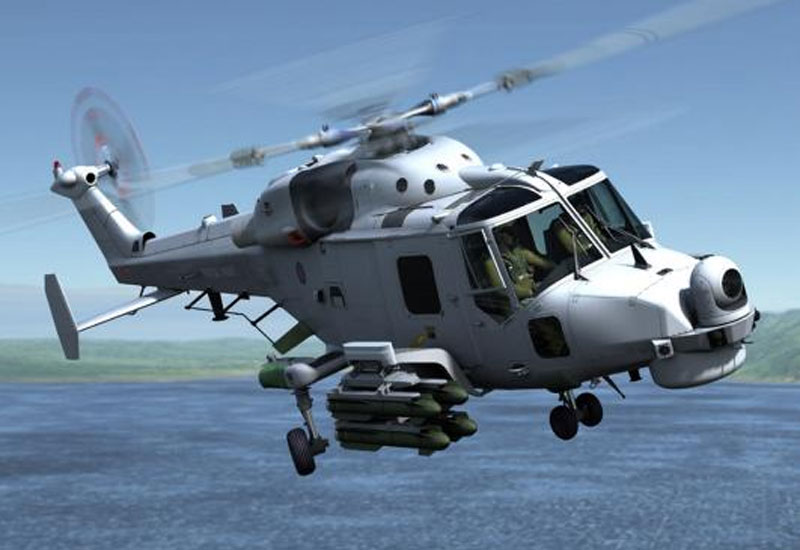
Armament for the Wildcat will be expectedly varied based on need. General armament will consist of self-defensive machine guns mounted on pintles at the doors (0.30 or 0.50 caliber in origin). Machine gun pods and rocket pods also figure into the ordnance load as do air-to-surface guided missile systems such as the "Hellfire" anti-tank. For anti-ship duty, the Wildcat is expected to field depth charges, anti-ship missiles and torpedoes. Armament will be carried across a pair of wing stubs fitted to the sides of the Wildcat fuselage. The integrated armament suite is developed to autonomously detect and engage land- or -sea-based targets including those underwater.

The Wildcat will allow for the use of modular armor fittings to further enhance survivability as well as offer "crash-resistant" seating for the crew. For search and rescue sorties, the Wildcat will be fitted with a rescue hoist and be designed to accept wounded on MEDEVAC litters in the cabin. Additionally, as a troop transport, the Wildcat will supply multiple seat in the cabin for combat-ready troops. For urban and forested deployments, the cabin can be fixed with a rappeling kit for quick insertion.
Text ©2003-2013 www.MilitaryFactory.com • All Rights Reserved • No Reproduction Permitted
MilitaryFactory.com does NOT sell equipment/weaponry. Material presented throughout this website is for historical and entertainment value and should not to be construed as usable for hardware restoration, maintenance or general operation. Please consult manufacturers for such information. Our disclaimer. Email corrections / Comments to MilitaryFactory at Gmail dot com.
Picture of AgustaWestland AW159 Lynx Wildcat
View All Images (1)

Specifications for the
AgustaWestland AW159 Lynx Wildcat
Anti-Submarine Warfare / Search and Rescue / Utility Helicopter


Country of Origin: Italy
Manufacturer: AgustaWestland - Italy
Initial Year of Service: 2014
Production: 62


Focus Model: AgustaWestland AW159 Lynx Wildcat
Crew: 2


Length: 50.00ft (15.24m)
Width: 41.99ft (12.80m)
Height: 12.24ft (3.73m)
Weight (Empty): 0lbs (0kg)
Weight (MTOW): 13,228lbs (6,000kg)


Powerplant: 2 x Rolls-Royce CTS800-4N turboshaft engines developing 1,362shp each while driving a four-blade main rotor and four blade tail rotor.


Maximum Speed: 184mph (296kmh; 160kts)
Maximum Range: 483miles (777km)
Service Ceiling: 0ft (0m; 0.0miles)
Rate-of-Climb: 0 feet per minute (0m/min)


Hardpoints: 4
Armament Suite:
OPTIONAL:
2 x 0.30 OR 0.50 caliber machine guns on pintle mounts at cabin doors.

ADDITIONAL (mission-specific across wingstub attachments):
Rocket Pods
Machine Gun Pods
Anti-Ship Missiles
Hellfire Anti-Tank Missiles
Depth Charges
Torpedoes


Variants:
AW159 Lynx Wildcat - For British Army and Royal Navy service (Fleet Air Arm).


Operators: United Kingdom

ALL AIRCRAFT CATEGORIES

BY DECADE:


1900 to 1909
1910 to 1919
1920 to 1929
1930 to 1939
1940 to 1949
1950 to 1959
1960 to 1969
1970 to 1979
1980 to 1989
1990 to 1999
2000 to 2009
2010 to 2019
2020 to 2029
VIEW ALL
Compare Aircraft


BY TYPE:


Anti-Submarine Warfare (ASW)
Attack Helicopters
Bomber Aircraft
Medium Bombers
Heavy Bombers
Close-Air Support (CAS)
Commercial Aircraft
Dive Bombers
Electronic Warfare Aircraft (EWA)
Experimental / X-Planes
Fighter Aircraft
Floatplane Aircraft
Flying Boat Aircraft
Aerial Refueling Tankers
Helicopters (ALL)
Interceptor Aircraft
Multi-Role Aircraft
Navy Carrier Aircraft
Night Fighters
Reconnaissance / Scout
Search & Rescue (SAR)
Scout Helicopters
Special Purpose
Torpedo Bombers
Trainer Aircraft
Transport Aircraft
Transport Helicopters
Unmanned Aerial Vehicles (UAVs)
Unmanned Combat Air Vehicles (UCAVs)


COLLECTIONS:


4th Generation Fighter Aircraft
5th Generation Fighter Aircraft
US X-Planes
Classic US Warbirds
French Military Helicopters
Grumman "Cats"
Howard Hughes Aircraft
Indian Air Force
Israeli Air Force
Libyan Aircraft
Modern Chinese Aircraft
Modern Chinese Fighters
Modern Military Aircraft
Modern North Korean Aircraft
Modern Trainer Aircraft
Modern US Aircraft
Mikoyan Aircraft
Sukhoi Aircraft
Syrian Aircraft
Top 10 Fighter Aircraft of All Time


AIRCRAFT BY CONFLICT:


Arab-Israeli War (1948)
Cuban Missile Crisis (1959-1962)
Falklands War (1982)
Indo-Pak War (1965, 1971)
Iran-Iraq War (1980-1988)
Lebanon War (1982)
Operation Allied Force (1999)
Operation Desert Storm (1991)
Six Day War (1967)
Spanish Civil War (1936)
Soviet-Afghan War (1979-1989)
Yom Kippur War (1973)


MISCELLANEOUS:


Aircraft Cockpits
Aircraft Manufacturers List
Aircraft Timeline

WORLD WAR 2:


1939 Aircraft
1940 Aircraft
1941 Aircraft
1942 Aircraft
1943 Aircraft
1944 Aircraft
1945 Aircraft
1946 Aircraft
Australian Aircraft
Battle of Britain Aircraft
Bombers
Four-Engine Bombers
British Aircraft
British Bombers
British Transports
Dive Bombers
Canadian Aircraft
Fighters
Chinese Aircraft
French Aircraft
German Aircraft
German Fighters
German Flying Boats
German Jets
Secret Weapons of the Luftwaffe
Italian Aircraft
Imperial Japanese Aircraft
Imperial Japanese Fighters
Mitsubishi Bombers
Navy Aircraft
Pearl Harbor
Polish Aircraft
Romanian Aircraft
US Aircraft
US Bombers
US Navy Aircraft
Soviet Aircraft
Torpedo Bombers
Trainer Aircraft
Transport Aircraft
Tuskegee Airmen Aircraft
W.A.S.P. Aircraft
WW2 Aircraft Ranked by Speed
VIEW ALL


WORLD WAR 1:


1914 Aircraft
1915 Aircraft
1916 Aircraft
1917 Aircraft
1918 Aircraft
Aircraft Timeline
Austro-Hungarian Aircraft
Bomber Aircraft
British Aircraft
Fighters
Flying Boats
French Aircraft
Imperial German Aircraft
Italian Aircraft
Scout Aircraft
Russian Empire Aircraft
US Aircraft
WW1 Aircraft Ranked by Speed
VIEW ALL


KOREAN WAR:


Australian Aircraft
Korean War Aces
Korean War Jets
North Korean Aircraft
US Military Aircraft
VIEW ALL


VIETNAM WAR:


Helicopters
North Vietnam Air Force
US Airpower
VIEW ALL


COLD WAR:


1950s French Aircraft
British V-Bombers
Cold War Bombers
Soviet Aircraft
Soviet Bombers
Soviet Interceptors
Soviet Helicopters
Strategic Air Command
US Aircraft
US Bombers
US Interceptors
VIEW ALL

Site Disclaimer | Privacy Policy | Site Map | MF Origins


©2013 www.MilitaryFactory.com • Content ©2003-2013 MilitaryFactory.com • All Rights Reserved • Site Contact Email: militaryfactory at gmail dot com. The "Military Factory" name and MilitaryFactory.com logo are registered ® trademarks and protected by all applicable domestic and international intellectual property laws.


Top MF Stuff: 2013 Military Pay Scale | Military Ranks | WW2 Weapons | Sniper Rifles | Kts to Mph | WW1 Aircraft | Automatic Rifles | Aircraft Cockpits | Vietnam War Weapons | Main Battle Tanks | Submachine Guns | Shotguns | French Military Victories


Most photographic images appearing on this site are courtesy of the United States Department of Defense and are approved for public use. Other images acquired through the public domain. Digital art work courtesy of Dan Alex. Business Consulting by Kyle Williams. Material presented throughout this website is for historical and entertainment value and should not to be construed as usable for hardware restoration, maintenance or general operation. Please consult manufacturers for such information.


eXTReMe Tracker