Military Factory
Military Pay Chart
Global Firepower
Military Industrial Complex
Second World War
Home
Military Pay Scale
Military Ranks
Small Arms
Aircraft
Land Systems
Navy
Education
Military Factory Facebook Logo
flag of United States

General Atomics MQ-1C Gray Eagle (Sky Warrior) Armed Unmanned Aerial Vehicle (2009)

Authored By Staff Writer | Last Updated: 5/7/2013

The General Atomics MQ-1C Gray Eagle is an upgrade to the existing MQ-1 Predator UAV line.

Find a School Near You
Follow Military Factory on Facebook:
Trending on Military Factory:
Recent Articles:
The remotely-piloted General Atomics MQ-1C "Sky Warrior" / "Gray Eagle" is part of the ever-growing breed of armed UAV (Unmanned Aerial Vehicle) systems that are being fielded by the United States Army. Recent actions in both Iraq and Afghanistan have finally delivered the need and subsequent technology for such systems and the US Army is actively working to procure UAV platforms for current and future combat zones. The MQ-1C represents a further development of the fabled Predator UAV line and is a larger, armed version of the former but with improved performance capabilities from a new jet fuel-burning diesel engine. As such, she is categorized as a "hybrid" UAV and, to date, is credited with over 6,000 hours of flight time and the neutralization of some 3,000 enemy insurgents across the Iraqi theater.

The original Predator UAV had been in service since 1995 and was predominantly developed as an unarmed reconnaissance-gathering platform. By the time the invasions of Afghanistan and Iraq had evolved to open wars, there naturally grew a need for armed UAVs to patrol the skies and expand upon the types tactical role. Tests of weaponized Predators were conducted as early as 2001 with general success. General Atomics then introduced the more powerful MQ-9 "Reaper" ("Predator B") as a private venture and this version was formally accepted and introduced into the American military inventory in 2007 - becoming the first UAV in service with "hunter-killer" capabilities. The new breed saw an increase to engine power, structural dimensions and ordnance-carrying capabilities which resulted in a broader mission scope. These systems could also utilize the same ground control facilities as the "Predator A" so it made them somewhat economical purchases.

General Atomics then followed the Predator line with the MQ-1C "Warrior" in response to the US Army's ERMP ("Extended Range Multi-Purpose") UAV competition. The competition was developed to replace the outgoing IAI RQ-5 Hunter UAV series. First flight of the Warrior was recorded in October of 2004 and flight testing began in the Spring of 2008. The first missile launch was recorded on February 23rd, 2009. Formal introduction into the US Army inventory was in 2009 and the MQ-1C has maintained active service since January 2010, first in Iraq and then in Afghanistan. Since then, the Warrior - which was also known as "Sky Warrior" - was renamed as "Gray Eagle" by the US DoD on August 19th, 2010.

The MQ-1C was born out of the US Army's 2002 ERMP UAV program seeking a UAV platform with improved loiter times and a replacement for the outgoing IAI RQ-5 Hunter UAV series. General Atomics, already having garnered the required experience with their Predator UAV family line, submitted a revised form in their "Sky Warrior" product. Similarly, a revised version of the IAI (Israeli Aircraft Industries) RQ-5 Hunter UAV was also considered during the evaluation. The General Atomics product was selected as the winner and assigned the designation of "MQ-1C". A contract was drawn up for further development at a taxpayer cost of approximately $214 million dollars with the full program cost expecting to reach $1 billion dollars.

Of note - the MQ-1C Gray Eagle is not the "Predator C" of the Predator family line. This title is given instead to the General Atomics "Avenger" which is in currently in development (2012) and sports a turbofan engine within a drastically revised "stealthy" airframe. The Avenger is also developed from the MQ-9 Reaper while the Gray Eagle can be thought of as an improved "Predator A" and directly descended from the original.

Between 2009 and 2010, the US Army conducted various tests involving the Gray Eagle and the Hellfire missile. In a 2009 test, the UAV achieved a 90% success rate when ten such missiles were fired at various targets. The sole miss was against a moving target located under the aircraft. In a 2010 test, the Gray Eagle launched eight missiles and achieve direct hits with each one. Six of these were "self-designated" by the Gray Eagle's onboard designator while the remaining pair were laser designated by accompanying AH-64 Apache attack helicopters. Gray Eagles, in early armed forms, were delivered to operational units in Iraq (June 2010) and Afghanistan (late 2010).

Compared to the original Predator, the Gray Eagle fits a new, more powerful engine which enhances both performance and long-term operation. The vehicle is fitted with a single Thielert Centurion 1.7 series diesel engine developing 165 horsepower and this supplies the airframe with the necessary power to operate at higher altitudes while also promote longer loitering times - both strong qualities of any solid UAV offering. The engine is mated to a three-bladed propeller assembly found at the rear of the fuselage and set in a "pusher" configuration. The Gray Eagle is capable of up to 170 mile per hour maximum speeds and sports a mission endurance time in excess of 24 hours. The system has operated up to 25,000 feet and can supply commanders with real-time reconnaissance, tracking and engagement capabilities.

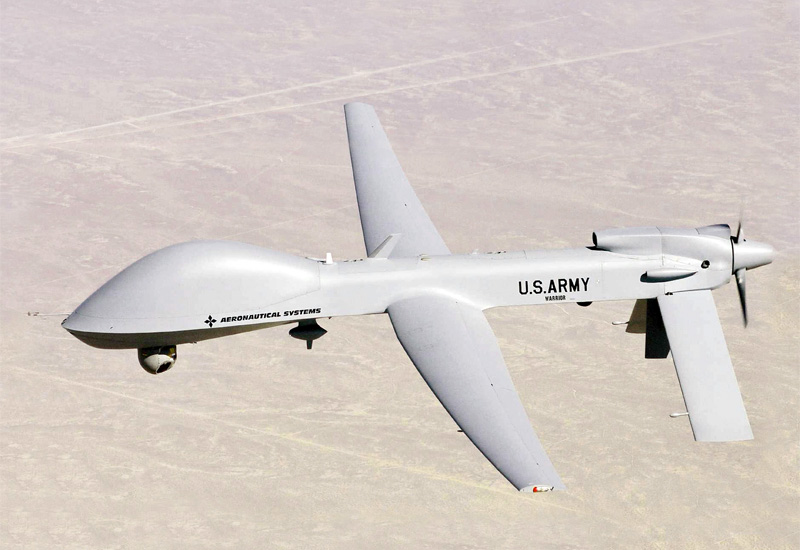
The Sky Warrior shares many external design elements with the Predator family line. Of particular note in this revision is its enlarged nose assembly containing a Synthetic Aperture Radar/Ground Moving Target Indicator (SAR-GMTI). Compared to the Predators before her, the Sky Warrior also displays a wider wingspan. While her previous forms also made use of a base combustion engine and propeller arrangement, the Sky Warrior delivers its performance through a unique diesel piston system that is fueled by a jet-engine grade mix. This not only supplies the Sky Warrior with improved capabilities, but it is also what allows for the increase in performance at altitude that the US Army was originally looking for from their ERMP program. The avionics suite is made up of the AZ/ZPY-1 STARLite radar system.

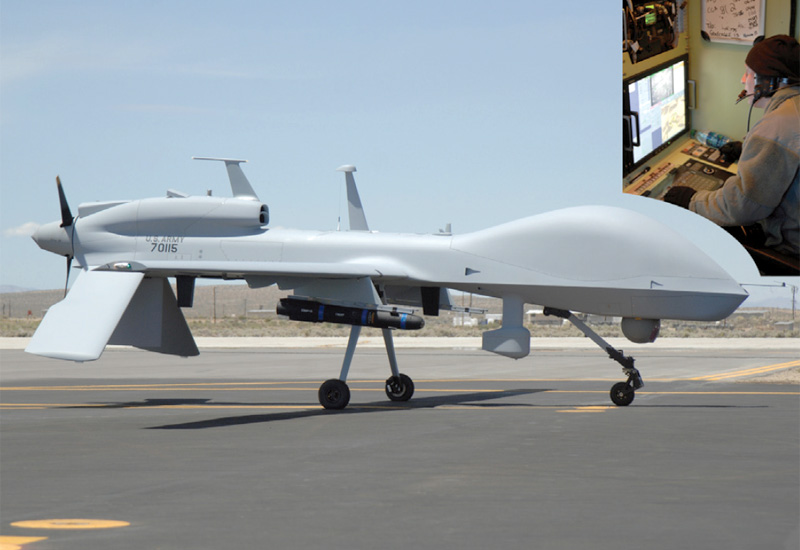
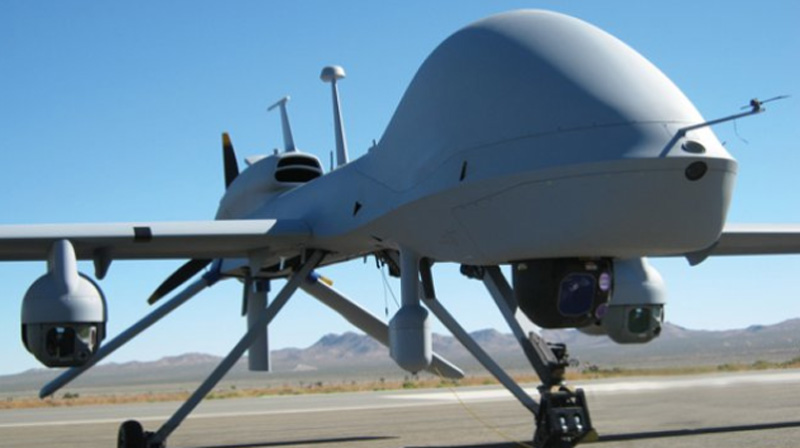
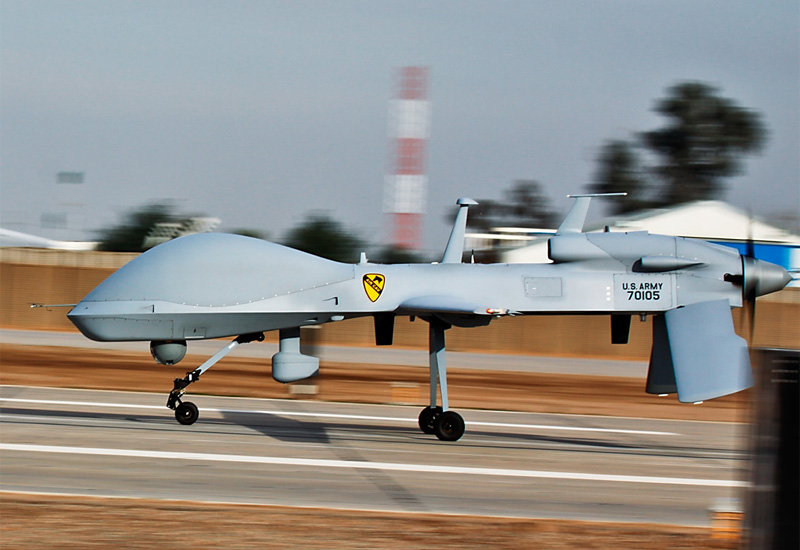
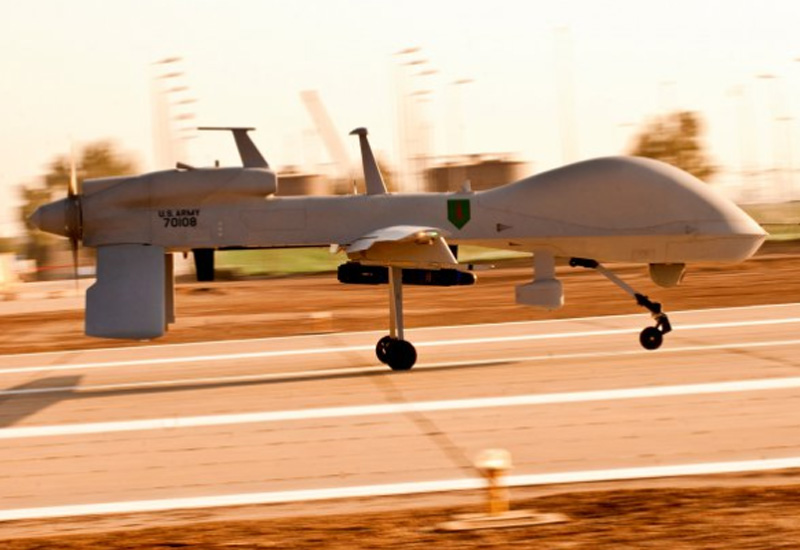
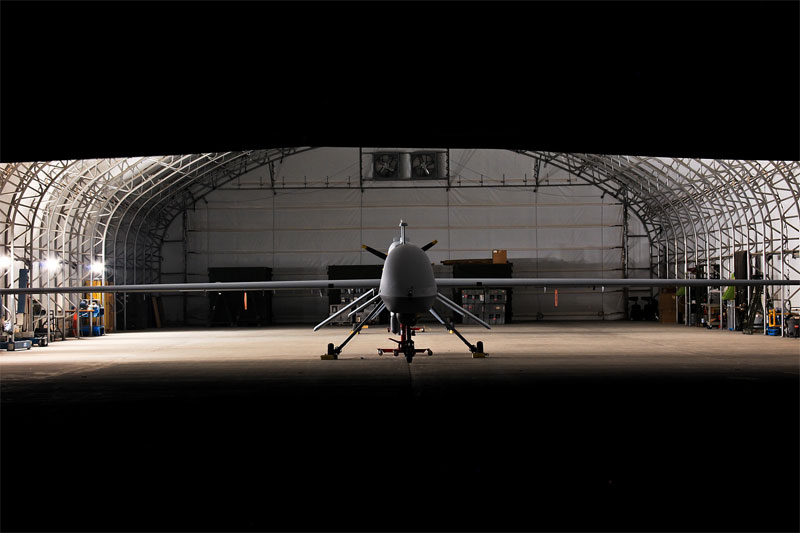
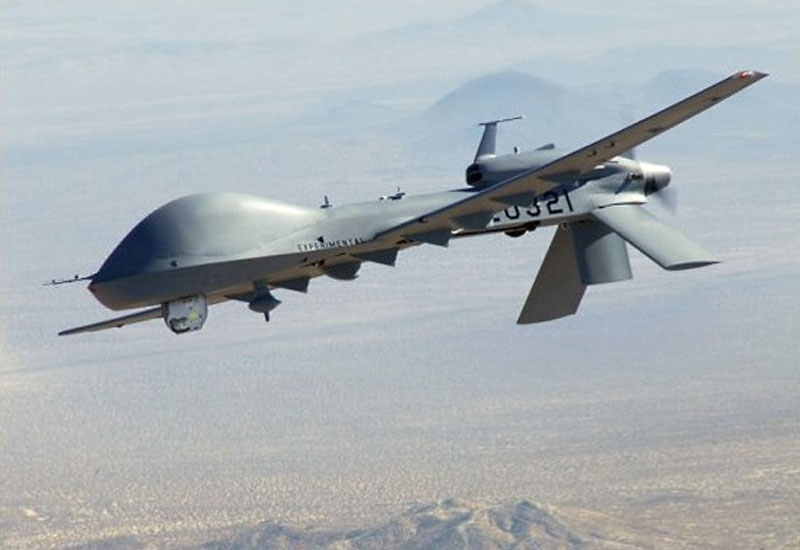
Externally, she shares essentially the same design layout of the former Predators. The front of the fuselage is dominated by a bulbous assembly which houses a radar (Lynx II Synthetic Aperture Radar) and tracking (Ground Moving Target Indicator) suite while a targeting system (AN/AAS-52 Multi-Spectral Targeting System) is fitted within a blister installation under the nose. She sports a straight wing design, these extending out at amidships. The fuselage is slender and characterized by the forward housing and the downturned vertical "Y" fins at the rear, themselves split by a third straight vertical fin. The engine is mounted to the extreme rear of the fuselage and is aspirated by a diminutive air inlet atop the fuselage spine. The motor spins a three-bladed propeller system in a "pusher" type arrangement and is capped by a noticeably thick spinner. She features a fully-retractable undercarriage and four external hardpoints for various munition loads or specialized equipment.

Power is supplied by a single Thielert Centurion 1.7 Heavy Fuel Engine (HFE). Performance includes an operating range equal to 200 nautical miles and an operating altitude between 25,000- and 29,000-feet. She can spend up to 36 hours in the air before being recalled. Her maximum speed is in the vicinity of 155 miles per hour. Dimensionally, the Sky Warrior fits a wingspan up to 56 feet and sports a height of 6.9 feet with an overall length of 28 feet. Her maximum take-off-weight is approximately 3,200lbs.

The MQ-1C is part of a new family of armed UAVs working for the United States Army. This supplies the branch with unprecedented flexibility in both seeking out targets of opportunity and in assisting friendly ground forces in contact with the enemy. She is cleared to carry four Hughes AGM-114 "Hellfire P+" anti-tank air-to-surface missiles to combat enemy ground vehicles (or enemies held within structures) or up to eight AIM-92 Stinger short-range air-to-air missiles to combat low-flying enemy aircraft such as close-air support platforms of helicopters. Additionally, the Gray Eagle is cleared to carry the GBU-44/B Viper Strike series of guided bombs for pinpoint weapons delivery and heightened accuracy. Ordnance capability is limited to 800lbs. Targeting is handled by way of the AN/AAS-52 Multi-Spectral Targeting System (MTS) fitted to the rotating cylindrical mount under the nose fairing. As with most UAV platforms, the MQ-1C is equally adept at basic reconnaissance sorties, proving to be that all-vital "eye-in-the-sky" that the enemy lacks.

In addition to its self-designation-and-attack reach, the MQ-1C has also been tested in the lazing of targets for other aircraft, acting in conjunction to produce a lethal "hunter-killer" team. She can target guided missiles from Hughes Apache tank-killing helicopters or guided drop ordnance from high-quality airframes such as General Dynamics/Lockheed F-16, the McDonnell Douglas / Boeing F/A-18 Hornet and even the 5th Generation Lockheed F-22 Raptor. The latest AH-64 Apache attack helicopter upgrade - the "Apache Block III" soon to appear in March of 2012 - actually provides integrated facilities that will allow the AH-64 pilot to interact with the ordnance of the Gray Eagle itself.


The Gray Eagle, like other new-generation UAVs, is fully mission autonomous and can take-off and land under its own programming while reaching mission waypoints via GPS. It can also launch its own ordnance and work in conjunction with participating attack helicopters. Multiple Gray Eagles can be assigned to a single Ground Control Station (GCS) (legacy stations to the Predator A series as well) and applicable flight control stations are included. Gray Eagle pilots make use of a flight-stick style input controller and keyboard.

As of this writing (2012), the US Army has procured some 12 Sky Warrior UAVs along with their applicable ground control units. Operations were initially to be handled solely by Task Force ODIN (Observe, Detect, Identify and Neutralize) based out of Fort Hood, Texas, with use possibly in both theaters of war (Iraq and Afghanistan). Task Force ODIN's performance has already earned them the Army Meritorious Unit Commendation with their work alongside the US Army's 25th Infantry Division. The MQ-1C is operated by specially trained operators of the United States Army. Unlike the United States Air Force, which restricts operations of its UAVs to only officers, the US Army allows operation of its UAVs by officers, warrant officers and enlisted personnel. Unlike other UAVs, Sky Warrior operators are actually stationed within Iraqi borders as opposed to operating their UAVs within the United States. The 1st Infantry Division received their Gray Eagles in June of 2010 while more are expected in the spring of 2012. To date, US use of UAV systems has exceeded 1 million hours of operation, a definite shift in the American methodology of war.

Originally intended to use the all-new designation of "MQ-12" as selected by the United States Army, the new UAV was actually assigned the Predator-style designation of MQ-1C by the United States Department of Defense instead. In US Army nomenclature, the "M" signifies a UAVs armed role and the "Q" signifies it is an unmanned aircraft system.

The Gray Eagle is early in its operational deployment so it is only natural that some issues have arisen. Some problems have emerged with poor remote video feed returns and unreliable radio communications, leading to a mission success rate of just 54% according to US Army reports. There have also been complaints aimed at the arrangement and comfort of Ground Control Station themselves. However, these same early Gray Eagles have proven their target detection and take-off/landing functions sound.

5.7.2013 - General Atomics Aeronautical Systems, Incorporated of Poway, California was given a contract modification of $110,261,703 USD for Gray Eagle product support and fleet sustainment in Afghanistan. The total contract face value is $354,683,431 with Army Contracting Command, Redstone Arsenal of Alabama as the contracting activity.
Text ©2003-2013 www.MilitaryFactory.com • All Rights Reserved • No Reproduction Permitted
MilitaryFactory.com does NOT sell equipment/weaponry. Material presented throughout this website is for historical and entertainment value and should not to be construed as usable for hardware restoration, maintenance or general operation. Please consult manufacturers for such information. Our disclaimer. Email corrections / Comments to MilitaryFactory at Gmail dot com.
Picture of General Atomics MQ-1C Gray Eagle (Sky Warrior)
Pic of the General Atomics MQ-1C Gray Eagle (Sky Warrior)
Image of the General Atomics MQ-1C Gray Eagle (Sky Warrior)
View All Images (7)

Specifications for the
General Atomics MQ-1C Gray Eagle (Sky Warrior)
Armed Unmanned Aerial Vehicle


Country of Origin: United States
Manufacturer: General Atomics - USA
Initial Year of Service: 2009
Production: 61


Focus Model: General Atomics MQ-1C Gray Eagle (Sky Warrior)
Crew: 3


Length: 26.25ft (8m)
Width: 55.77ft (17.00m)
Height: 6.89ft (2.10m)
Weight (Empty): 0lbs (0kg)
Weight (MTOW): 3,199lbs (1,451kg)


Powerplant: 1 x Thielert Centurion 1.7 Heavy-Fuel Engine delivering 135 horsepower.


Maximum Speed: 155mph (250kmh; 135kts)
Maximum Range: 0miles (0km)
Service Ceiling: 29,003ft (8,840m; 5.5miles)
Rate-of-Climb: 0 feet per minute (0m/min)


Hardpoints: 4
Armament Suite:
Up to 800lbs of external stores across four hardpoints to include (or combination of):

4 x Hughes AGM-114 Hellfire anti-tank missiles
8 x AIM-92 Stinger short-range anti-aircraft missiles.
4 x GBU-44/B Viper Strike guided bombs


Variants:
MQ-1C "Sky Warrior" - Base Production Series Designation.


MQ-12 - Original Intended US Army Designation


Operators: United States

ALL AIRCRAFT CATEGORIES

BY DECADE:


1900 to 1909
1910 to 1919
1920 to 1929
1930 to 1939
1940 to 1949
1950 to 1959
1960 to 1969
1970 to 1979
1980 to 1989
1990 to 1999
2000 to 2009
2010 to 2019
2020 to 2029
VIEW ALL
Compare Aircraft


BY TYPE:


Anti-Submarine Warfare (ASW)
Attack Helicopters
Bomber Aircraft
Medium Bombers
Heavy Bombers
Close-Air Support (CAS)
Commercial Aircraft
Dive Bombers
Electronic Warfare Aircraft (EWA)
Experimental / X-Planes
Fighter Aircraft
Floatplane Aircraft
Flying Boat Aircraft
Aerial Refueling Tankers
Helicopters (ALL)
Interceptor Aircraft
Multi-Role Aircraft
Navy Carrier Aircraft
Night Fighters
Reconnaissance / Scout
Search & Rescue (SAR)
Scout Helicopters
Special Purpose
Torpedo Bombers
Trainer Aircraft
Transport Aircraft
Transport Helicopters
Unmanned Aerial Vehicles (UAVs)
Unmanned Combat Air Vehicles (UCAVs)


COLLECTIONS:


4th Generation Fighter Aircraft
5th Generation Fighter Aircraft
US X-Planes
Classic US Warbirds
French Military Helicopters
Grumman "Cats"
Howard Hughes Aircraft
Indian Air Force
Israeli Air Force
Libyan Aircraft
Modern Chinese Aircraft
Modern Chinese Fighters
Modern Military Aircraft
Modern North Korean Aircraft
Modern Trainer Aircraft
Modern US Aircraft
Mikoyan Aircraft
Sukhoi Aircraft
Syrian Aircraft
Top 10 Fighter Aircraft of All Time


AIRCRAFT BY CONFLICT:


Arab-Israeli War (1948)
Cuban Missile Crisis (1959-1962)
Falklands War (1982)
Indo-Pak War (1965, 1971)
Iran-Iraq War (1980-1988)
Lebanon War (1982)
Operation Allied Force (1999)
Operation Desert Storm (1991)
Six Day War (1967)
Spanish Civil War (1936)
Soviet-Afghan War (1979-1989)
Yom Kippur War (1973)


MISCELLANEOUS:


Aircraft Cockpits
Aircraft Manufacturers List
Aircraft Timeline

WORLD WAR 2:


1939 Aircraft
1940 Aircraft
1941 Aircraft
1942 Aircraft
1943 Aircraft
1944 Aircraft
1945 Aircraft
1946 Aircraft
Australian Aircraft
Battle of Britain Aircraft
Bombers
Four-Engine Bombers
British Aircraft
British Bombers
British Transports
Dive Bombers
Canadian Aircraft
Fighters
Chinese Aircraft
French Aircraft
German Aircraft
German Fighters
German Flying Boats
German Jets
Secret Weapons of the Luftwaffe
Italian Aircraft
Imperial Japanese Aircraft
Imperial Japanese Fighters
Mitsubishi Bombers
Navy Aircraft
Pearl Harbor
Polish Aircraft
Romanian Aircraft
US Aircraft
US Bombers
US Navy Aircraft
Soviet Aircraft
Torpedo Bombers
Transport Aircraft
Tuskegee Airmen Aircraft
W.A.S.P. Aircraft
WW2 Aircraft Ranked by Speed
VIEW ALL


WORLD WAR 1:


1914 Aircraft
1915 Aircraft
1916 Aircraft
1917 Aircraft
1918 Aircraft
Aircraft Timeline
Austro-Hungarian Aircraft
Bomber Aircraft
British Aircraft
Fighters
Flying Boats
French Aircraft
Imperial German Aircraft
Italian Aircraft
Scout Aircraft
Russian Empire Aircraft
US Aircraft
WW1 Aircraft Ranked by Speed
VIEW ALL


KOREAN WAR:


Australian Aircraft
Korean War Aces
Korean War Jets
North Korean Aircraft
US Military Aircraft
VIEW ALL


VIETNAM WAR:


Helicopters
North Vietnam Air Force
US Airpower
VIEW ALL


COLD WAR:


1950s French Aircraft
British V-Bombers
Cold War Bombers
Soviet Aircraft
Soviet Bombers
Soviet Interceptors
Soviet Helicopters
Strategic Air Command
US Aircraft
US Bombers
US Interceptors
VIEW ALL

Site Disclaimer | Privacy Policy | Site Map | MF Origins


©2013 www.MilitaryFactory.com • Content ©2003-2013 MilitaryFactory.com • All Rights Reserved • Site Contact Email: militaryfactory at gmail dot com. The "Military Factory" name and MilitaryFactory.com logo are registered ® trademarks and protected by all applicable domestic and international intellectual property laws.


Top MF Stuff: 2013 Military Pay Scale | Military Ranks | WW2 Weapons | Sniper Rifles | Kts to Mph | WW1 Aircraft | Automatic Rifles | Aircraft Cockpits | Vietnam War Weapons | Main Battle Tanks | Submachine Guns | Shotguns | French Military Victories


Most photographic images appearing on this site are courtesy of the United States Department of Defense and are approved for public use. Other images acquired through the public domain. Digital art work courtesy of Dan Alex. Business Consulting by Kyle Williams. Material presented throughout this website is for historical and entertainment value and should not to be construed as usable for hardware restoration, maintenance or general operation. Please consult manufacturers for such information.


eXTReMe Tracker