Military Factory
Military Pay Chart
Global Firepower
Military Industrial Complex
Second World War
Home
Military Pay Scale
Military Ranks
Small Arms
Aircraft
Land Systems
Navy
Education
Military Factory Facebook Logo
flag of Soviet Union

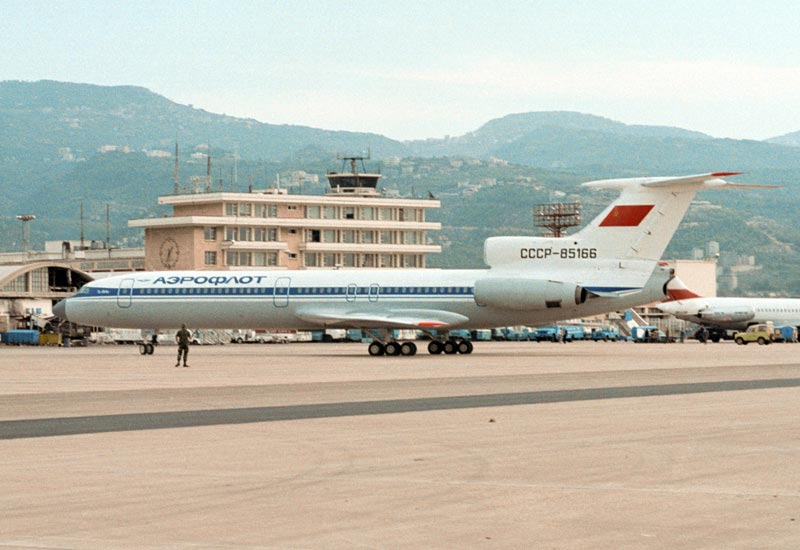
Tupolev Tu-154 (Careless) Commercial Passenger Airliner (1972)

Authored By Staff Writer | Last Updated: 9/4/2012

The Tupolev Tu-154 has had a tainted service record since its inception - a mix of crew errors, stresses of harsh operating environments and accidents.

The Tupolev concern of Russia holds an aviation history dating as far back as 1926, having since established a name in large military and commercial aircraft designs. To supply the latter with a new medium-ranged hauler (replacing several outgoing turboprop models), Tupolev assumed a three-turbofan-engined, low monoplane wing design comparable to Western offerings of the time. The three engines were held in the aft-section of the fuselage, a configuration popular during the 1960s and 1970s, and design work on the type preceded its first flight, this recorded on October 4th, 1968. After passing trials and gaining the required certifications, the new design emerged as the Tu-154 with production beginning in 1968 and spanning until 2011. Deliveries from Tupolev to awaiting carriers began in 1970 to which formal introduction was in 1972, this with Aeroflot. 1,025 examples were ultimately produced and this breed stocked some 21 airlines during her operational tenure. Today, roughly 100 are still flying, impressive considering the type's inception over 40 years ago. Upon recognition from the West, NATO observers christened the aircraft the "Careless".

Unlike Western airliner types, the Tu-154 was specifically designed for very rigorous conditions and for navigating the broad and unforgiving airspaces common to the then-Soviet frontier. The undercarriage was reinforced for operations from rough airfields while the body was developed to content with freezing conditions of the north. Since maintenance facilities in more rural areas of the country would offer little to no service for the aircraft, the Tu-154 was designed to operate for long periods of time before requiring a scheduled overhaul. Such stresses undoubtedly caused several of the 39 published accidents involving the Tu-154 series during its service life. Other factors usually centered around pilot/crew errors and accidents.

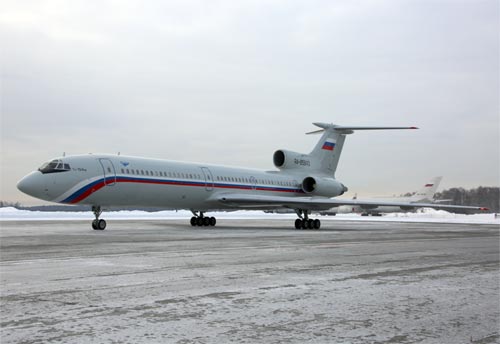
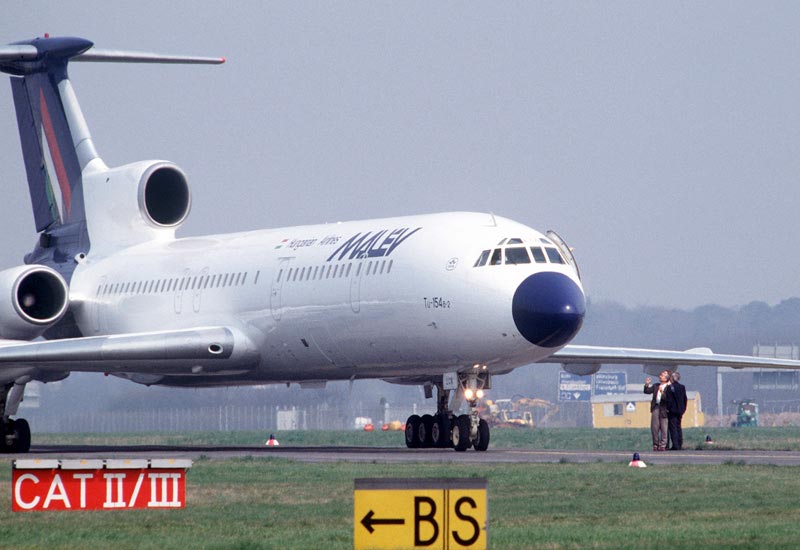
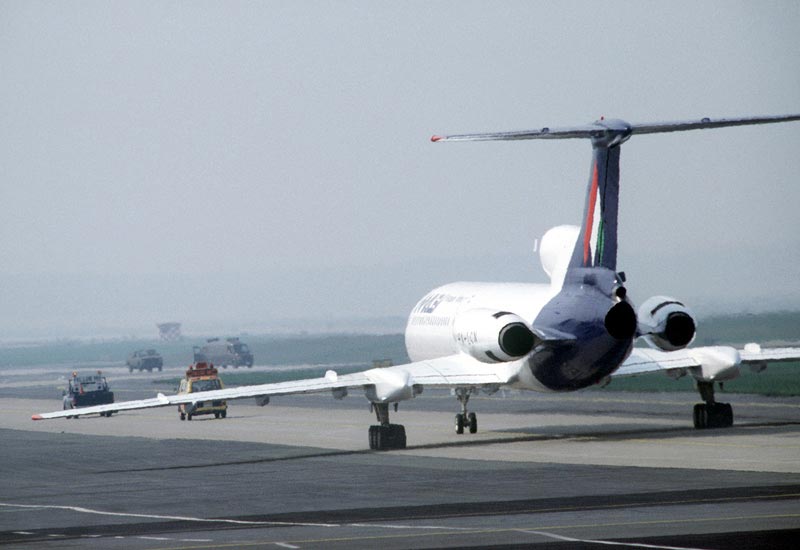
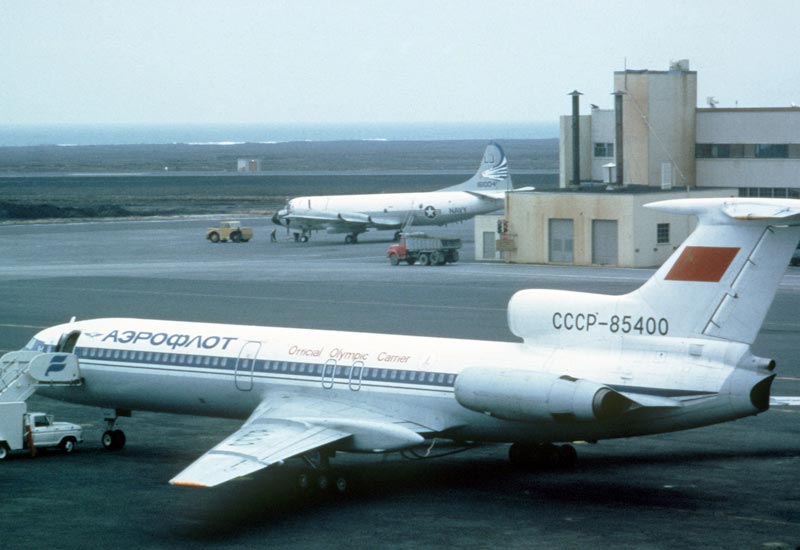
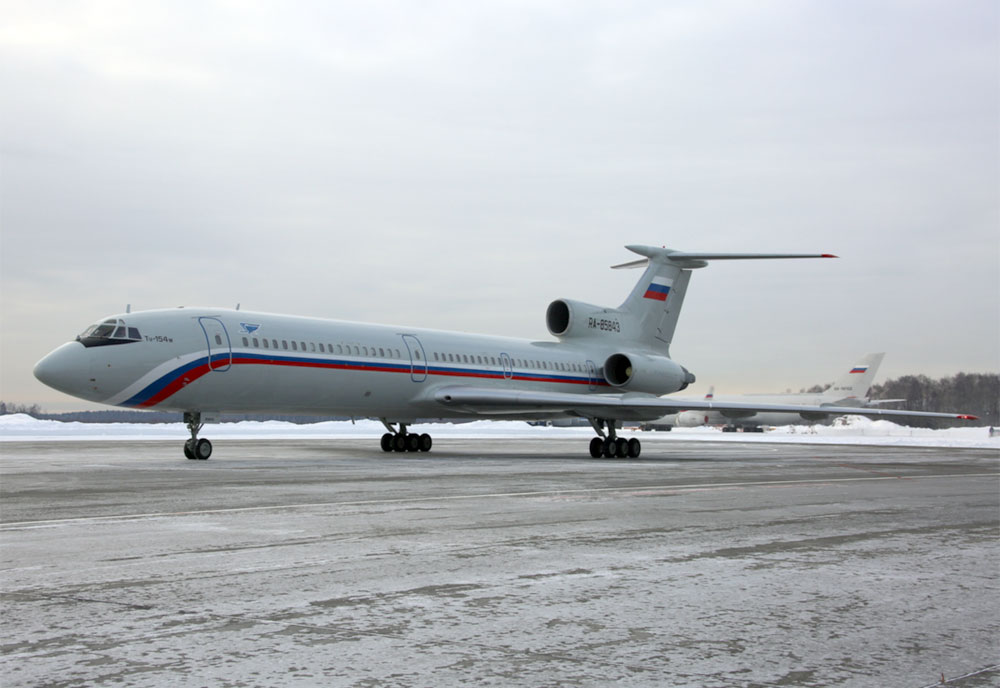
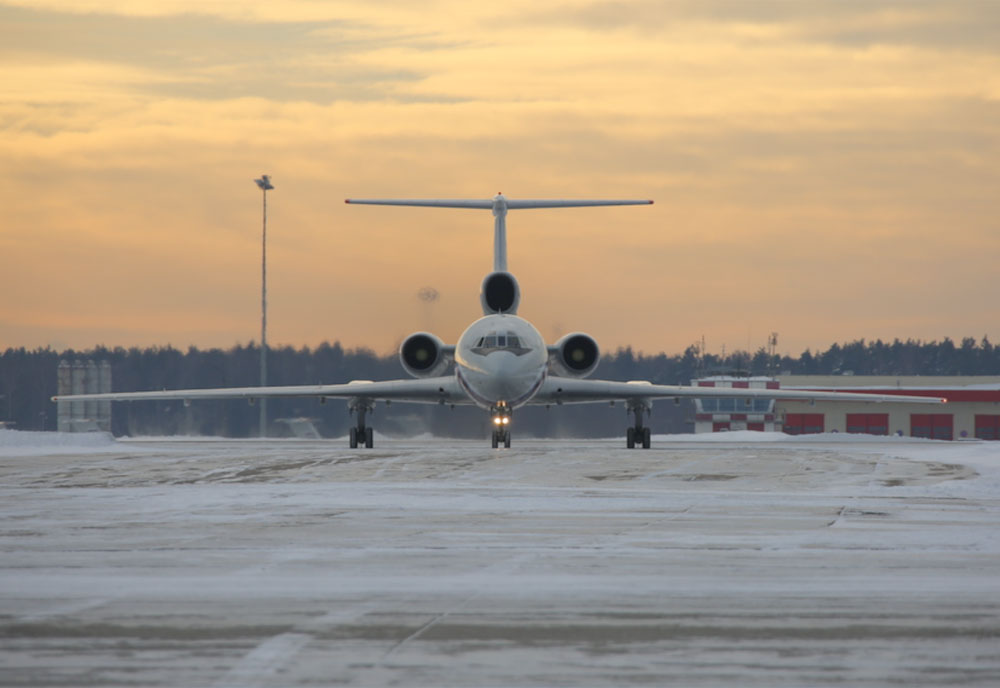
Design of the Tu-154 was conventional with a slim, tubular fuselage, forward-set cockpit, low-mounted swept main wing assemblies and a high-mounted Tee-style tailplane atop a vertical fin. All three engines were concentrated to the rear of the design with two straddling the vertical fin and the third buried at its frontal base (running from the fuselage spine). The sides of the fuselage were appropriately dotted with rectangular windows for passenger viewing. There were four rectangular access doors to either fuselage side for quick embarking/disembarking of passengers. Cargo was stored in the deck beneath the passenger seating area. The flight crew sat well-forward in the design with good views over the nose through a framed window set. The vehicle traveled along the ground view a tricycle undercarriage that consisted of two main landing gear legs and a nose leg. The main legs were of note for their multi-wheeled design, wheels numbering six in all. The nose leg was conventional with a two wheel set. Internally. the Tu-154 was arranged to carry approximately 164 passengers. Outwardly, the Tu-154 was highly comparable to the American Boeing 727 series and the British Hawker Siddeley Trident models - both appearing prior to the Tupolev design.

Over the course of its life, the Tu-154 family of aircraft has seen an appropriate helping of variants. The initial production model was known simply as the "Tu-154" with seating for 164 with 42 examples being built in all. An upgraded form then appeared to become the Tu-154A which added additional internal fuel stores, exit doors and multiple interior configurations to suit carrier requirements. The engines were uprated Kuznetsovs. The Tu-154B brought about use of new, stronger wings due to fractures that began emerging in the preceding production models then in service. Additional fuel storage, exit doors and passenger seated was also introduced. The Tu-154B became the new Tu-154 standard to which the preceding marks were upgraded to when possible. A slightly differing Tu-154B form followed, this as the Tu-154B-1 with improved avionics, comforts and undercarriage with seating for 160 passengers. 64 of this subvariant were delivered. The Tu-154B-2 was similar and increased seating to 180 passengers with the loss of the onboard kitchen facility. 311 of this type were produced in all. The Tu-154S was a cargo-hauler conversion model with revised internals. Nine were converted from existing Tu-154 and Tu-154B models. The Tu-154M was a modernized variant appearing in 1982 with Soloviev D-30KU-154 series turbofans. Performance and operational ranges were both improved. The Tu-154M-LK-1 was a VIP model converted for astronaut (cosmonaut) training. The Tu-154M-ON was a one-off observation platform utilized by East Germany, lost to accident in 1997. The Tu-154M-100 was the last offered modernized mark first appearing in 1998. These three examples were differentiated by their Western-type avionics and seating for 157 and delivered to Slovakia for a time.

Early Tu-154 marks were powered by the Kuznetsov NK-8 series turbofan engines while later, more modern marks, appeared with the Soloviev D-30 series turbofan. Maximum take-off weight (MTOW) and range were improved between the two designs while maximum speeds and service ceilings reamined comparable.

Use of the Tu-154 inevitably went beyond civilian carrier hands with operations conducted at the government level for some. The type also gained a foothold in the lucrative military market where it served the air forces of Armenia, Bulgaria, China, Czechoslovakia/Czech Republic, Cuba, East Germany/Germany (reunified), North Korea, Poland, Mongolia, Russia/Soviet Union, Turkmenistan , Ukraine and Uzbekistan.

The a recent high profile crash involving a Tu-154 occurred on October 4th, 2010 when aircraft 101 - carrying Polish President Lech Kaczynski and his cabinet - crashed on final approach, killing all on board. One of the deadliest crashed was CCCP-85311 on October 7th, 1985, which stalled and crashed due to pilot error and an overloaded plane - 200 souls were lost. The most recent published incident was on January 1st, 2011 when RA-85588 caught fire during taxing, resulting in an explosion and death of three of the 124 persons on board.
Text ©2003-2013 www.MilitaryFactory.com • All Rights Reserved • No Reproduction Permitted
MilitaryFactory.com does NOT sell equipment/weaponry. Material presented throughout this website is for historical and entertainment value and should not to be construed as usable for hardware restoration, maintenance or general operation. Please consult manufacturers for such information. Our disclaimer. Email corrections / Comments to MilitaryFactory at Gmail dot com.
Picture of Tupolev Tu-154 (Careless)
Pic of the Tupolev Tu-154 (Careless)
Image of the Tupolev Tu-154 (Careless)
View All Images (4)

Specifications for the
Tupolev Tu-154 (Careless)
Commercial Passenger Airliner


Country of Origin: Soviet Union
Manufacturer: Tupolev - Soviet Union / Russia
Initial Year of Service: 1972
Production: 1,025


Focus Model: Tupolev Tu-154M (Careless)
Crew: 4 + 160


Length: 157.48ft (48m)
Width: 123.20ft (37.55m)
Height: 37.40ft (11.40m)
Weight (Empty): 121,916lbs (55,300kg)
Weight (MTOW): 229,281lbs (104,000kg)


Powerplant: 3 x Soloviev D-30KU-154 turbofan engines delivering 23,148lbs of thrust each.


Maximum Speed: 590mph (950kmh; 513kts)
Maximum Range: 4,101miles (6,600km)
Service Ceiling: 39,698ft (12,100m; 7.5miles)
Rate-of-Climb: 0 feet per minute (0m/min)


Hardpoints: 0
Armament Suite:
None.


Variants:
Tu-154 - Initial production model; seating for 164; 42 examples produced.


Tu-154A - Improved Tu-154 model; increased internal fuel and emergency exit doors; uprated engines; seating for up to 152.

Tu-154B - Revised Tu-154/Tu-154A due to wing fractures encountered; new revised wing assemblies; increased internal fuel volume; increased ranges; 111 produced.

Tu-154B-1 - Based on the Tu-154B; seating for 160; revised avionics; 64 examples produced.

Tu-154B-2 - Modernized Tu-154B-1; seating for 180 sans galley; 311 examples produced.

Tu-154S - Cargo Hauling Variant of the Tu-154B; 9 examples converted from existing Tu-154/Tu-154B production models.

Tu-154M - Modernized Tu-154 appearing in 1984; switch to Soloviev D-30 turbofan engines; improved range; 320 examples delivered.

Tu-154M-LK-1 - modified Tu-154 VIP model for use as cosmonaut trainer.

Tu-154M-ON (Monitoring Aircraft) - Observation platform converted from Tu-154 for East German Air Force; lost to accident in 1997.

Tu-154M-100 - Improved/modernized Tu-154 variant; appearing in 1998; Western avionics; seating for 157.


Operators:
Afghanistan; Albania; Armenia; Azerbaijan; Bulgaria; China; Cuba; Czechoslovakia; Czech Republic; Djibouti; East Germany; Egypt; Georgia; Germany; Hungary; Iran; Kazakhstan; Kyrgyzstan; Libya; Macedonia; Moldova; Mongolia; Nicaragua; North Korea; Pakistan; Poland; Romania; Russia; Somalia; Soviet Union; Slovakia; Syria; Turkey; Turkmenistan; Ukraine; Uzbekistan; Yemen

ALL AIRCRAFT CATEGORIES

BY DECADE:


1900 to 1909
1910 to 1919
1920 to 1929
1930 to 1939
1940 to 1949
1950 to 1959
1960 to 1969
1970 to 1979
1980 to 1989
1990 to 1999
2000 to 2009
2010 to 2019
2020 to 2029
VIEW ALL
Compare Aircraft


BY TYPE:


Anti-Submarine Warfare (ASW)
Attack Helicopters
Bomber Aircraft
Medium Bombers
Heavy Bombers
Close-Air Support (CAS)
Commercial Aircraft
Dive Bombers
Electronic Warfare Aircraft (EWA)
Experimental / X-Planes
Fighter Aircraft
Floatplane Aircraft
Flying Boat Aircraft
Aerial Refueling Tankers
Helicopters (ALL)
Interceptor Aircraft
Multi-Role Aircraft
Navy Carrier Aircraft
Night Fighters
Reconnaissance / Scout
Search & Rescue (SAR)
Scout Helicopters
Special Purpose
Torpedo Bombers
Trainer Aircraft
Transport Aircraft
Transport Helicopters
Unmanned Aerial Vehicles (UAVs)
Unmanned Combat Air Vehicles (UCAVs)


COLLECTIONS:


4th Generation Fighter Aircraft
5th Generation Fighter Aircraft
US X-Planes
Classic US Warbirds
French Military Helicopters
Grumman "Cats"
Howard Hughes Aircraft
Indian Air Force
Israeli Air Force
Libyan Aircraft
Modern Chinese Aircraft
Modern Chinese Fighters
Modern Military Aircraft
Modern North Korean Aircraft
Modern Trainer Aircraft
Modern US Aircraft
Mikoyan Aircraft
Sukhoi Aircraft
Syrian Aircraft
Top 10 Fighter Aircraft of All Time


AIRCRAFT BY CONFLICT:


Arab-Israeli War (1948)
Cuban Missile Crisis (1959-1962)
Falklands War (1982)
Indo-Pak War (1965, 1971)
Iran-Iraq War (1980-1988)
Lebanon War (1982)
Operation Allied Force (1999)
Operation Desert Storm (1991)
Six Day War (1967)
Spanish Civil War (1936)
Soviet-Afghan War (1979-1989)
Yom Kippur War (1973)


MISCELLANEOUS:


Aircraft Cockpits
Aircraft Manufacturers List
Aircraft Production
Aircraft Timeline

WORLD WAR 2:


1939 Aircraft
1940 Aircraft
1941 Aircraft
1942 Aircraft
1943 Aircraft
1944 Aircraft
1945 Aircraft
1946 Aircraft
Australian Aircraft
Battle of Britain Aircraft
Bombers
Four-Engine Bombers
British Aircraft
British Bombers
British Transports
Dive Bombers
Canadian Aircraft
Fighters
Chinese Aircraft
French Aircraft
German Aircraft
German Fighters
German Flying Boats
German Jets
Secret Weapons of the Luftwaffe
Italian Aircraft
Imperial Japanese Aircraft
Imperial Japanese Fighters
Mitsubishi Bombers
Navy Aircraft
Pearl Harbor
Polish Aircraft
Romanian Aircraft
US Aircraft
US Bombers
US Navy Aircraft
Soviet Aircraft
Torpedo Bombers
Trainer Aircraft
Transport Aircraft
Tuskegee Airmen Aircraft
W.A.S.P. Aircraft
WW2 Aircraft Ranked by Speed
VIEW ALL


WORLD WAR 1:


1914 Aircraft
1915 Aircraft
1916 Aircraft
1917 Aircraft
1918 Aircraft
Aircraft Timeline
Austro-Hungarian Aircraft
Bomber Aircraft
British Aircraft
Fighters
Flying Boats
French Aircraft
Imperial German Aircraft
Italian Aircraft
Scout Aircraft
Russian Empire Aircraft
US Aircraft
WW1 Aircraft Ranked by Speed
VIEW ALL


KOREAN WAR:


Australian Aircraft
Korean War Aces
Korean War Jets
North Korean Aircraft
US Military Aircraft
VIEW ALL


VIETNAM WAR:


Helicopters (ALL)
Transport Helicopters
North Vietnam Air Force
US Airpower
VIEW ALL


COLD WAR:


1950s French Aircraft
British V-Bombers
Cold War Bombers
Soviet Aircraft
Soviet Bombers
Soviet Interceptors
Soviet Helicopters
Strategic Air Command
US Aircraft
US Bombers
US Interceptors
VIEW ALL

Site Disclaimer | Privacy Policy | Site Map | MF Origins


©2013 www.MilitaryFactory.com • Content ©2003-2013 MilitaryFactory.com • All Rights Reserved • Site Contact Email: militaryfactory at gmail dot com. The "Military Factory" name and MilitaryFactory.com logo are registered ® trademarks and protected by all applicable domestic and international intellectual property laws.


Top MF Stuff: 2013 Military Pay Scale | Military Ranks | WW2 Weapons | Sniper Rifles | Kts to Mph | WW1 Aircraft | Automatic Rifles | Aircraft Cockpits | Vietnam War Weapons | Main Battle Tanks | Submachine Guns | Shotguns | French Military Victories


Most photographic images appearing on this site are courtesy of the United States Department of Defense and are approved for public use. Other images acquired through the public domain. Digital art work courtesy of Dan Alex. Business Consulting by Kyle Williams. Material presented throughout this website is for historical and entertainment value and should not to be construed as usable for hardware restoration, maintenance or general operation. Please consult manufacturers for such information.


eXTReMe Tracker