Military Factory
Military Pay Chart
Global Firepower
Military Industrial Complex
Second World War
Home
Military Pay Scale
Military Ranks
Small Arms
Aircraft
Land Systems
Navy
Education
Military Factory Facebook Logo
flag of Imperial Germany

Gotha G.V Heavy Bomber (1917)

Authored By Staff Writer | Last Updated: 8/7/2012

The German Air Service utilized the Gotha series of heavy bombers to good effect throughout World War 1.

Find a School Near You
Follow Military Factory on Facebook:
Trending on Military Factory:
Recent Articles:
With the Germans having gained critical territory up to the Belgian coast in 1914, thoughts to the bombing of targets within the British mainland became more of a reality. The first Zeppelins attacked the capital city of London with relative impunity and stunned its population in June of 1915. This was then followed by a more successful outing in September, prompting the English to relocate critical frontline squadrons for the purpose of home defense. While use of Zeppelins as bombers lessened, LVG light bombers were then used to attack the city in November of 1915 - proving the English capital within strategic reach of the then-available German light bombers. However, a true long-range, heavy-class solution was still to come - and finally made available - by the arrival of the Gotha bomber series, the classic German heavy bomber of World War 1.

The Gotha aircraft was a two-engined, biplane design forged of a steel skeleton, wood framing and fabric skin. They proved a formidable foe for they were able to operate in both day and night, possess a potent ordnance load and defend one another against enemy fighters with relatively good success when flying in tactical formation and guns at the ready. Anti-aircraft artillery proved their greatest threat for these large bombers were still slow-moving targets to ground-based artillery, particularly during the day and in massed groups. On the other hand, the preceding Zeppelin bombers maintained the inherent advantage of operating at ceilings that enemy fighters could not, becoming vulnerable during the landing process or when caught unawares but their bombing accuracy was suspect. For the Gotha, crash landings proved a somewhat all-too common occurrence and her flight characteristics tested the mettle of any pilot, particularly during night sorties. Gotha G-series construction was such that they proved to be rather robust machines, able to withstand a good deal of punishment from both regular combat usage and from enemy machine gun fire. The series inevitably served well in replacing the ponderous and expensive Zeppelins and limited light bombers and went on to form the backbone of the German bombing campaigns for the duration of the war. The increasing losses of Zeppelins only spurred development of a more defined solution that the Gotha became.

The original Gotha G.I production model arrived in 1915 and was produced in 20 examples, ultimately joined by the reworked G.II (11 examples) and the re-engined G.III (25 examples) in 1916. In 1917, the much improved G.IV was delivered and some 230 examples of this machine were produced out of Gothaer Waggonfabrik AG facilities, marking her as the definitive production G-bomber form to date. Its evolutionary features included a tunnel designed to allow the rear gunner to fire through the fuselage of the plane against lower targets as well as a plywood skin covering taking the place of fabric. However, this form still exhibited some operational limitations when placed into service, spurring the Gothaer concern to develop a more refined and improved version known as the "G.V". The design of this new Gotha bomber, like others previous, was attributed to engineer Hans Burkhard (Oskar Ursinus and Helmut Friedel designed the original G.I model). The aircraft achieved first flight in 1917 and formally entered operational service in August of that year. At least 205 examples were completed from the middle of 1917 to the end of the war in November of 1918 and all serving the Luftstreitkrafte solely, seeing extensive action along the Eastern and Western Fronts.

A forward machine gunner managed the front-most position in the bomber. The machine gun was fitted to a trainable ring mount for greater firing arcs against incoming frontal threats. The pilot managed a position just aft of the forward gun cockpit and set to portside along the fuselage wall, protected by nothing more than the frame and skin of the aircraft as well as a forward windscreen. Flight control was via a four-spoked steering wheel mounted atop a column. The instrument panel was ahead of the steering column with engine controls to the left. The internal bomb bay ("bomb chamber") and gangway of earlier G-series bomber aircraft was now replaced by an internal fuel store directly behind his position, forcing any ordnance to be held externally. The earlier G.IV model held its fuel tanks along the engine nacelles but this naturally posed a high risk to both crew and airframe alike, particularly upon crash landing - the fuel contents spilling out over the hot engines and igniting. The rear of the aircraft initially housed an additional pair of gun emplacements, one dorsal and another ventral. The dorsal position - fitting a machine gun on a trainable ring mount - could counter high-angled inbound threats while the ventral position (with rather limited fields of fire) was designed exclusively to deal with low inbound threats to threaten the aircraft's rather vulnerable underbelly. In later versions, the ventral gun was given up in favor of increasing the "Gotha Tunnel" firing arc for the dorsal position. This kept the rear gunner at his one placement without having to shift to another gun at another position. The Gotha series was crewed by only three personnel - made up of the forward gunner, pilot and rear gunner. Standard armament was two or three 7.92mm Parabellum MG14 series machine guns while up to 1,500lbs external ordnance could be carried aloft (standard load of 1 x 660lb bomb and 4 x 220lb bombs).

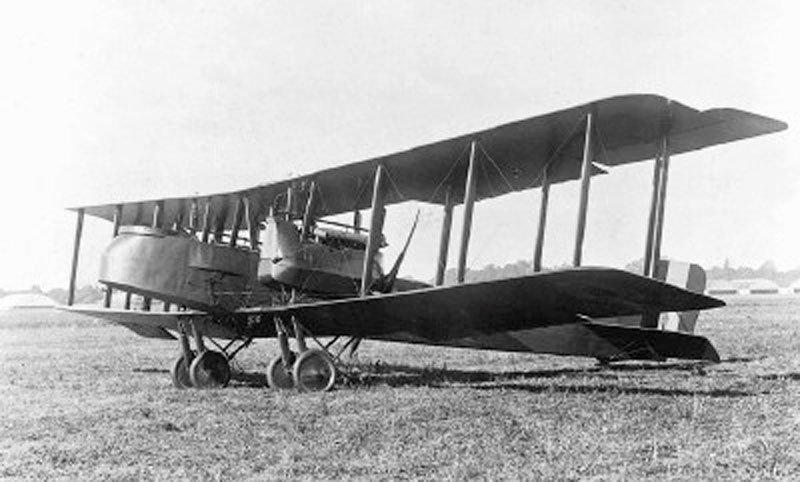
The outward design of the G.V was characterized by its large, four-bay, swept biplane wing arrangement with parallel struts that sat over and under the fuselage. The fuselage was well-contoured at the nose for basic aerodynamics and slab-sided elsewhere, housing all of the crew and fuel. The engines were held outboard of the fuselage in relatively streamlined nacelles. The undercarriage was fixed and dominated by large landing wheels attached to the lower wing assembly. In its original form, the aircraft showcased a single vertical tail fin with applicable horizontal tail surfaces but later variants brought about a dual rudder system and biplane tailplanes for improved handling.

The G.V sported a running length of 40 feet, 8 inches with a wingspan of 77 feet, 9 inches. At rest, the aircraft stood at 14 feet tall. When empty, the G.V managed a weight of 6,039lbs while her Maximum Take-Off Weight registered at 8,745lbs. Power was supplied by 2 x Mercedes D.IVa series inline piston engines, each delivering up to 260 horsepower. Maximum speed was 87 miles per hour with an operational range of approximately 520 miles and a service ceiling up to 21,300 feet.

The Gotha V series was produced in a few major production variants beginning with the base G.V model of 1917 with its single tail rudder. 100 of the type were ordered. This mount was further developed in the upcoming G.Va model which introduced a new twin-rudder compound tail unit with biplane tailplanes (known in the German as the "Kastensteuerung"). The fuselage was shortened and at least 25 of the type were completed and delivered for service.

The G.Vb then appeared in June of 1918 with 80 examples on order. While most of these were delivered to German units, a final series was relocated to the authority of the Triple Entente at the time of the November 1918 Armistice. These versions saw an increase to ordnance payload carrying capability as well as an increased MOTW (Maximum Take-Off Weight). The main landing gears were now reinforced with double wheels and retrofitted on existing G.Vs when possible.

G.V bombers netted 83 tons of ordnance dropped on England during the whole course of the war. Daylight raids went on until the summer of 1917 before the G-bombers were set apart exclusively for night sorties. Despite its "newness", the G.V offered up no performance benefit over the existing G.IV series it was intended to succeed for it proved heavier (due to poor quality wood) and underpowered (due to poor quality fuel). Use of steel in their design was something of a pioneering feat concerning aircraft construction of the time.
Text ©2003-2013 www.MilitaryFactory.com • All Rights Reserved • No Reproduction Permitted
MilitaryFactory.com does NOT sell equipment/weaponry. Material presented throughout this website is for historical and entertainment value and should not to be construed as usable for hardware restoration, maintenance or general operation. Please consult manufacturers for such information. Our disclaimer. Email corrections / Comments to MilitaryFactory at Gmail dot com.
Picture of Gotha G.V
View All Images (1)

Specifications for the
Gotha G.V
Heavy Bomber


Country of Origin: Imperial Germany
Manufacturer: Gothaer Waggonfabrik AG - Germany
Initial Year of Service: 1917
Production: 205


Focus Model: Gotha G.V
Crew: 3


Length: 40.75ft (12.42m)
Width: 77.76ft (23.70m)
Height: 14.76ft (4.50m)
Weight (Empty): 6,038lbs (2,739kg)
Weight (MTOW): 8,746lbs (3,967kg)


Powerplant: 2 x Mercedes D.IVa inline piston engines delivering 260 horsepower each.


Maximum Speed: 87mph (140kmh; 76kts)
Maximum Range: 522miles (840km)
Service Ceiling: 21,325ft (6,500m; 4.0miles)
Rate-of-Climb: 0 feet per minute (0m/min)


Hardpoints: 5
Armament Suite:
STANDARD:
1 x 7.92mm Parabellum LMG 14 machine gun in nose fuselage position.
1 x 7.92mm Parabellum LMG 14 machine gun in rear dorsal fuselage position.

OPTIONAL:
1 x 7.92mm Parabellum LMG 14 machine gun in rear ventral fuselage position.

Up to 1,500lbs of bombs held externally.


Variants:
G.V - Appearing in 1917; base production series designation; 11 examples produced.


G.Va - Appearing in 1918; revised tail unit; shorter forward fuselage; auxiliary nose landing gear; 25 examples produced.

G.Vb - Appearing in 1918; increase bomb load;increased maximum take-off weight; revised landing gear system; 80 ordered but never operational by war's end.


Operators: Imperial Germany

ALL AIRCRAFT CATEGORIES

BY DECADE:


1900 to 1909
1910 to 1919
1920 to 1929
1930 to 1939
1940 to 1949
1950 to 1959
1960 to 1969
1970 to 1979
1980 to 1989
1990 to 1999
2000 to 2009
2010 to 2019
2020 to 2029
VIEW ALL
Compare Aircraft


BY TYPE:


Anti-Submarine Warfare (ASW)
Attack Helicopters
Bomber Aircraft
Medium Bombers
Heavy Bombers
Close-Air Support (CAS)
Commercial Aircraft
Dive Bombers
Electronic Warfare Aircraft (EWA)
Experimental / X-Planes
Fighter Aircraft
Floatplane Aircraft
Flying Boat Aircraft
Aerial Refueling Tankers
Helicopters (ALL)
Interceptor Aircraft
Multi-Role Aircraft
Navy Carrier Aircraft
Night Fighters
Reconnaissance / Scout
Search & Rescue (SAR)
Scout Helicopters
Special Purpose
Torpedo Bombers
Trainer Aircraft
Transport Aircraft
Transport Helicopters
Unmanned Aerial Vehicles (UAVs)
Unmanned Combat Air Vehicles (UCAVs)


COLLECTIONS:


4th Generation Fighter Aircraft
5th Generation Fighter Aircraft
US X-Planes
Classic US Warbirds
French Military Helicopters
Grumman "Cats"
Howard Hughes Aircraft
Indian Air Force
Israeli Air Force
Libyan Aircraft
Modern Chinese Aircraft
Modern Chinese Fighters
Modern Military Aircraft
Modern North Korean Aircraft
Modern Trainer Aircraft
Modern US Aircraft
Mikoyan Aircraft
Sukhoi Aircraft
Syrian Aircraft
Top 10 Fighter Aircraft of All Time


AIRCRAFT BY CONFLICT:


Arab-Israeli War (1948)
Cuban Missile Crisis (1959-1962)
Falklands War (1982)
Indo-Pak War (1965, 1971)
Iran-Iraq War (1980-1988)
Lebanon War (1982)
Operation Allied Force (1999)
Operation Desert Storm (1991)
Six Day War (1967)
Spanish Civil War (1936)
Soviet-Afghan War (1979-1989)
Yom Kippur War (1973)


MISCELLANEOUS:


Aircraft Cockpits
Aircraft Manufacturers List
Aircraft Timeline

WORLD WAR 2:


1939 Aircraft
1940 Aircraft
1941 Aircraft
1942 Aircraft
1943 Aircraft
1944 Aircraft
1945 Aircraft
1946 Aircraft
Australian Aircraft
Battle of Britain Aircraft
Bombers
Four-Engine Bombers
British Aircraft
British Bombers
British Transports
Dive Bombers
Canadian Aircraft
Fighters
Chinese Aircraft
French Aircraft
German Aircraft
German Fighters
German Flying Boats
German Jets
Secret Weapons of the Luftwaffe
Italian Aircraft
Imperial Japanese Aircraft
Imperial Japanese Fighters
Mitsubishi Bombers
Navy Aircraft
Pearl Harbor
Polish Aircraft
Romanian Aircraft
US Aircraft
US Bombers
US Navy Aircraft
Soviet Aircraft
Torpedo Bombers
Transport Aircraft
Tuskegee Airmen Aircraft
W.A.S.P. Aircraft
WW2 Aircraft Ranked by Speed
VIEW ALL


WORLD WAR 1:


1914 Aircraft
1915 Aircraft
1916 Aircraft
1917 Aircraft
1918 Aircraft
Aircraft Timeline
Austro-Hungarian Aircraft
Bomber Aircraft
British Aircraft
Fighters
Flying Boats
French Aircraft
Imperial German Aircraft
Italian Aircraft
Scout Aircraft
Russian Empire Aircraft
US Aircraft
WW1 Aircraft Ranked by Speed
VIEW ALL


KOREAN WAR:


Australian Aircraft
Korean War Aces
Korean War Jets
North Korean Aircraft
US Military Aircraft
VIEW ALL


VIETNAM WAR:


Helicopters
North Vietnam Air Force
US Airpower
VIEW ALL


COLD WAR:


1950s French Aircraft
British V-Bombers
Cold War Bombers
Soviet Aircraft
Soviet Bombers
Soviet Interceptors
Soviet Helicopters
Strategic Air Command
US Aircraft
US Bombers
US Interceptors
VIEW ALL

Site Disclaimer | Privacy Policy | Site Map | MF Origins


©2013 www.MilitaryFactory.com • Content ©2003-2013 MilitaryFactory.com • All Rights Reserved • Site Contact Email: militaryfactory at gmail dot com. The "Military Factory" name and MilitaryFactory.com logo are registered ® trademarks and protected by all applicable domestic and international intellectual property laws.


Top MF Stuff: 2013 Military Pay Scale | Military Ranks | WW2 Weapons | Sniper Rifles | Kts to Mph | WW1 Aircraft | Automatic Rifles | Aircraft Cockpits | Vietnam War Weapons | Main Battle Tanks | Submachine Guns | Shotguns | French Military Victories


Most photographic images appearing on this site are courtesy of the United States Department of Defense and are approved for public use. Other images acquired through the public domain. Digital art work courtesy of Dan Alex. Business Consulting by Kyle Williams. Material presented throughout this website is for historical and entertainment value and should not to be construed as usable for hardware restoration, maintenance or general operation. Please consult manufacturers for such information.


eXTReMe Tracker