To head off the sudden global military need for a modern medium-lift transport system estimated to come within the next decade or so, the Brazilian concern of Embraer began private development of a new twin-engined jet-powered transport in the same vein as the venerable and ubiquitous Lockheed C-130 "Hercules". The endeavor - designated as the "KC-390" - is expected become one of the most ambitious of the company's projects since operations began in 1969, especially with its intended overseas targets. As with the American C-130 before it, the KC-390 (since rebranded as 'C-390') is intended to be a multi-faceted performer and peak the interest of various possible suitors around the world - many who will be forced to move from the aged C-130 family - maintaining origins in a 1950's design initiative - to more modern medium-lift solution. Embraer marketing boasts a lower maintenance and operation cost of their newer C-390 over that of the C-130 systems currently in service.
The Embraer concern (once a state-run organization) was initially supported heavily by government contracts which help broaden its military procurement experience considerably. In the 1980s, the firm branched out to include a line of successful commercial airliners and these saw profitable sales overseas, helping to solidify the Embraer name on a global scale. Within time, many components were being produced locally which helped to keep dependence on foreign suppliers to a minimum and further strengthen the Embraer line. Embraer then became a private company through a 1994 sale which included ownership stakes to well-known firms such as EADS, Thales and Dassault Aviation. From that rebirth, the company has maintained a strong foothold in both local and foreign aviation markets to date.
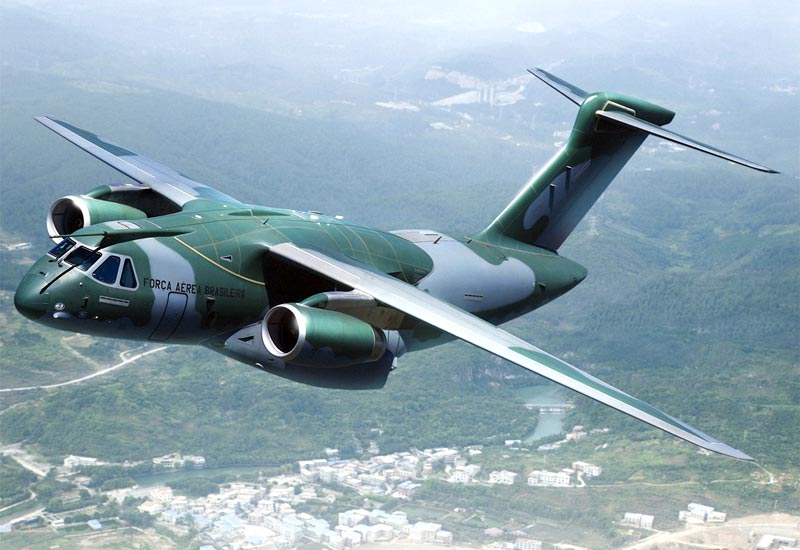
The C-390 is a twin-engine, high-wing transport. Its configuration follows a conventional arrangement as found the Lockheed C-130 and the up-and-coming Airbus A400M "Grizzly" (among others) though its powerplant scheme of 2 x IAE V2500-E5 turbofan jet engines make it a more powerful hauling platform. Each engine is rated at up to 29,000lb of thrust which provides a maximum speed of 850kmh with a service ceiling of 36,000 feet. Range reaches out to 3,250 nautical miles - roughly the southern tip of Argentina to the southern edge of Canada (ferry range). Its transport functionality dictates two design qualities - high-mounted engines to clear ground activity and a rear-mounted cargo bay with raised empennage giving unfettered access to the cargo hold. The cargo compartment measures 17.75 meters long with a 3.45 meter width and 2.9 meter height, allowing it to move 84 medical litters (complete with staff), 84 passengers (with special seating installed), 64 paratroopers (with full mission gear in tow) and military vehicles such as HMMWV ("Humvees"). At least 2 such vehicles fit in the provided hold. The internal arrangement is designed from the outset to be modular so as to carry tons of cargo pallets in place of human occupants. The minimum operating crew for the aircraft is two pilots and a flight engineer.
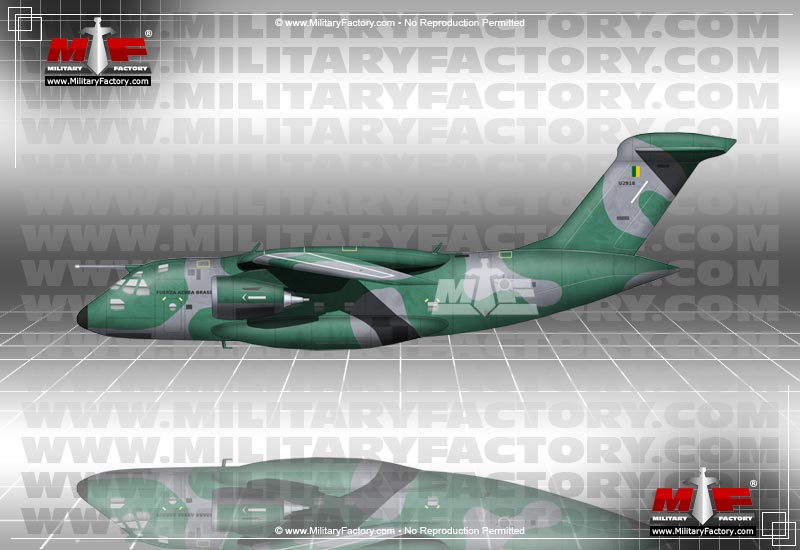
The cockpit is set well-ahead in the fuselage with good views over the nose and to each engine nacelle (the nose assembly purposefully designed as short and sloped downwards). Wings are noticeably swept back while the tail unit comprises a conventional "T" arrangement with high-mounted horizontal planes. The cockpit sports a dual-HUD configuration with dual-control systems for both pilots. A real-time digital mission system is integrated into the C-390's function as is a GPS navigation fit. Flight controls are assisted by a digital Fly-by-Wire (FbW) system.
In April of 2009, Embraer was given $1.5 billion dollars to construct two working prototypes to which the first is scheduled for completeness in 2014. The Brazilian Air Force is, naturally, the launch customer of this aircraft with an initial order of 28 aircraft announced in July of 2010. In June of 2012, it was further announced that Boeing had teamed with Embraer to assist in further development of the platform which signifies a possible partnership in the selling of the C-390 at the global level. At any rate, the partnership certainly broadens the marketing appeal of the aircraft to a high degree and will speed up overall development through Boeing expertise. In turn, Boeing will strengthen its reach in the growing Brazilian/South American market (having opened a local office in Sao Paulo in 2011) and has an obvious desire to sell its F/A-18E/F 'Super Hornets' to the Brazilian Air Force to fulfill its "F-2X" fighter competition requirement calling for a modern fighter. Beyond the obvious American involvement, the C-390 incorporates components through a plethora of outside vendors originating from Argentina, Czech Republic, France, and Israel. Other key American contributors listed include L-3 Communications and Rockwell Collins.
For interested military parties, the C-390 is intended to serve as a primary medium-class hauler though it will also be available in an in-flight refueling tanker variant configuration. Additionally, the C-390 design incorporates features that allow itself to be refueled in mid-air, making its operational endurance rather impressive. The C-390 is intended to go beyond use as a military transport as plans have been laid for a civilian-minded cargo-hauler. This hauler will be a "stretched" fuselage version of the military form with a side-mounted loading door.
To date, possible names mentioned in the procurement of the new aircraft have included Argentina, Brazil, Chile, France, Portugal and Sweden. France has made it clear that it will purchase the C-390 in number if their Dassault 'Rafale' multirole fighter is selected for the aforementioned F-2X fighter competition. The U.S. government, however, has already cleared technical assistance for Brazil which undoubtedly gives Boeing an edge. As such, politics certainly plays a role in such matters. If the C-390 program comes to fruition, it will certainly threaten the C-130's hold on the global stage. However, it will face stiff competition from upcoming designs such as the Airbus A400M "Atlas", which - despite its setbacks - has finally entered limited delivery to its various local and global customers.
In 2012, there were a total of 120 KC-390s are on order for the Brazilian military while 36 of these will be involved in an initial production batch.
February 2015 - On February 3rd, 2015, a KC-390 aircraft completed its first flight. Series introduction is scheduled for sometime in 2016 (as of February 2015). The Brazilian Air Force has 28 total KC-390 units on order as well as two prototypes. A further 60 aircraft have been added through orders from Argentina, Colombia, Chile, Czech Republic, and Portugal.
July 2015 - It was announced that deliveries of the KC-390 to the Brazilian Air Force wold be delayed from 2016 to 2018 citing limited defense funding. Certification is now expected for sometime in 2017.
In March of 2016 it was announced that Embraer was readying the second KC-390 vehicle for its testing phase. Military mission tests regarding this unit will follow.
November 2016 - Brazilian military authorities have given Embraer type certification for its KC-390 transport aircraft. IOC (Initial Operational Capability) is scheduled for late 2017. Deliveries are set for 2018.
March 2017 - The KC-390 completed a dry run with its refueling drogues in place and extended. A Northrop F-5 of the Brazilian Air Force served in the test and accepted the drogue.
October 2017 - One of the KC-390 prototypes went on to experience a sudden loss of altitude during a scheduled stall test. This led to a grounding of prototype PT-ZNF (Aircraft 001).
November 2017 - The KC-390 has been flown to the United States to begin its flight testing phase. This will take place in the skies above Jacksonville, Florida. Deliveries to the Brazilian Air Force are still on pace for 2018.
January 2018 - Portugal-based SkyTech has signed a Letter-of-Intent for six KC-390 aircraft.
March 2018 - The KC-390 is continuing its testing phase. A set back in October 2017 grounded one of the two prototypes in existence. This example has since returned to the test program.
March 2018 - The KC-390 series remains on schedule for service entry to occur during mid-2018.
July 2018 - Embraer has moved closer to securing a KC-390 deal with Portugal. Portugal stands as the first export customer of the promising KC-390 product of Brazil. Five airframes are in focus with an option for a sixth specimen. Deliveries would begin in 2021.
July 2018 - On July 31st, Embraer announced that first-deliveries of its KC-390 tanker to the Brazilian Air Force would be delayed by up to six months. First production-quality models would not become available until early 2019.
October 2018 - The first production-quality KC-390 aircraft achieved its first-flight on October 9th, 2018 over Gaviao Peixoto, Brazil. This example will eventually be delivered to the Brazilian Air Force.
October 2018 - A third KC-390 example has completed its first-flight. This example marks a series-production model.
October 2018 - The KC-390 has received local Brazilian civilian airspace type certification.
February 2019 - Boeing and Embraer have expanded their sales support base for the KC-390 project, now in no fewer than five nations globally.
April 2019 - Production efforts for the KC-390 have begun to gain steam as the product heads towards military certification.
June 2019 - Initial deliveries of KC-390 units to the Brazilian Air Force will come sometime in 2019, a delay from the original 2018 goal.
July 2019 - Portugal has formally signed a contract to purchase five examples of the Brazilian KC-390 transport aircraft. First deliveries are slated for February 2023 and will continue into February of 2027, bringing about a highly-capable, modern element to the Portuguese air service. By this action, Portugal becomes the KC-390's first official export customer.
August 2019 - Elbit of Israel has been tapped to supply the KC-390 program with its integrated Electronic Warfare (EW) suite.
November 2019 - Boeing and Embraer have rebranded their KC-390 product as the C-390 'Millennium'.
December 2019 - The KC-390 has successfully completed low-speed heavy cargo drops in testing.
June 2020 - With Boeing's sudden departure from its Embraer partnership, the Brazilian aero-company will look to new supporters in its task of bringing the C-390 to a wider global market. China and India remain at the forefront for such an arrangement.
August 2020 - The Portuguese Air Force has approved the KC-390 during its preliminary design review process. Five are on order for the country.
November 2020 - Hungary has signed a deal with Embraer to procure a pair of KC-390 transports.
February 2021 - A Brazilian Air Force KC-390 example is in Alaska to undergo Cold Weather Testing.
April 2021 - The Brazilian Air Force has cleared the KC-390 type to refuel other KC-390 aircraft inflight.
August 2021 - The KC-390 has begun short-field / rough-field testing by Embraer.
November 2021 - In a blow to the promising KC-390 program, the Brazilian Air Force has announced it will be cutting its KC-390 procurement plans from 28 airframes to 15 - prompting Embraer to threaten legal action against the service.
June 2022 - The Netherlands has selected the KC-390 to succeed its aging fleet of C-130 Hercules tactical airlifters.
September 2022 - Embraer will be teaming up with L3Harris to propose a jet-powered tactical-level aerial tanker to the United States Air Force based on the KC-390 airframe.
October 2022 - The Brazilian Air Force has announced that it will be reducing its planned acquisition of KC-390s to nineteen airframes.
April 2023 - It was announced that the C-390 has reached Full Operational Capability (FOC) with host-nation Brazil.
September 2023 - Austria has selected the KC-390 as its next tactical-level transport.
Power & Performance Those special qualities that separate one aircraft design from another. Performance specifications presented assume optimal operating conditions for the Embraer C-390 Medium-Lift Twin-Engine Tactical Military Transport Aircraft.
2 x International Aero Engines (IAE) V2500-E5 non-afterburning turbofan engines developing 29,000 lb of thrust each. Propulsion
615 mph 990 kph | 535 kts Max Speed
36,089 ft 11,000 m | 7 miles Service Ceiling
3,616 miles 5,820 km | 3,143 nm Operational Range
Structure The nose-to-tail, wingtip-to-wingtip physical qualities of the Embraer C-390 Medium-Lift Twin-Engine Tactical Military Transport Aircraft.
3 (MANNED) Crew
111.3 ft 33.91 m O/A Length
115.0 ft (35.06 m) O/A Width
33.7 ft (10.26 m) O/A Height
191,802 lb (87,000 kg) MTOW
Armament Available supported armament and special-mission equipment featured in the design of the Embraer C-390 Millennium (KC-390) Medium-Lift Twin-Engine Tactical Military Transport Aircraft .
None. Hold reserved for cargo - 64 paratroopers, 84 passengers or medical litters, cargo pallets or 2-3 HMMWV-class military vehicles.
Variants Notable series variants as part of the Embraer C-390 Millennium (KC-390) family line.
C-390 'Millennium' - Base Series Designation.
KC-390 - Original Series Designation.
PT-ZNF (Aircraft 001) - Initial flyable prototype.
Operators Global customers who have evaluated and/or operated the Embraer C-390 Millennium (KC-390). Nations are displayed by flag, each linked to their respective national aircraft listing.
Total Production: 10 Units Contractor(s): Embraer Defense and Security - Brazil
[ Argentina (possible); Australia (possible); Austria (selected); Brazil; Chile (possible); Colombia (possible); Czech Republic (possible); Hungary; Netherlands (announced); Portugal; South Korea (committed) ]
1 / 2
Image from official Embraer marketing material.
2 / 2
Image copyright www.MilitaryFactory.com; No Reproduction Permitted.
Going Further... The Embraer C-390 Millennium (KC-390) Medium-Lift Twin-Engine Tactical Military Transport Aircraft appears in the following collections:
The "Military Factory" name and MilitaryFactory.com logo are registered ® U.S. trademarks protected by all applicable domestic and international intellectual property laws. All written content, illustrations, and photography are unique to this website (unless where indicated) and not for reuse/reproduction in any form. Material presented throughout this website is for historical and entertainment value only and should not to be construed as usable for hardware restoration, maintenance, or general operation. We do not sell any of the items showcased on this site. Please direct all other inquiries to militaryfactory AT gmail.com. No A.I. was used in the generation of this content.