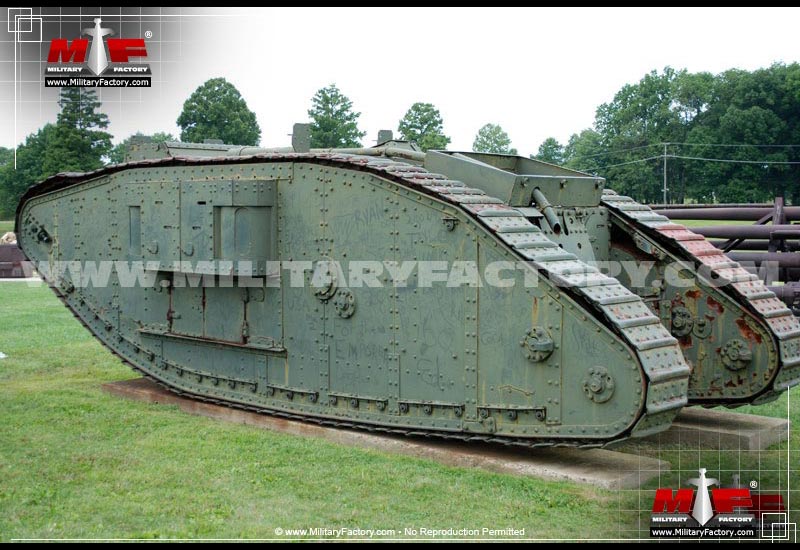
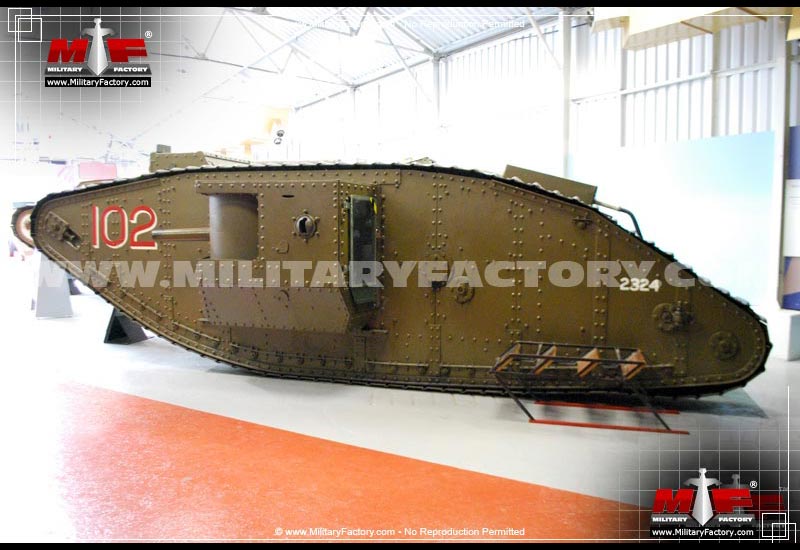
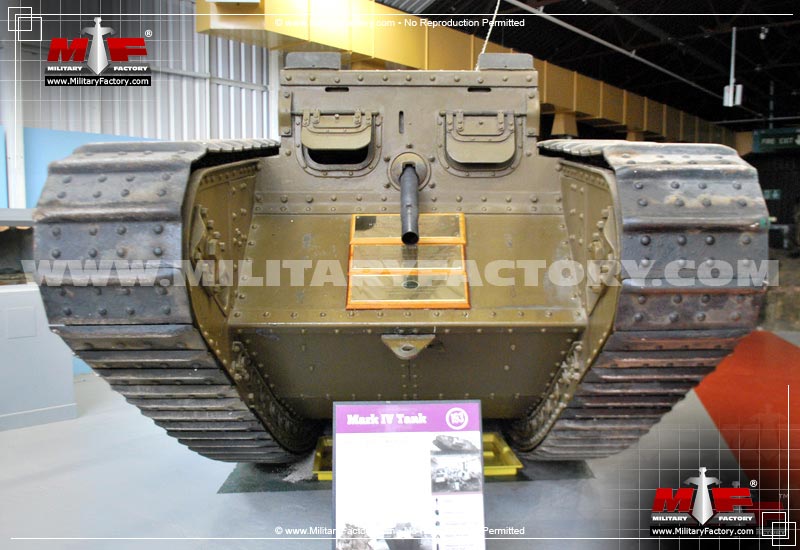
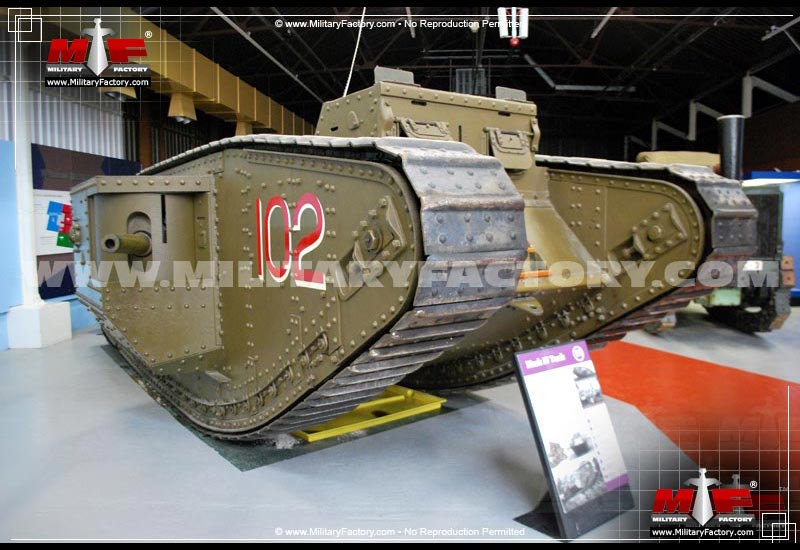
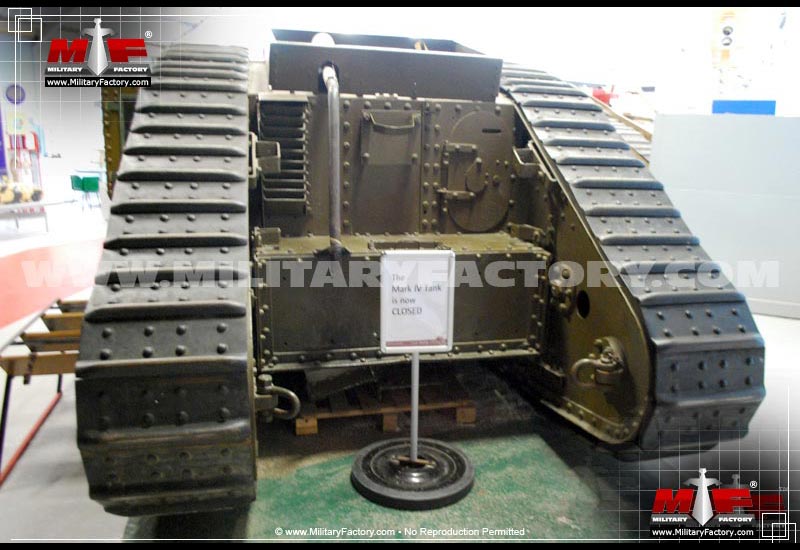
"The Tank Mk IV was a further development of the groundbreaking Mk I design and appeared in large numbers by the end of World War 1."
Power & Performance Those special qualities that separate one land system design from another. Performance specifications presented assume optimal operating conditions for the Tank Mk IV Heavy Tank / Armored Fighting Vehicle (AFV).
1 x Daimler gasoline-fueled engine developing 105 to 125 horsepower driving a conventional track-and-wheel arrangement. Installed Power
4 mph 6 kph Road Speed
35 miles 56 km Range
Structure The physical qualities of the Tank Mk IV Heavy Tank / Armored Fighting Vehicle (AFV).
8 (MANNED) Crew
26.4 ft 8.05 meters O/A Length
12.8 ft 3.91 meters O/A Width
8.2 ft 2.49 meters O/A Height
56,000 lb 25,401 kg | 28.0 tons Weight
Armament & Ammunition Available supported armament, ammunition, and special-mission equipment featured in the design of the Tank Mk IV Heavy Tank / Armored Fighting Vehicle (AFV).
MALE:
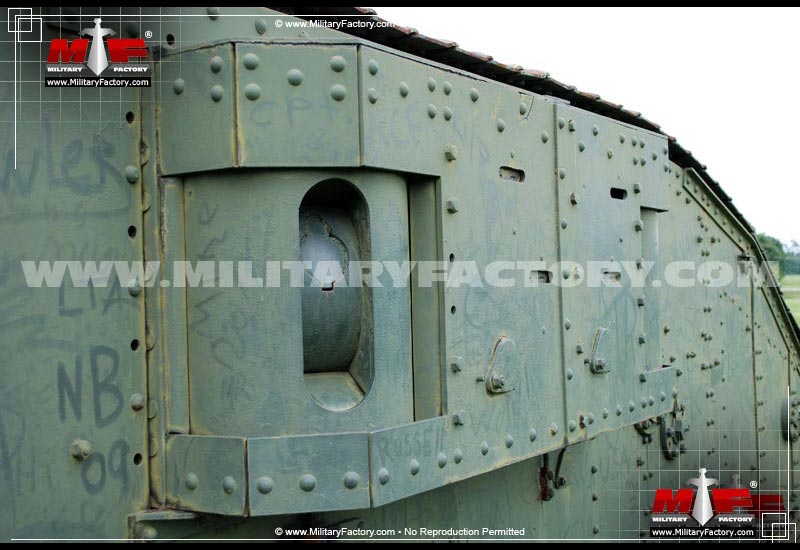
2 x 57mm (6-pdr) guns in side sponsons.
4 x 7.7mm Lewis machine guns on flexible mounts.
FEMALE:
5 x 7.7mm Lewis machine guns on flexible mounts.
AMMUNITION: 184 x 57mm projectiles.
Variants Notable series variants as part of the Tank Mk IV family line.
Tank Mk I - Initial Production Variant Designation; Male and Female versions.
Tank Mk II - Male and Female versions
Tank Mk III - Increased armor thickness; Male and Female versions.
Tank Mk IV (Male) - Shorter 6-pdr gun length; decreased size of side sponsons for easier transport; unditching beam framework implemented; internal reworkings as needed.
Tank Mk IV (Female) - Sans 6-pdr guns; 6 x machine guns for anti-infantry support.
Tank Mk IV (Hermaphrodrite) - 1 x 6-pdr gun in one sponson and 2 x machine guns in other sponson.
Tank Mk IV "Tank Tender" - Battlefield Supply Vehicle
Tank Mk IV Tadpole - Lengthened hull design for improved trench crossing.
Tank Mk IV Fascine - Trench-filling fascine carrier.
Beutepanzerwagen IV - German designation utilized for captured British versions, basically meaning "captured armored vehicle" of the fourth mark.
It was the British Navy - under Winston Churchill, First Lord of the Admiralty - that pushed the "tank" into existence (then known as "landships"). Development of the prototype "Little Willie" tracked armored vehicle gave way to the production level Tank Mk I ("Big Willie") to which 150 of the type were produced and used in the first recorded tank actions of World War 1 in September of 1916. The type brought about limited success for it was prone to breakdowns, vulnerable to artillery fire and managed a snail's pace of roughly 3 to 4 miles per hour - and the latter only on ideal surfaces. Conversely, the vehicle was armed with a pair of cannon, led her crew in relatively safety from small arms fire and could cross trenches of approximately 9 feet across. Its initial use came as a nasty shock to the Germans which allowed the British to gain territory on their historical enemy through psychology alone.
Within time, the Germans developed wider trenches, anti-tank ditches, strategically placed artillery and minefields, an anti-tank rifle and armor-piercing machine gun ammunition to stop these steel beasts in their tracks. The "Tank Mk II" was developed from the Tank Mk I was a crew trainer yet even these were pressed into service, some 50 examples being completed and shipped to France. As in the Tank Mk I before it, "male" variants were the cannon-armed marks while "female" variants were machine gun-armed marks intended to protect the males on their approach. The Tank Mk II shared much with the Tank Mk I to which the "Tank Mk III" was devised as a another more advanced trainer intended to share features of the upcoming "Tank Mark IV" series. Reserved for training from the start, the Tank Mk III series never saw combat in The Great War and since development of the Tank Mk IV slow in coming, the Tank Mark IIIs were slow themselves to appear in a finalized form. As with the Tank Mk II, there were 50 Tank Mk IIIs produced.
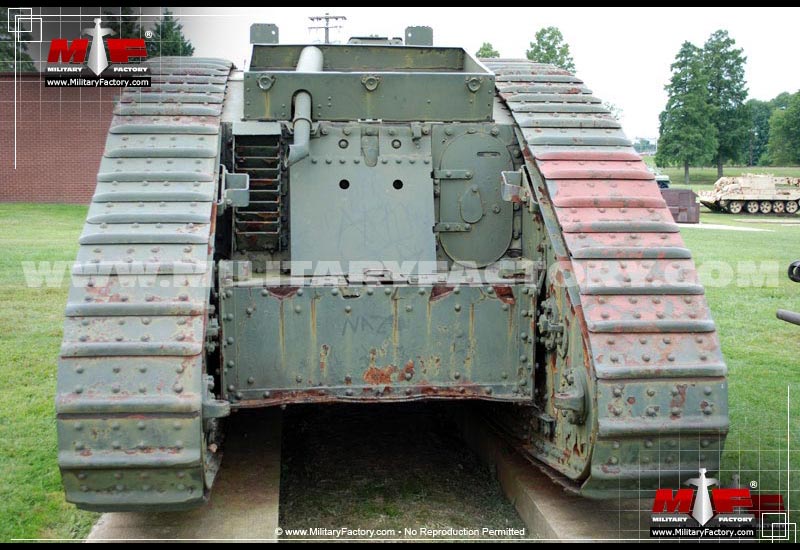
The Tank Mk IV was intended as a much-improved version of the original Tank Mk I. Armor protection was specifically addressed for the Germans managed weaponry that could now pierce the outlying armor plate of the Mk Is and Mk IIs. The Mk I also fielded long-barreled versions of the QF 6-pounder field gun and these were prone to getting grounded in earthen mounds that were common to the crater-marked battlefields of World War 1. As such, the Tank Mk IV was given short-barreled versions of these same QF 6-pounder guns. The gasoline-fueled nature of the earlier marks also meant that a direct hit to the fuel stores could ignite an internal fire. The Tank Mk IV, therefore, had her fuel supply set upon an external tank mounted on the rear of the hull, segregated from the crew compartment. Many early landships were also prone to becoming stuck when attempting to cross an opening wider than the length of track and thusly became "ditched" as a result. An anti-ditching beam was installed on the Tank Mk IV to help the landship "unditch" itself. With their fixed sponsons, the Tank Mk I and Mk II series were wide vehicles to transport cross-country on rail - the fastest mechanical transport system of the time. As such, engineers devised "collapsing" sponsons for the Tank Mk IV that allowed for a slimmer frontal profile.
The changes to the British tank line were promising enough that the British Army adopted the Tank IV and production began in earnest in May of 1917. As with the previous marks, there would be two distinct versions of this tank in play - a cannon-armed male and a machine gun-armed female. The designs would still mimic much of what was learned in production and operation of the previous marks - the rhomboid shape with its long running track systems straddling the hull structure and a crew of eight to manage her various stations (four alone to work the steering and braking system). Armament for the males included 2 x QF 6-pounder cannons with 3 x .303 machine guns while females managed 5 x .303 Lewis machine guns. A typical male carried 180 x high-explosive projectiles. Power was derived from a 105- or 125-horsepower Daimler gasoline engine. Foresight on the part of the British Army also saw to it that hundreds of the new tank type would be on hand in an effort to end the trench warfare stalemate and drive the Germans back into Germany.
1,220 Tank Mk IVs were ultimately completed and, of these, 420 were of the male type while 595 were of the female variety. An additional 205 specialist vehicles were completed as "Tank Tenders" which were gun-less supply vehicles. The Tank Mk IV went on to become the primary British tank of World War 1. Other specialist variants included a "hermaphrodite" breed with 1 x 6-pounder cannon in one sponson and 2 x 7.7mm machine guns in the other. The "Tadpole" was a longer-hull Mk IV intended to cross wider trench openings. The "Fascine" variant was developed to lay down its own trench-filling fascine supply and cross over with little issue. Production of Mk IV tanks was spread across Metropolitan Carriage & Motor Company, Fosters of Lincoln, Armstrong-Whitworth, Coventry Ordnance Works, William Beardmore & Company and Mirrlees, Watson & Company.
Tanker conditions inside these vehicles were simply awful. The engine sat in the open at the middle of the hull, offering the mechanic unfettered access but filling the fighting compartment with deadly fumes and noise that restricted communication to hand signals and pats. The air was stagnant and filled with industrial grease and burning fuel while overall dimensions made for were extremely tight workspaces. The unsuspended nature of the tracks meant that occupants could be violently thrown about over rough terrain. Outward vision was accomplished through simple horizontal ports and gunners at the sponsons needed to utilize several such openings to track targets. The driver's peripheral vision was not only limited by these ports but also by the "horns" formed at either hull side from the track systems. The guns themselves offered only limited side-to-side traversal and elevation for they were intended to engage targets below the tank in a trench or at equal level with the tank. As was the case with the previous landship marks, mechanical difficulties were abundant and led to more losses than to enemy fire. Artillery still remained the largest tank-killer of such vehicles in a war context it was highly common for these heavy landships to become bogged in soft ground or uneven terrain.
Regardless, such vehicles were the best of their type at this point in the war anywhere in the world. The British designs were generally more favorable for the battlefield environment when compared to the early French offerings and it was only the Renault FT-17 Light Tank with its rotating turret that eventually gave the French a useful offering. In any case, much of the middle-to-late ground war progress could be attributed to the contributions of these early Allied tank designs, particularly when they were fielded in the hundreds at once alongside infantry and in conjunction with artillery and air power.
The Tank Mk IV was featured in the June 1917 Messines Ridge battle, a decisive Allied victory in Flanders, Belgium. Tanks were preceded by a massive artillery barrage intended to soften enemy positions and the attack proved a success with the strategic ridge in allied hands by June 14th. Tank Mk IVs were assisted by the rather dry, compact terrain in which they actually outpaced their accompanying infantryman; in actions prior, infantry had the opposite problem of outpacing their armored support. Conversely, it was soft terrain at the Battle of Passchendaele (Third Battle of Ypres) that limited the tactical value of the Tank Mk IVs present there. The battle began on July 31st, 1917 and engagements ran until November of that year in which the Allies gained a hard-fought victory.
On November 20th of that year, some 432 (some sources claim 476) tanks were in play during the Battle of Cambrai including Mk IV types. By this time, the Mk I and Mk II types had been converted to gun-less carriers. The Mk IV tanks were used along a front some 12 miles wide and 4 miles deep at the critical Hindenburg Line near Cambrai, France. Initial progress was good and the tanks were preceded by a large artillery barrage in normal operational fashion utilizing a "creeping" technique, shells landing just ahead of the armored force. The Allies managed to dislodge the Germans though armor was slowed by accompanying infantry which were charged with clearing out each collapsing pocket of enemies trench by trench. German counterattacks were repelled thanks largely in part to the presence of British tanks but, in major areas, the German defense held firm. As such, the offensive bogged down and the Germans eventually countered to regain the resulting salient and ultimately repaired their broken lines. The battle ran until December 8th and ultimately ended in a stalemate. Of the 476 tanks committed to battle in the offensive, 179 were lost including 65 to direct enemy fire and 114 to either terrain issues or mechanical breakdown. Perhaps the most important facet of the battle was in the lead role that the tanks played - no longer were they considered "support" units.
It was the Tank Mk IV that formed one half of the first-ever tank-versus-tank duel in the history of modern warfare, this occurring at the Second Battle of Villers-Bretonneux on April 24th, 1918. Three British Tank Mk IVs squared off against three of the gangly and cumbersome German Sturmpanzerwagen A7V armored fighting vehicles. The engagement was rather anti-climactic and more or less a "draw" in the context of battle. Some 15 German A7V vehicles were involved in an initial assault on Allied positions at Bois d'Auenne, Villers-Bretonneux and Cachy in an attempt to reach Amiens. Three such vehicles then committed to engaging Allied infantrymen at Villers-Bretonneux where they were met by three British Tank Mk IVs sent up to fortify the position. One Mk IV was a cannon-armed male while the remaining two were machine gun-armed females. Distance between the two parties was approximately 400 yards. Both sides began trading shots with the Germans opening fire first. One A7V was squarely hit and was only knocked out of action when its drivers rolled the vehicle over in the heat of battle. The two Allied female Mk IVs were damaged and forced to flee. Two other German A7Vs were then damaged but remained viable, engaging the last Mk IV. The second A7V was eventually abandoned by her crew, either to damage or mechanical breakdown which forced the third A7V to flee. This left the sole remaining Mk IV as something of the "victor" of the fight - such ended the first "tank-versus-tank" duel.
The German's tank program never produced much beyond the aforementioned A7V and these were more armored mobile "bunkers" thank true fighting machines of value. Ponderous and slow, they managed only moderate successes if used in the right tactical situation but they fielded thicker armor at 30mm versus the 12mm found on the British Tank Mk IV. German A7Vs were also armed with a German-equivalent 57mm cannon though all systems (steering, braking, mechanics, gunnery and machine guns) required the services of 18 personnel. As such, production of the type was limited to just 20 vehicle's by war's end. The German Army therefore made use of abandoned or broken down Mk IV in some number as the war progressed. At least 40 Mk IVs were re-used in this fashion and were known in the German inventory as Beutepanzerwagen IV ("Captured Armored Vehicle of the 4th Mark", essentially meaning "loot" or "war booty"). Some were given German cannon in place of their British versions and managed by an increased crew of 12 persons. Many of these began operational service after December of 1917 to which the German Army could manage four full tank companies.
Operators Global customers who have evaluated and/or operated the Tank Mk IV. Nations are displayed by flag, each linked to their respective national land systems listing.
Total Production: 1,220 Units Contractor(s): Metropolitan / Fosters / Armstrong-Whitworth / Coventry / William Beardmore / Mirrlees - UK
[ German Empire (captured); Kingdom of Italy; United Kingdom ]
1 / 10
Image copyright www.MilitaryFactory.com; No Reproduction Permitted.
2 / 10
Image copyright www.MilitaryFactory.com; No Reproduction Permitted.
3 / 10
Image copyright www.MilitaryFactory.com; No Reproduction Permitted.
4 / 10
Image copyright www.MilitaryFactory.com; No Reproduction Permitted.
5 / 10
Image copyright www.MilitaryFactory.com; No Reproduction Permitted.
6 / 10
Image copyright www.MilitaryFactory.com; No Reproduction Permitted.
7 / 10
Image copyright www.MilitaryFactory.com; No Reproduction Permitted.
8 / 10
Image copyright www.MilitaryFactory.com; No Reproduction Permitted.
9 / 10
Image copyright www.MilitaryFactory.com; No Reproduction Permitted.
10 / 10
Image copyright www.MilitaryFactory.com; No Reproduction Permitted.
The "Military Factory" name and MilitaryFactory.com logo are registered ® U.S. trademarks protected by all applicable domestic and international intellectual property laws. All written content, illustrations, and photography are unique to this website (unless where indicated) and not for reuse/reproduction in any form. Material presented throughout this website is for historical and entertainment value only and should not to be construed as usable for hardware restoration, maintenance, or general operation. We do not sell any of the items showcased on this site. Please direct all other inquiries to militaryfactory AT gmail.com. No A.I. was used in the generation of this content.