Military Factory
Military Pay Chart
Global Firepower
Military Industrial Complex
Second World War
Home
Military Pay Scale
Military Ranks
Small Arms
Aircraft
Land Systems
Navy
Education
Military Factory Facebook Logo
flag of United States

Tank Mark VIII (International Tank / Liberty Tank) Armored Fighting Vehicle (1919)

Authored By Dan Alex | Last Updated: 7/24/2012

The Mark VIII was the first tank produced through an international collaboration - this being the United States and Britain.

Find a School Near You
Follow Military Factory on Facebook:
Trending on Military Factory:
Recent Articles:
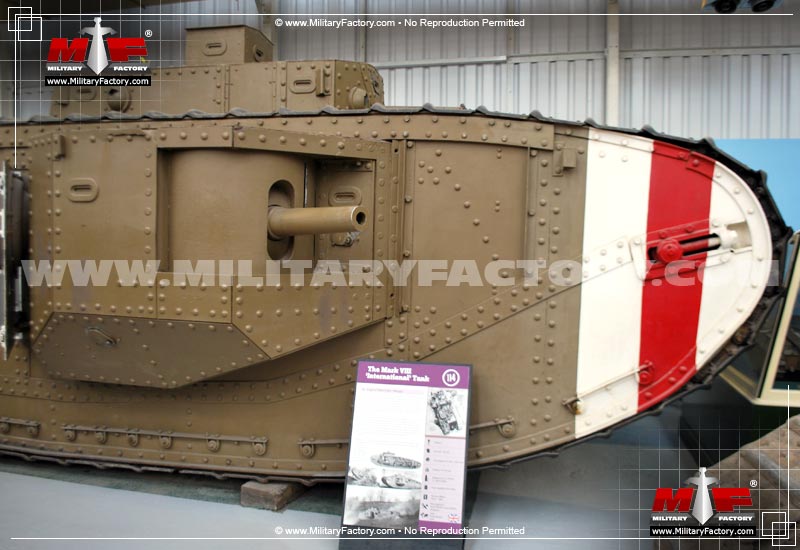
The Mark VIII "International Tank" (also "Liberty" when powered by the American Liberty engine) would become the first tank in history to be produced via an international collaborative effort - this made possible through an agreement between the United States and Great Britain with production to be undertaken in France. While the Mark VIII would prove promising, delays in its development ultimately led to the ambitious wartime production orders for several thousand examples being cancelled at the end of the conflict in November of 1918. As such, the Mark VIII was limit to just 125 production examples with most of these falling into use with the United States Army in the post-war years. The British Army remained the only other major operator of note before retired American stocks were sold to Canada for tanker training prior to World War 2 in 1940.

World War 1 began in the summer of 1914 and spanned an Eastern (Russian) and Western Front (France/Belgium). German progressed was eventually held in check in North France to which the war degraded into a stalemate of trench lines, artillery fire and massed charges that left thousands dead in single days of fighting. Warplanners looked to engineers to develop new methods of breaking this stalemate and various implements were tried including poison gas, the flamethrower, fighter and bomber aircraft, the hand grenade, portable automatic weapons and the "landship" - otherwise known today as the "tank".

The United States of America declared war on Germany on April 6th, 1917 which, on many levels, spelled the end of whatever advantages the Germans held. The fresh manpower, available in the tens of thousands, would relieve beleaguered British, French and Belgian forces and provide a much-needed shot in the arm for the war effort. In June of 1917, the US government held talks with the British government about procuring the latest available British tanks for service in the United States Marine Corps (this by way of the United States Navy). The focus initially settled on the Mk VI tank then in development, this to become the primary British tank of the war and a further evolution of the original Mk I line ("Big Willie"). At the same time, Britain was in need of manufacturing assistance and were secretly looking to America to help fulfill the demand now that they had officially entered the conflict. Though the Mk VI might have been a serviceable system in its own right, the Americans believed that they could apply their expertise in the designing of an improved and more powerful form to fall in line with American industrial capabilities of the time.

Before the US Navy could move to send its people to Britain to begin work on the new tank (to be known as the "International" tank, noting the multi-nation involvement), the American Department of War relocated the need for a new tank to the US Army. American Major H. W. Alden joined his British counterparts in London on October 3rd, 1917, and the new tank design was penciled out. Winston Churchill, then the Minister of Munitions, signed off on the design after a December 4th, 1917 meeting. The lofty production total consisting of 1,500 examples was to be met by the end of 1918 (many still assuming the war would progress into 1919). The US would be responsible for the major internal components including the transmission, engine and rear sprockets whilst the British would contribute (though not limited to) armor plating, structural supports, weapons as well as applicable ammunition. France would become the third major player in the agreement and take on orders of the tank as well as eventually provide French-based factories for localized production. In the end, the Allies would have, in their stable, a standardized tank system that could promote commonality of parts across the different armies with support through like-minded manufacturing practices should the war continue beyond 1918. So as to not endanger the future of the Mk VIII effort, all British work on the aforementioned Mk VI tank was stopped in December of 1917.

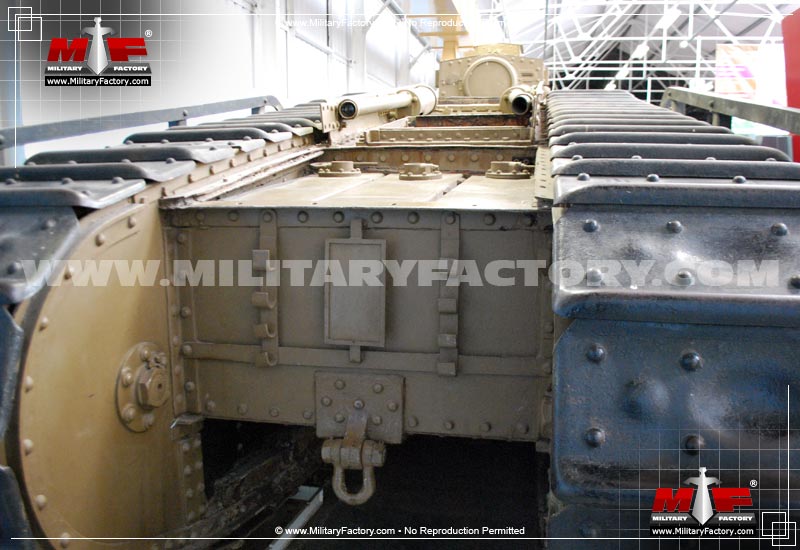
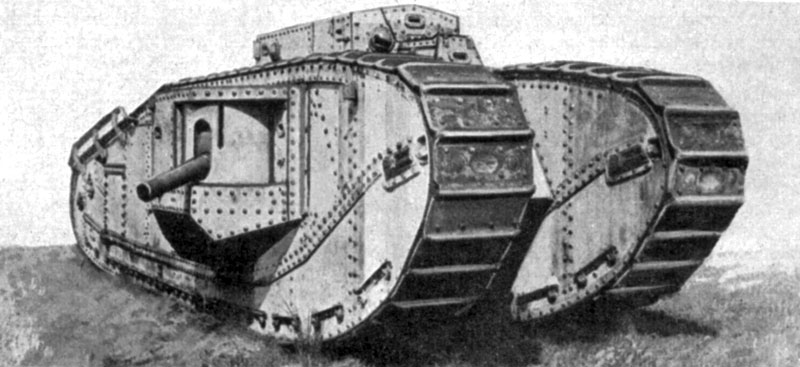
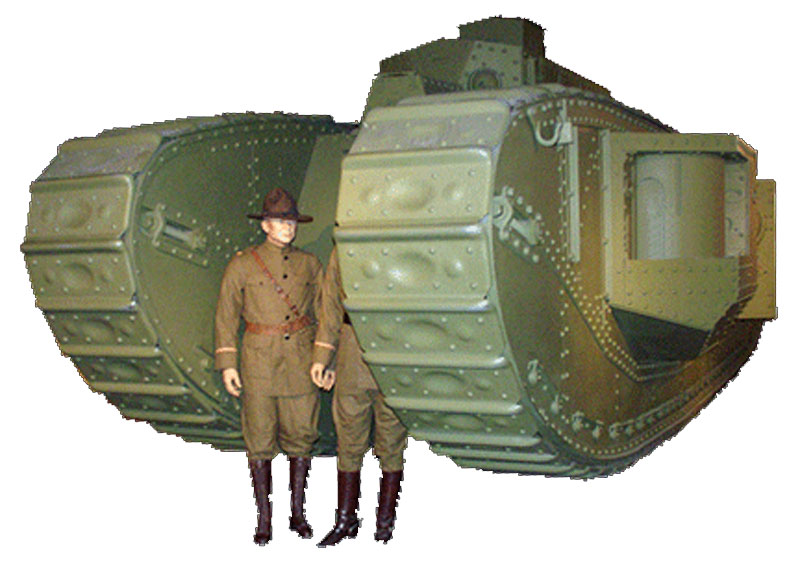
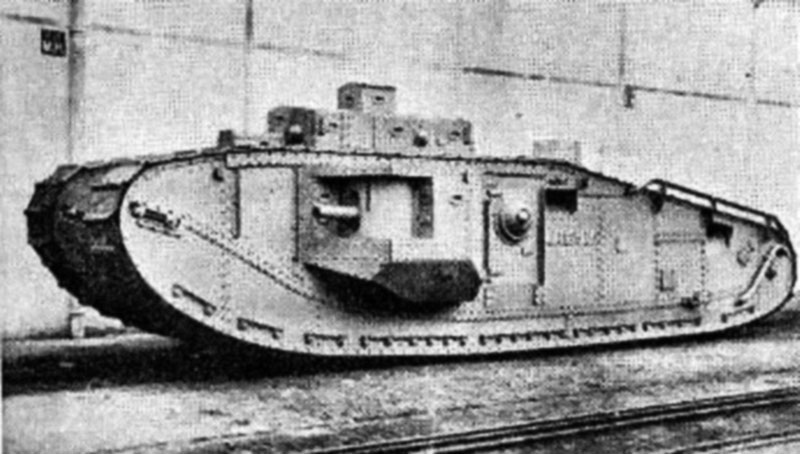
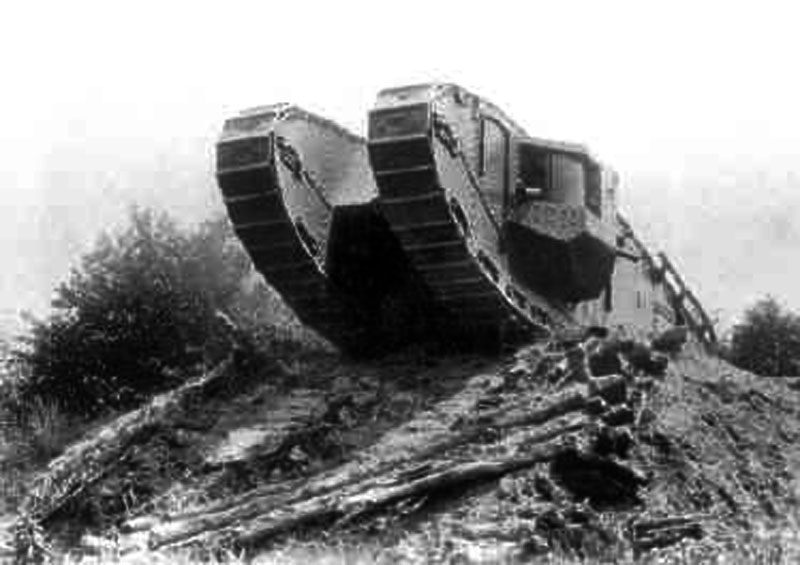
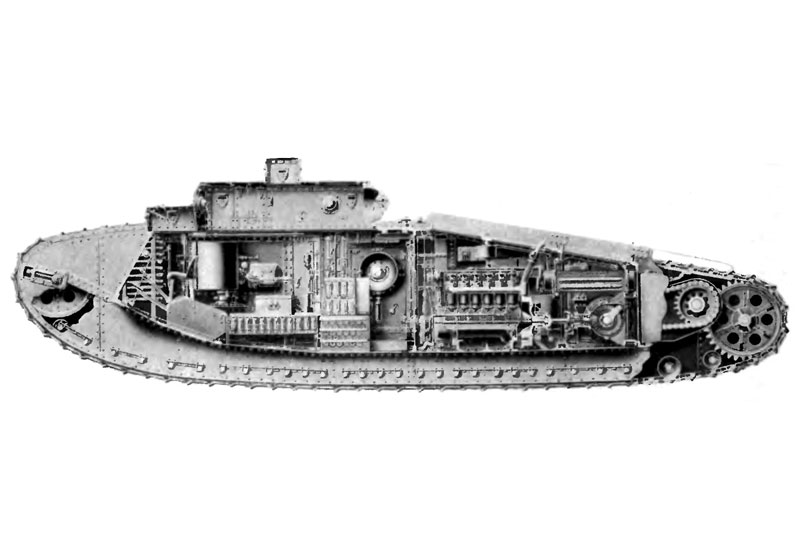
In some ways, the new Mark VIII bridged the design gap between those early lozenge-shaped tanks of the war and those shapes to come during the inter-war years. It sported a compartmentalized interior that separated the crew from the engine. The large powerplant (either a V-12 Liberty or V-12 Ricardo gasoline engine of 300 horsepower) was fitted to the rear of the hull and cut-off from the crew compartment by a bulkhead. The bulkhead served to deflate the deadly fumes and high-decibel noise coming from the engine. The engine was tied to an epicyclic gearbox allowing for two forward and two reverse speeds. The external side profile of the tank showcased a tear-drop appearance as well as long-running tracks extending past the length of the hull on either side and at either hull end. The track design served well in allowing the Mark VIII to traverse the network of trenches and craters littering the World War 1 battlefields. The suspension system was unsprung which promoted a very rough ride but simplified production. The hull was adorned with a slab-sided superstructure that allowed the tank commander a view of the action through four vision ports fitted to a cupola. The commander stood over a platform housing the supply of 57mm projectiles for the main guns. The crew was led by the tank commander with the driver situated in the forward hull and an onboard mechanic seated near the engine to the rear. A gunner and a loader manned each cannon position while machine-gunners handled the available defensive machine guns to prevent infantry attacks against the tank. A special deflection plate was affixed to the rear upper hull to assist the rear gunners in engaging enemy infantry to the vehicle's lower "six" - a defensive weak spot in any tank design. Such a detail allowed gunners to engage enemy infantry down in the trenches as the tank passed over. Armor protection was 16mm at its thickest while operational range was limited to 50 miles with a top speed of 6.5 miles per hour.

Armament centered around 2 x British 6-pounder (57mm) OQF guns mounted in the side sponsons (sponsons being structural outcroppings common to many early tanks, this before the turret became standardized throughout tank designs). These were given limited traverse but could attack enemy targets forward, to the sides and under the sides of the tank (a hull-roof-mounted turret would not have been able to contribute to the latter). The sponsons were also made to collapse inward so as to decrease the width of the tank when transported by rail. Self-defense was a bevy of British- or American-made .30 caliber machine guns as needed.

Despite the expected 1,500-strong order required by years' end, production never fully got underway. Factories built on French soil never got up to speed and other pursued avenues - both in the US and in Britain - never materialized to the point that a single tank could be outputted. The first American prototype was not even completed until September 28th, 1918. By the time the weapons were added, the war had concluded and the quantitative wartime orders were scrapped. The British prototype was made ready on the armistice itself, this being November 11th, 1918.

Despite their own 1,500-strong order, only 5 British Mk VIII tanks were delivered for army service and these were relegated to training only. Construction was completed on some 24 more examples (made possible by way of available spare parts) though all remaining British Mk VIIIs were ultimately scrapped.

The Americans fared a better with their Mk VIII production for at least 100 systems were produced between 1919 and 1920, ultimately supplying the 67th Infantry (Tank) Regiment. These tanks survived up to about 1932 to which they then ended up in Army storage facilities. At the outbreak of World War 2, the Canadians were in dire need of tanks for training and purchased the remaining Mk VIIIs on the cheap. Such ended the legacy of the Mark VIII "International Tank".

The US 301st Tank Battalion (Heavy) - later becoming the 17th Tank Battalion (Heavy) - made use of the tank. From 1921 to 1922, Major Dwight D. Eisenhower - of World War 2 fame - was put in charge of the unit as commander. Only a few Mk VIIIs exist today as exhibit pieces on both US and British soil. One example is on display at the Aberdeen Proving Ground in Aberdeen, Maryland.

The Mark VIII* (Star) was a proposed lengthened version of the Mark VIII, intended to provide better trench crossing support. The project came to naught never went past the design stage.

The "Beast" appearing in the motion picture "Indiana Jones and the Last Crusade" was actually based on the design of the Mark VIII with the most notable exception in the movie being the addition of a traversable turret in place of the superstructure.
Text ©2003-2013 www.MilitaryFactory.com • All Rights Reserved • No Reproduction Permitted
MilitaryFactory.com does NOT sell equipment/weaponry. Material presented throughout this website is for historical and entertainment value and should not to be construed as usable for hardware restoration, maintenance or general operation. Please consult manufacturers for such information. Our disclaimer. Email corrections / Comments to MilitaryFactory at Gmail dot com.
Picture of Tank Mark VIII (International Tank / Liberty Tank)
Pic of the Tank Mark VIII (International Tank / Liberty Tank)
Image of the Tank Mark VIII (International Tank / Liberty Tank)
View All Images (5)

Specifications for the
Tank Mark VIII (International Tank / Liberty Tank)
Armored Fighting Vehicle


Country of Origin: United States
Manufacturer: Rock Island Arsenal - USA / North British Locomotive Company - UK
Initial Year of Service: 1919
Production: 125


Focus Model: Tank Mark VIII (International Tank / Liberty Tank)
Crew: 11


Overall Length: 34.12ft (10.40m)
Width: 12.50ft (3.81m)
Height: 10.24ft (3.12m)
Weight: 41.4 US Short Tons (37,592kg; 82,876lbs)


Powerplant: 1 x Ricardo OR Liberty 12-cylinder gasoline engine developing 300 horsepower.


Maximum Speed: 6mph (10 km/h)
Maximum Range: 50 miles (80 km)


NBC Protection: None
Nightvision: None


Armament:
PRIMARY:
2 x 6-pdr (57mm) OQF cannons in side sponsons

SECONDARY:
7 x 7.92mm Hotchkiss machine guns OR 5 x 7.62mm Browning M1917 machine guns.


Ammunition:
208 x 57mm projectiles
13,848 x .30 caliber ammunition


Variants:
Mark VIII (International Tank / Liberty) - Base Series Designation; fitted with Ricardo or Liberty V12 engine of 300hp; 2 x 57mm main guns; up to 7 machine guns; crew of 11 or 12.


Mark VIII* (Star) - Proposed trench-crossing derivative with longer hull with specialized track system; never produced.


Operators: United Kingdom; United States; Canada

ALL LAND SYSTEMS CATEGORIES

By Decade:


1910 to 1919
1920 to 1929
1930 to 1939
1940 to 1949
1950 to 1959
1960 to 1969
1970 to 1979
1980 to 1989
1990 to 1999
2000 to 2009
2010 to 2019
VIEW ALL
Compare Tanks


By Type:


4x4 Military Vehicles
6x6 Military Vehicles
8x8 Military Vehicles
Artillery Gun Systems
Anti-Aircraft (AA) Guns
Anti-Aircraft (AA) Vehicles
Anti-Tank (AT) Guns
Anti-Tank (AT) Vehicles
Armored Cars
Armored Personnel Carriers (APC)
Battlefield Robots
Halftrack Vehicles
Heavy Tanks
Infantry Fighting Vehicles (IFV)
Light Tanks
Main Battle Tanks (MBT)
Modern Combat Tanks
Medium Tanks
Military Motorcycles
Multiple Launch Rocket Systems (MLRS)
Reconnaissance Vehicles
Special Purpose Vehicles
Self-Propelled Guns (SPG)
Tank Destroyers
General Purpose / Utility Vehicles


By Nation:


Afghanistan
Britain
China
France
Germany
Iran
Iraq
Israel / Israeli Army
Italy
Libyan Army
North Korea / North Korean Army
Pakistan
Russia
South Korea
Soviet Union
Syrian Army
United States
VIEW ALL

World War 2:


Artillery
Infantry Fighting Vehicles
Tank Destroyers (All)
Tanks (All)
Australian Tanks
British Tanks
Canadian Tanks
Cruiser Tanks (UK)
Czechoslovakian Tanks
French Tanks
German Tanks
German Tank Destroyers
German FlaK Guns
German Reconnaissance Vehicles
Hungarian Tanks
Italian Tanks
Japanese Tanks
Romanian Tanks
Soviet Tanks
Swedish Tanks
US Tanks
VIEW ALL


World War 1:


France WW1 Tanks
Germany WW1 Tanks
Britain WW1 Tanks
US WW1 Tanks
WW1 Artillery
WW1 Tanks (all)
VIEW ALL


Spanish Civil War:

VIEW ALL


Korean War:

Tanks
VIEW ALL


Vietnam War:

VIEW ALL


Cold War:

Cold War Tanks
Cold War American Tanks
Falklands War
Post-WW2 British Tanks
VIEW ALL


Gulf War (1991):

VIEW ALL


Miscellaneous:

Armored Vehicle Chassis Types

Site Disclaimer | Privacy Policy | Site Map | MF Origins


©2013 www.MilitaryFactory.com • Content ©2003-2013 MilitaryFactory.com • All Rights Reserved • Site Contact Email: militaryfactory at gmail dot com. The "Military Factory" name and MilitaryFactory.com logo are registered ® trademarks and protected by all applicable domestic and international intellectual property laws.


Top MF Stuff: 2013 Military Pay Scale | Military Ranks | WW2 Weapons | Sniper Rifles | Kts to Mph | WW1 Aircraft | Automatic Rifles | Aircraft Cockpits | Vietnam War Weapons | Main Battle Tanks | Submachine Guns | Shotguns | French Military Victories


Most photographic images appearing on this site are courtesy of the United States Department of Defense and are approved for public use. Other images acquired through the public domain. Digital art work courtesy of Dan Alex. Business Consulting by Kyle Williams. Material presented throughout this website is for historical and entertainment value and should not to be construed as usable for hardware restoration, maintenance or general operation. Please consult manufacturers for such information.


eXTReMe Tracker