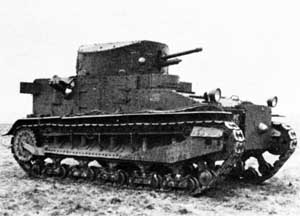
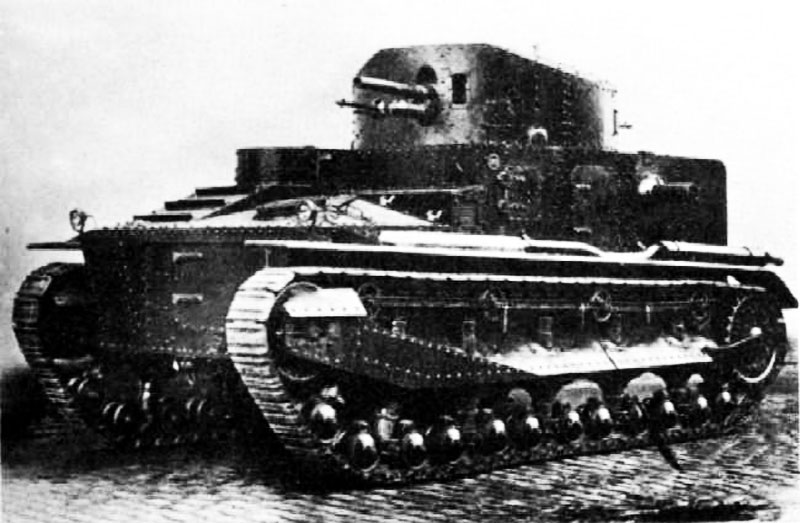
The Vickers Medium Mark I series of tanks was one of the few mass-produced tank systems to be found in the 1920s. With a war-weary world cutting back much in the way of military production, the Medium Mark I managed a relatively healthy existence to lead the British Army into a new age of mechanized warfare. Though never to see combat service at any level, the type served the British well in defining key tank design features and in-the-field mechanized battle tactics that would become a mainstay of armored warfare leading up to World War 2.
After World War 1, British authorities were content to simplify and downsize their armored corps. By 1920, a new government-funded tank design was being developed under the designation of Medium Mark D light infantry tank to bring about a more modern design. Meanwhile, the Vickers firm was concurrently working on a private-venture light armored fighting vehicle (AFV) all their own. While the Medium Mark D project eventually led to naught, the Vickers firm produced two working prototype versions - a machine gun-laden "female" and a cannon-armed "male" - by the end of 1921 known collectively as the 'Vickers Light Tank".
The Vickers Light Tank proved too unique for its time (particularly its new, complicated and unreliable transmission system) and the program was soon dropped in 1922. However, progress had also been made on a more conventional alternative started in 1922 that inevitably became the "Light Tank Mark I" under the Vickers company designation of A2E1. The Light Tank Mark I was initially envisioned as a light armored fighting vehicle with exceptional speed and range for the time. Its 47mm armament was also specifically designed to handle other tanks in head-on duels as opposed to being used in support of, or alongside, advancing infantry. A three-man turret was selected to help improve communications between the tank commander and the gunner, allowing for more accurate and faster targeting and engagement. The mounting of the main armament in a rotating turret was something of a novelty up to this point as well, with many early post-war tank systems still mounting main guns in fixed superstructures or limited-traversing side sponsons. Therefore, the Light Tank Mark I was the first British tank to feature an all-around traversing turret as well as geared elevation for its main gun. Evaluation of this new system took place in 1923 and deliveries to the British Army began in 1924. That same year, the tank was reclassified as a "medium" class tank and redesignated as the "Medium Tank Mark I".
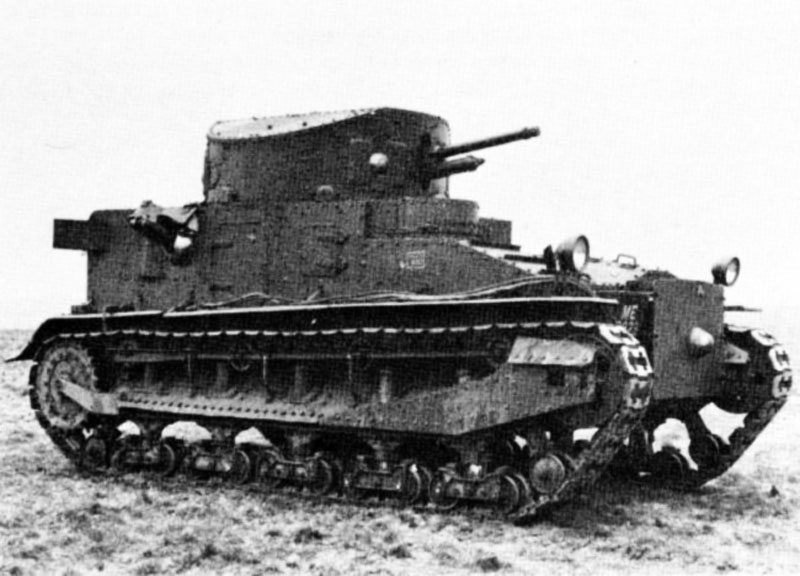
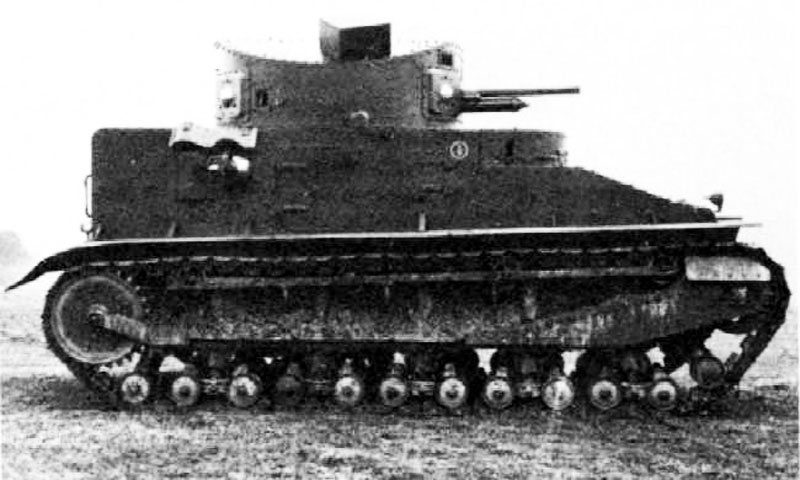
The Vickers design was a vast departure from the lozenge-shaped monsters dominating the battlefields of World War 1. Like other tanks developed at the beginning of the 1920s, the Mark I sported something of a tall side profile made up of a hull and superstructure to which was affixed a curved and oblong turret. Unlike most tank designs of the time, however, the Mark I made use of an efficient turret compartment in which three of the five-man crew were situated. This essentially became the standard for tank designs to follow - a practice still utilized today. The five crew were made up of the driver, tank commander, gunner/mechanic and two dedicated machine gunners. The driver was situated in the front right of the hull, just left of the engine. The tank commander, gunner and one machine gunner took their positions in the turret. It is of note that the interior of the tank was not compartmentalized, meaning that the crew shared the same cabin space as the powerplant - something of a drawback when one considers the noise and fumes generated by the gasoline engine. Ten small doubled road wheels were fitted in pairs to either track side. The suspension system was sprung and helped to make speed a top attribute of the Medium Mark I. However, the tank was only allotted an armor thickness of 8mm, making for poor armor protection overall, particularly along the critical forward-facing plates. Crew entry and exit was via double-hinged doors along the superstructure sides while there was also a door fitted to the rear of the hull, offset to the right. Power was supplied by an Armstrong Siddeley V-8 air-cooled gasoline engine delivering 90 horsepower tied to a four-speed gearbox, the engine itself developed from an aircraft powerplant. Top speed was listed at 13 miles per hour with a range of 150 miles. The operational weight was just over 13 tons.
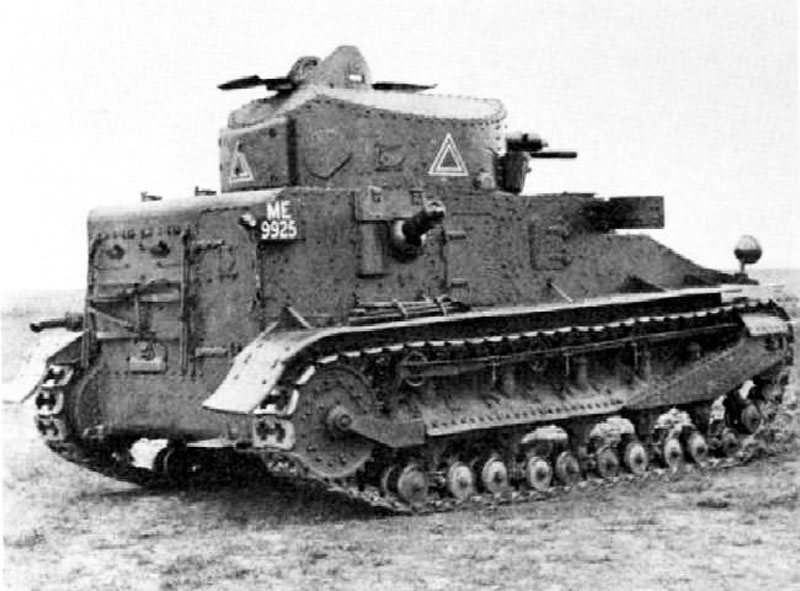
The Medium Mark I mounted a main armament consisting of a 1 x 47mm QF ("Quick Firing') 3-pounder gun. While the gunner also doubled as the tank mechanic, the turret machine gunner was also assigned double duty as the loader. This seemingly strange assignment of tasks was no doubt refined some by the time of World War 2 - where co-axially mounted machine guns were now controlled by the gunner himself and a dedicated ammunition loader was made a principle part of tank crews. The main armament was supplemented by a collection of 4 x Hotchkiss M1914 7.7mm machine guns and a further 2 x 7.7mm Vickers machine guns for self-defense against infantry attacks. The two Vickers machine guns were fitted to ball-mountings on either superstructure side, just aft of the crew entry/exit side doors.
The Medium Mark I served with the Royal Tank Regiment up until 1938 before being phased out by much more modern and effective systems. The Vickers Medium Mark II tank was a slightly improved form of the Medium Mark I detailed elsewhere on this site.
Power & Performance Those special qualities that separate one land system design from another. Performance specifications presented assume optimal operating conditions for the Vickers Medium Mark I Medium Tank.
1 x Armstrong Siddeley V-8 air-cooled gasoline engine developing 90 horsepower. Installed Power
13 mph 21 kph Road Speed
150 miles 241 km Range
Structure The physical qualities of the Vickers Medium Mark I Medium Tank.
5 (MANNED) Crew
17.5 ft 5.33 meters O/A Length
9.1 ft 2.78 meters O/A Width
8.8 ft 2.68 meters O/A Height
29,566 lb 13,411 kg | 14.8 tons Weight
Armament & Ammunition Available supported armament, ammunition, and special-mission equipment featured in the design of the Vickers Medium Mark I Medium Tank.
PRIMARY:
1 x 47mm QF 3-pounder main gun.
SECONDARY:
2 x 7.7mm M1914 Hotchkiss machine guns.
4 x 7.7mm Vickers machine guns.
AMMUNITION: Not Available.
Variants Notable series variants as part of the Vickers Medium Mark I family line.
A2E1 - Internal Vickers Designation
Light Tank Mark I - Original Designation; changed in 1924.
Medium Tank Mark I - Initial Production Model; 30 examples produced; service beginning 1924.
Medium Tank Mark IA - Improved Mark I; increased armor protection; improved bogies; revised turret.
Medium Tank Mark IA* - Rebuilt Mark Is and Mark IAs; sans Hotchkiss guns; co-axial installation of Vickers machine gun; rotating cupola.
Medium Tank Mark I CS / Medium Tank Mark IA CS - Close-Support Smoke-Laying Vehicles rebuilt from Mark I and Mark IAs; 1 x 15-pdr mortar.
Experimental Wheel-and-Track Medium Mark I - Proposed Variant; never mass-produced.
Operators Global customers who have evaluated and/or operated the Vickers Medium Mark I. Nations are displayed by flag, each linked to their respective national land systems listing.
Total Production: 200 Units Contractor(s): Vickers - UK
[ United Kingdom ]
1 / 4
Front right side view of the Vickers Medium Mark I on display
2 / 4
Right side profile view of the Vickers Medium Mark I tank
3 / 4
Rear right side view of the Vickers Medium Mark I tank; note exhaust muffler along the left of the superstructure rear
4 / 4
Front left side view of the Vickers Mark I tank; note turret armament and superstructure side ball-mount machne guns
The "Military Factory" name and MilitaryFactory.com logo are registered ® U.S. trademarks protected by all applicable domestic and international intellectual property laws. All written content, illustrations, and photography are unique to this website (unless where indicated) and not for reuse/reproduction in any form. Material presented throughout this website is for historical and entertainment value only and should not to be construed as usable for hardware restoration, maintenance, or general operation. We do not sell any of the items showcased on this site. Please direct all other inquiries to militaryfactory AT gmail.com. No A.I. was used in the generation of this content.