After the events of World War 2 and Japanese removal from mainland Asia, Korea remained a divided country with a communist north influenced by the Soviet Union and the democratic south supported by the United States. The nation was divided along the 38th Parallel and both governments maintained a physical presence (and interest) throughout the peninsula during the early "Cold War" years between the East and West. The promise of free elections fell through in 1948 and worsened already growing tensions. This resulted in the North, with the blessings of Soviet leader Stalin and Chinese leaders, invading the South on June 25th, 1950 in an attempt to forcibly unify the peninsula under communist rule. Thus began the Korean War, becoming the first notable engagement of the Cold War between the United States and the Soviet Union (though largely considered a "proxy war" in military terms).
During this time, the world was already weary of war and defense budgets were drastically slashed from their peaks seen during World War 2. As such, much of the World War 2 inventory remained and this included the ubiquitous M4 Sherman medium tank of the American Army. For the communist North, it fielded a plethora of Soviet T-34 medium tanks - a hero of World War 2 - some of the later variants mounting the potent 85mm main gun in the T-34/85 configuration. Alongside the M4 Sherman, the United States Army could also field the late-war M26 Pershing, originally categorized as a heavy tank before advances of the time downsized it to a medium tank classification in the post-war world.
The 46-ton, 90mm-armed M26 Pershing (or "General Pershing") was introduced in 1945, expected to partake in the final tank battles against German armor in World War 2. Germany was fielding the excellent Panzer V Panther medium tank and the stout Tiger I and Tiger II heavy tanks by the end of the war - designs that outmatched the American M4 Sherman on many levels. However, Germany capitulated in May of 1945 to which the M26 was just beginning to arrive in Europe (the first in January 1945) in useful numbers and saw only limited combat against Axis foes. In service, it ultimately proved unreliable and its powerpack (same as in the lighter M4 Sherman) was not up to the expected pressures of such a heavy design. However, its armor protection and 90mm main gun were quality improvements over that of the M4 Sherman. The M26 saw service in the Korean War up until it was withdrawn from frontline service in 1951.
The relative disappointment that was the M26 as a medium tank spurred development of an improved form beginning in 1948. The poorer qualities of the M26 were revised to include a new engine and transmission system centered around strong armor protection and the proven 90mm main gun. The initiative bore the experimental designation of "M26E2", showcasing its M26 Pershing roots, until changes became so numerous in the design that the product earned its own designation of "M46" in 1949. The M46 was further nicknamed the "Patton" in honor of the famous American World War 2 General George S. Patton of the US Third Army.
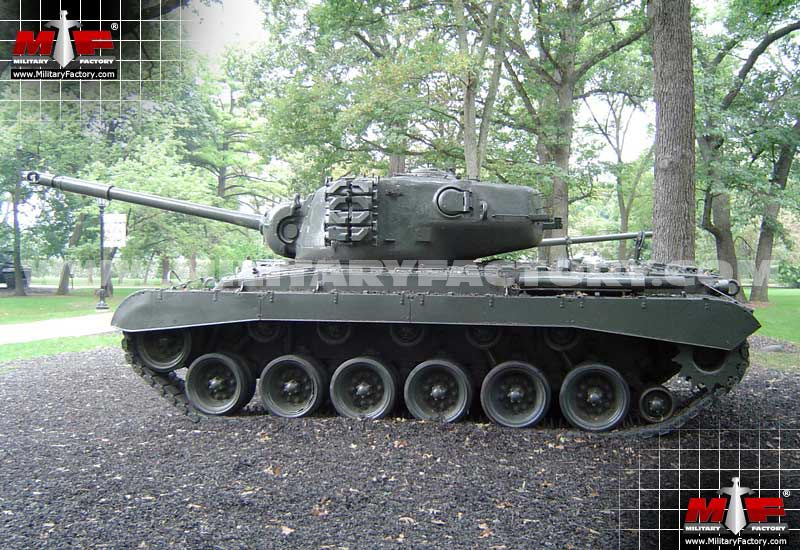
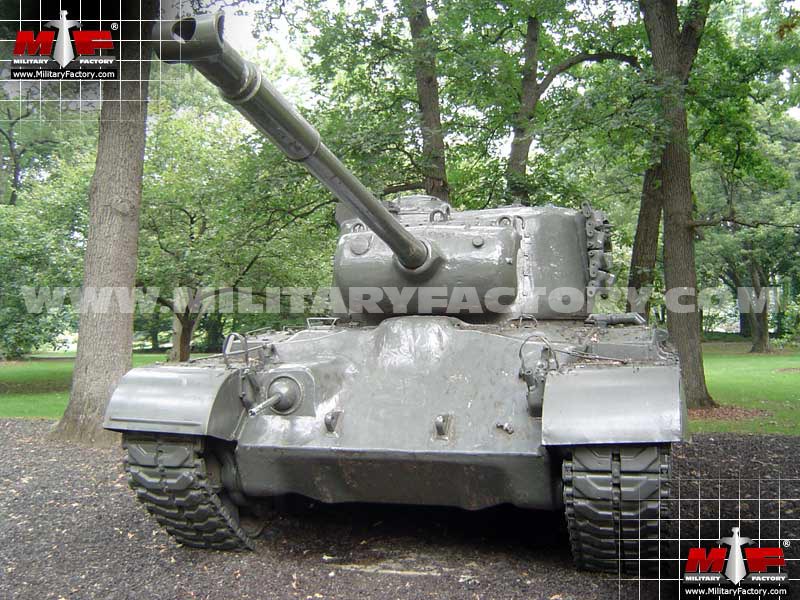
The M46 was a 48.5 ton design, categorized as a true medium tank from the beginning. It managed a running length of 8.48 meters with a width of 3.51 meters and height of 3.18 meters. The vehicle was crewed in the standard fashion by five men - a driver (seated front-left in the hull), the tank commander, a dedicated gunner and loader and the assistant driver/bow machine gunner. Armor protection was 102mm at its thickest, primarily along the front and sides. Power was served through a Continental AVDS-1790-5A series V-12, air-cooled, twin-turbo, gasoline-fueled engine of 810 horsepower output residing in a rear hull compartment. The engine was mated to a General Motors/Allison CD-850-3 series transmission system with 2 forward gears and 1 reverse gear. Performance included a top speed of 30 miles per hour and an operational range of 80 miles (in ideal circumstances). The vehicle was suspended atop a torsion bar configuration which allowed for adequate cross-country travel. The running gear included a six double-tired wheeled configuration with the drive sprocket at the rear and the track idler at the front. Armament was made up of the 90mm M3A1 main gun along with 2 x .30 caliber M1919A4 tank machine guns for self-defense (one fitted coaxially in the turret, fired alongside the main gun, and the other in the front-right hull). The turret offered a full 360-degree traversal of the main gun with limited elevation and was fitted just ahead of amidships with noticeable overhang at the rear over the engine compartment. The main gun barrel sported a single baffled muzzle brake and bore evacuator sleeve. The design would become the basic template for near-future American tank designs until the arrival of the M1 Abrams in the early 1980s.
After the requisite performance trials by the US Army, the M46 entered serial production (in its basic form as the "M46") and entered formal service in 1950. First M46 elements arrived in Korea on August 8th, 1950 with the US 6th Tank Battalion. By the end of the year, some 200 units would be available and 800 of the original M46s would be produced in all. The M46 fought alongside existing M26 (before their eventual withdrawal) and the large fleet of M4 Shermans as well as other light tanks in circulation. Once M46 stocks were adequate, the M26 was officially withdrawn for the better and Shermans began to see a similar fate in time.
After some practical operational use, the M46 was modified through the improved M46A1 variant. This version fitted a fire suppression system as well as an integrated cooling system and improved braking arrangement. Electrics were modernized and these forms were further upgraded with Continental AV-1790-5B series engines coupled with Allison CD-850-4 series transmission systems. All told, production of this type totaled 360 units.
In combat, the M46 gave a good account of itself. It outmatched the North Korean Soviet T-34/76 and the limited T-34/85 medium tank types considerably. The 90mm main gun proved a good penetrating power at range while Western tactics proved superior for the day. The subsequent battles regained swathes of territory originally lost in the initial North Korean push, eventually pulling Chinese forces into the fold (Soviet jet fighter pilots also flew against Americans). The M46 proved critical in the defense of the all-important Pusan Perimeter during the latter half of 1950 that, its loss, would have spelled defeat for both US forces and South Koreans otherwise. M46s were used in support of the amphibious US Marine landings at Inchon thereafter and were also fielded used in support of UN forces during their retreat after the Chinese thrust. The war would eventually conclude in a cease-fire armistice though no formal conclusion was ever recognized - meaning that a state of war has consistently existed between the North and South since. As such, limited skirmishing continues today across the Korean Demilitarized Zone (DMZ), a zone spanning some 2.5 miles between the North and South as a buffer of sorts. The Korean War became the sole combat exposure for the M46 breed as it was soon replaced by the similar M47 Patton beginning in 1952. M47s were not used in the war but went on to stock US allies across Europe and the Middle East in the years following. Remnant M46s were eventually leased to Belgium, France and Italy as interim fighting and training systems until the expected arrival of M47s in their respective inventories.
Such ended the tenure of the M46 Patton, the first of the Patton tank line that has since culminated with the M60 Patton of 1961 - America's first "Main Battle Tank". The M60 itself was superseded by the excellent M1 Abrams Main Battle Tank in 1980.
The M46 Patton was formally retired in 1957. 1,160 M46 tanks were built in all by the Detroit Arsenal Tank Plant. The M46 was utilized by both US Marine and Army elements in the Korean War.
Power & Performance Those special qualities that separate one land system design from another. Performance specifications presented assume optimal operating conditions for the M46 Patton (General Patton) Medium Tank Tracked Combat Vehicle.
1 x Continental AVDS-1790-5A V12, 4-cycle, twin-turbo, water-cooled gasoline engine developing 810 horsepower. Installed Power
30 mph 48 kph Road Speed
81 miles 130 km Range
Structure The physical qualities of the M46 Patton (General Patton) Medium Tank Tracked Combat Vehicle.
5 (MANNED) Crew
31.2 ft 9.5 meters O/A Length
11.5 ft 3.5 meters O/A Width
10.4 ft 3.16 meters O/A Height
97,003 lb 44,000 kg | 48.5 tons Weight
Armament & Ammunition Available supported armament, ammunition, and special-mission equipment featured in the design of the M46 Patton (General Patton) Medium Tank Tracked Combat Vehicle.
1 x 90mm M4A1 main gun
1 x 12.7mm machine gun roof-mounted (optional)
1 x 7.62mm coaxial machine gun
1 x 7.62mm bow-mounted machine gun
AMMUNITION: 70 x 90mm projectiles
550 x 12.7mm ammunition
5,500 x 7.62mm ammunition
Variants Notable series variants as part of the M46 Patton (General Patton) family line.
M26E2 - Original Product Designation
M46 - Base Series Designation; fitted with Continental V12 engine; cross-drive transmission; M3A1 90mm main gun as found on the M26A1 Pershing; repositioned exhausts; 800 examples produced.
M46A1 - Improved oil cooling, braking system fire extinguisher systems, updated instrument panels, updated electrical wiring, improved transmission and powerpack (CD-850-4 transmission, AV-1790-5B engine); 360 examples produced.
M46 (Dozer) - Fitted with M3 dozer conversion kit.
Operators Global customers who have evaluated and/or operated the M46 Patton (General Patton). Nations are displayed by flag, each linked to their respective national land systems listing.
Total Production: 1,160 Units Contractor(s): Detroit Tank Arsenal - USA
[ Belgium; France; Italy; United States ]
1 / 2
Image copyright www.MilitaryFactory.com; No Reproduction Permitted.
2 / 2
Image copyright www.MilitaryFactory.com; No Reproduction Permitted.
The "Military Factory" name and MilitaryFactory.com logo are registered ® U.S. trademarks protected by all applicable domestic and international intellectual property laws. All written content, illustrations, and photography are unique to this website (unless where indicated) and not for reuse/reproduction in any form. Material presented throughout this website is for historical and entertainment value only and should not to be construed as usable for hardware restoration, maintenance, or general operation. We do not sell any of the items showcased on this site. Please direct all other inquiries to militaryfactory AT gmail.com. No A.I. was used in the generation of this content.