Long before German engineers lent their talents to the outrageous and very optimistic heavy tank designs of World War 2, they were already undertaking work on a super-heavy tank creation during World War 1. The war began in 1914 and technology concerning tanks, aircraft, machine guns and artillery soon raced to keep up with the constant changes. It was not until the war gridlocked into stalemates across trenches that the tank came into its own. Tanks could be used to devastating effect in breaking across fields of barbed wire, craters, felled trees and men and the open spaces that trench networks created. Additionally, armament in the war of cannon and machine guns allowed these system to engage enemy positions head on in relative safety.
The best known of the German World War 1 tanks became the Sturmpanzerwagen A7V - the only German tank to reach serial production before the end of the war. This creation appeared in 1918 after a lengthy years-long development period and only 21 were ultimately produced. The type was crewed by no fewer than 18 personnel and armed with a 57mm cannon as primary armament backed by no fewer than 6 x 7.9mm Maxim machine guns. The internals were held in a boxy, high-profile structure that presented a slow, plodding and tempting target. The A7V was part of the first-ever tank-versus-tank battle against the British which, interestingly, proved inconclusive by military standards. Nevertheless, the Germans were somewhat late to the game in realizing the potency of the tank as an integral battlefield component - no so in World War 2 however.
With the history of the A7V presented, the Germans were already keen on development of a new "super heavy" tank system as soon as June of 1917 - this before even a single production form of the A7V was delivered to the Army. The super heavy tank concept centered around smashing fortified positions through sheer strength and firepower. As such, she would be heavily armed and armored for the task with speed - many times - considered an afterthought for such heavy-minded designs. Captains Joseph Vollmer and Weger were charged with its design.
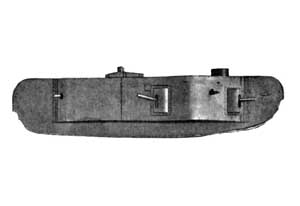
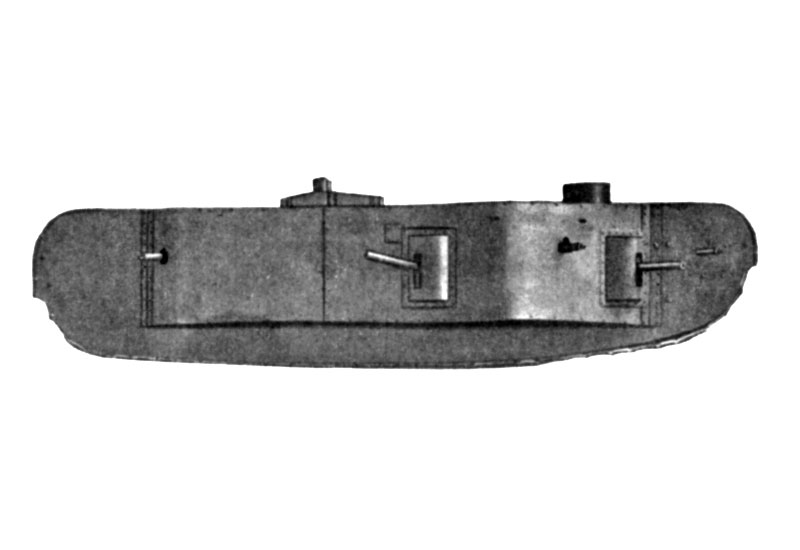
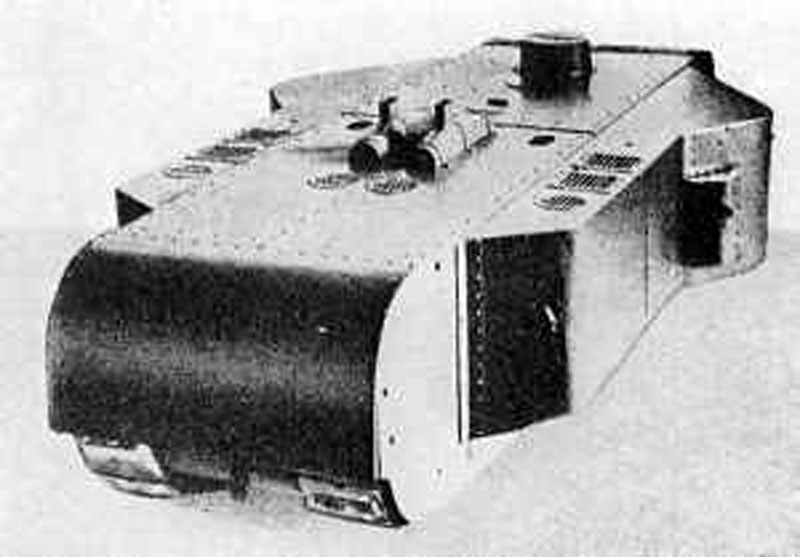
The core design centered around the proven "lozenge" shaped tank systems consistent with World War 1 armored doctrine. This would incorporated long-running, roller-type track systems along the sides with riveted steel armor protection all about the design. The top facing was flat save for an observation cupola towards the front and twin exhaust stacks at the rear. The primary armament were 4 x 77mm field guns along side sponson protrusions, two guns to a hull side. One set faced forward whilst the other set faced to the rear. Self-defense would be handled by up to 7 x 7.92mm Maxim machine guns - two along the forward sides ahead of the sponsons, two aft of the forward 77mm guns, two facing rear at the back of the sponsons and a single fitting at the center front hull. Some 800 rounds of 77mm projectiles were available as were 21,000 rounds of 7.92mm machine gun ammunition. Power was supplied by two Daimler-Benz V6 aircraft engines delivering 650 horsepower each and tied to an electric-magnetic clutch transmission system. Suspension was unsprung.
Such a large vehicle would require the use of a bevy of specially trained personnel to manage the gears, maintain the engines, manage the cannon and machine guns and direct the crew. No fewer than 22 to 27 personnel were part of the tank's standard operating crew. The communications suite was based on the U-Boat submarine systems. Armor protection ranged from 10mm to 30mm in thickness across the various facings.
The original design called for a vehicle of 165 tons but this was inevitably deemed too heavy for even the most basic of functions. As such, the requested weight was brought down to a more manageable 120 tons. This allowed the engineers to work with a shortened, "lighter" hull. However, size was still a major concern and the design soon evolved into a modular-based one, being able to break down into four major sections for railway transport due to the fact that, when whole, the design could not fit atop a standard German railway flatcar.
On June 28th, 1917, the formal Vollmer and Weger design was presented and approved by the German War Ministry for serial production as the "K Grosskampfwagen" - better known today as the "K-Wagen" for short. Initial numbers called for ten tanks to be built, with their construction split between Wegman and Company out of Kassel and Riebe-Kugellager of Berlin for expediency. However, the requests came much too late for Germany was forced into surrender in November of 1918. By this time, only two near-complete prototypes existed, never to see combat action - done in by both the end of the war and a shortage of needed construction material. Both examples were studied by the victors and eventually scrapped.
The K-Wagen concept inevitably suffered from the limitations of all super heavy tank concepts revisited in the upcoming World War 2. She was simply too large and heavy for basic transport, her having to be broken down, loaded, transported to a location, unloaded and reconstructed before she could function. The twin engine design was loud, noisy and underpowered despite the combined horsepower output. The arrangement managed a measly 4.7 miles per hour in ideal conditions - of which World War 1 battlefields lacked. The 77mm cannons were held in limited-traverse sponsons which limited the K-Wagen in a tactical sense. Crew comforts were horrendous to say the least, 27 personnel working in confined spaces full of smoke and lethal fumes. The K-Wagen structure itself was a tempting target to awaiting enemy artillerymen - measuring 43 feet long with a 20 foot width and some 9.8 feet tall.
If the K-Wagen holds some sort of favorable mention in history it is that the system became the first true attempt at designing and constructing a combat-capable super heavy tank. It also remains the second largest tank to see completion behind only the World War 2-era German Panzer VII "Maus" system.
Power & Performance Those special qualities that separate one land system design from another. Performance specifications presented assume optimal operating conditions for the K Grosskampfwagen (K-Wagen) Super-Heavy Tank Project.
2 x Daimler-Benz V6 engines developing 650 horsepower each driving conventional track-and-wheel arrangement. Installed Power
5 mph 8 kph Road Speed
Structure The physical qualities of the K Grosskampfwagen (K-Wagen) Super-Heavy Tank Project.
22 (MANNED) Crew
42.7 ft 13 meters O/A Length
19.7 ft 6 meters O/A Width
9.8 ft 3 meters O/A Height
240,000 lb 108,862 kg | 120.0 tons Weight
Armament & Ammunition Available supported armament, ammunition, and special-mission equipment featured in the design of the K Grosskampfwagen (K-Wagen) Super-Heavy Tank Project.
4 x 77mm field guns.
7 x 7.92mm Maxim 08/15 machine guns.
AMMUNITION: 800 x 77mm projectiles.
21,000 x 7.92mm ammunition.
Variants Notable series variants as part of the K Grosskampfwagen (K-Wagen) family line.
K Grosskampfwagen - Formal Designation
K-Wagen - Shortened Designation
Operators Global customers who have evaluated and/or operated the K Grosskampfwagen (K-Wagen). Nations are displayed by flag, each linked to their respective national land systems listing.
Total Production: 2 Units Contractor(s): Riebe / Wegman and Company - Imperial Germany
The "Military Factory" name and MilitaryFactory.com logo are registered ® U.S. trademarks protected by all applicable domestic and international intellectual property laws. All written content, illustrations, and photography are unique to this website (unless where indicated) and not for reuse/reproduction in any form. Material presented throughout this website is for historical and entertainment value only and should not to be construed as usable for hardware restoration, maintenance, or general operation. We do not sell any of the items showcased on this site. Please direct all other inquiries to militaryfactory AT gmail.com. No A.I. was used in the generation of this content.