Military Factory
Military Pay Chart
Global Firepower
Military Industrial Complex
Second World War
Home
Military Pay Scale
Military Ranks
Small Arms
Aircraft
Land Systems
Navy
Education
Military Factory Facebook Logo
flag of France

FS Mistral (L9013) Amphibious Assault Ship / Helicopter Carrier (2005)

Authored By Staff Writer | Last Updated: 5/9/2013

The FS Mistral is the lead ship of the multi-purpose Mistral-class of amphibious assault ships.

Find a School Near You
Follow Military Factory on Facebook:
Trending on Military Factory:
Recent Articles:
The FS Mistral is one of the primary amphibious assault ships of the French Navy (also categorized as a "Command and Projection Ship"). Since her inception in 2005, the vessel has already gone on to prove her worth in several actions - particularly in relief operations. The Mistral can manage a full complement of troops and vehicles while also providing services for the injured thanks to various onboard measures implemented into her design. A powerful vessel, the multirole FS Mistral will enjoy a long and active service life for the French Navy - either in support of amphibious operations, evacuating refugees, treating masses of wounded or sick or replenishing forward-operating elements.

The amphibious landing is one of the most complicated and dangerous of military maneuvers that requires strict attention to detail, competent components and the fine tuning of a well-oiled machine. The amphibious assault has been a tool in the arsenal of generals since the first boat landed warriors against the enemy. The amphibious assault proved a grand strategic move throughout the campaigns of World War 2 and cemented the practice for modern warfare. As such, a special class of warship was eventually born from the fighting, devised specially to support such actions and these became the aptly-titled "amphibious assault ship".

Amphibious Assault Ships provide the warplanner with unprecedented flexibility when attempting to land ground forces onto enemy territory from the sea. Today's vessels can carry tanks, vehicles, men, machinery and support aircraft to ensure a higher success rate than ever envisioned. For the French Navy, the Mistral-class of amphibious assault ship is a relatively new addition and fulfills this role quite nicely. The FS Mistral itself represents the lead ship of her class of three strong which includes the FS Tonnerre (L9014) and the FS Dixmude (L9015). She was laid down on July 10th, 2003 with DCNS handling her construction and officially launched on October 6th, 2004 before being formally commissioned in December of 2005. The Mistral makes her home port out of Toulon, France. The vessel class replaced the Ouragan (L9021) and Orage (L9022) then in service with the French Navy.

The Mistral was completed in three main sections during her construction. This included the bow, center and stern sections. The bow section was completed by Alstom Marine-Chantiers de l'Atlantique in Saint Nazaire whilst the center and stern sections were completed by DCN. Final assembly took place at the Brest shipyard. During its design phase, representatives of the French Army and Navy all had input into the creation of the Mistral to best suit the purposes of the military.

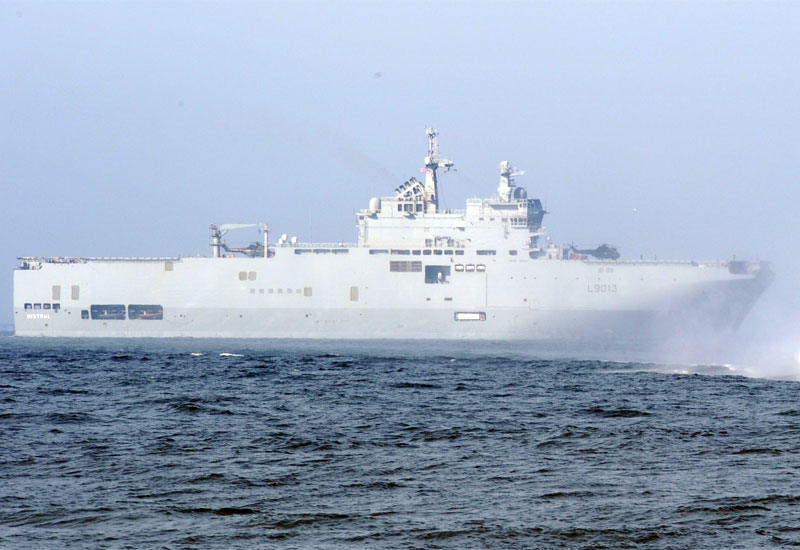
Design-wise, the FS Mistral takes on a unique shape, having the hull appearance of a passenger cruise liner complete with a pointed bow, slab sides and a cut-off stern. The vessel features a large-area flight deck suitable for the accepting and launching of rotary-wing aircraft from stern, midship and bow positions - multiple simultaneous helicopter launches from six landing sports are indeed possible and play up to the strengths of the Mistral. Her base command bridge is located at the front of a starboard-side island superstructure which is detailed primarily by a pair of masts. Air traffic control is managed by a position perched at the rear of the island superstructure. Radar, sensors, TV-satellite and navigation aid fixtures are all present on the island. Her communications suite is such that the vessel can be used as a command post for large-scale operations including serving as the fleet flagship. Four smoke funnels are noted at the aft portion of the superstructure and these exhaust the propulsion system buried deep within the hull. Various openings along both sides of the vessel allow for access to the sea while the stern houses the main sea access bay. A heavy industries powered crane is noted ahead of the stern section and aft of the island. Two elevators at the rear and rear-starboard sides of the flight deck allow for access to the hangar area below. Internally, the aft portion of the vessel houses three main floors - the first being the helicopter hanger. The next deck is reserved for vehicles with a ramp leading down to the last deck near the waterline. This serves multiple purposes, allowing for more vehicle storage, vehicle loading onto support vessels and a launch area for said support vessels out to sea. The midship decks contain sleep quarters, a full hospital, various operations rooms and the like. The hospital includes two operating rooms (can be expanded to six), burn treatment, dental suite and the hangar area can be modified as an ad hoc medical facility if need be. Forward of amidships are various areas for the crew that includes a mess hall. The hangar area also includes the all-important workshop for at-sea repairs and engineers and craftsmen. The vessel measures a running length of 199 meters with a beam of 32 meters and a draught of 6.2 meters.

The FS Mistral is typically staffed by over 180 crew made up of officers and sailors. An additional 450 personnel can be carried aboard as required - particularly under full combat load when supporting an amphibious assault or during relief operations. She is an electrically-powered vessel (the first all-electric propulsion military vessel anywhere in the world) and, as such, her propulsion system is made up of 2 x Mermaid electric motors with 3 x Finnish Wartsila 16V32 series diesel generators as well as 1 x Wartsila Vaasa 18V200 auxiliary diesel-generator. Propulsion is accomplished by way of 2 x Alstom nacelle PODs - Propulsion Orientable Drives - along the stern undersides and a azimuth bow thruster. All this drives power to two engine pods at the stern and delivers a top speed of approximately 19 knots in ideal conditions. Of note structurally is use of fold-out stabilizer fins fitted along each ship side, under the waterline at amidships.

Vessels such as the Mistral are primarily designed as "heavy haulers" at sea, designed to support an amphibious landing assault. As such, the vessel can carry a 13 main battle tanks along with some 60 other armored, logistical and support vehicles. The air arm of the Mistral consists of a mix of various helicopter types which can range from up to 35 light-class helicopters to 16 heavy-class models - all intended to support beach landings or evacuations. In terms of support ships, the Mistral can send out two LCAC hovercraft or four standard landing craft.

The Mistral is defensed by a small collection of armament, to which she relies mostly on supporting warships (such as missile frigates) for heavy outlying protection. Primary ranged defense is 2 x MBDA France Simbad Mistral surface-to-air missiles (one launcher fitted at the bow and the other at the stern). These are backed by 2 x 30mm Breda-Mauser Dual-Purpose cannons (one fitted at the bow and the other at the stern). Close-in defense is provided by up to 4 x 12.7mm Browning M2HB heavy machine guns suitable for attacking low-flying aircraft or light-armored surface targets. The Thales ARBR 21 series radar warning receiver suite manages incoming threats to the ship. Surveillance is by a Thales Naval France MMR-3D NG G-band multirole radar faiclity.
Continue to Page 2 (of 2) >>
Text ©2003-2013 www.MilitaryFactory.com • All Rights Reserved • No Reproduction Permitted
MilitaryFactory.com does NOT sell equipment/weaponry. Material presented throughout this website is for historical and entertainment value and should not to be construed as usable for hardware restoration, maintenance or general operation. Please consult manufacturers for such information. Our disclaimer. Email corrections / Comments to MilitaryFactory at Gmail dot com.
Picture of FS Mistral (L9013)
View All Images (1)

Specifications for the
FS Mistral (L9013)
Amphibious Assault Ship / Helicopter Carrier


Country of Origin: France
Initial Year of Service: 2005
Operators: France


Crew: 310


Length: 652ft (198.73m)
Beam: 105ft (32.00m)
Draught: 20.6ft (6.28m)
Displacement: 16,500tons


Machinery: 4 x Wartsila diesel alternators; 1 x Wartsila Vaasa auxiliary diesel-alternator; 2 x Mermaid electric motors; 2 x propeller shafts.


Surface Speed: 18.8kts (22mph)
Range: 9,506miles (15,298km)


Armament:
2 x Simbad Mistral surface-to-air missile systems.
2 x 30mm Breda-Mauser dual-purpose cannons
4 x 12.7mm Browning M2HB heavy machine guns


Air Arm: 16 x Heavy-lift transport helicopters OR 35 x Light-class helicopters. Attack helicopters and Harrier-type jump jet aircraft also supported.


Ship Class: Mistral-class
Number-in-Class: 3
Ships-in-Class: FS Mistral (L9013); FS Tonnerre (L9014); FS Dixmude (L9015)

ALL NAVY SHIP CATEGORIES
Site Disclaimer | Privacy Policy | Site Map | MF Origins


©2013 www.MilitaryFactory.com • Content ©2003-2013 MilitaryFactory.com • All Rights Reserved • Site Contact Email: militaryfactory at gmail dot com. The "Military Factory" name and MilitaryFactory.com logo are registered ® trademarks and protected by all applicable domestic and international intellectual property laws.


Top MF Stuff: 2013 Military Pay Scale | Military Ranks | WW2 Weapons | Sniper Rifles | Kts to Mph | WW1 Aircraft | Automatic Rifles | Aircraft Cockpits | Vietnam War Weapons | Main Battle Tanks | Submachine Guns | Shotguns | French Military Victories


Most photographic images appearing on this site are courtesy of the United States Department of Defense and are approved for public use. Other images acquired through the public domain. Digital art work courtesy of Dan Alex. Business Consulting by Kyle Williams. Material presented throughout this website is for historical and entertainment value and should not to be construed as usable for hardware restoration, maintenance or general operation. Please consult manufacturers for such information.


eXTReMe Tracker