Military Factory
Military Pay Chart
Global Firepower
Military Industrial Complex
Second World War
Home
Military Pay Scale
Military Ranks
Small Arms
Aircraft
Land Systems
Navy
Education
Military Factory Facebook Logo
flag of United Kingdom

HMS Prince of Wales (R09) Aircraft Carrier (2018)

Authored By Staff Writer | Last Updated: 8/20/2012

Barring any major changes to the program, the HMS Prince of Wales aircraft carrier will be made ready in 2023.

Find a School Near You
Follow Military Factory on Facebook:
Trending on Military Factory:
Recent Articles:
The HMS Prince of Wales (R09) has been ordered as the second ship in the Queen Elizabeth-class of aircraft carriers to stock the British Royal Navy beginning in 2020 (the lead ship being the HMS Queen Elizabeth). With the official defense contract in place on July 3rd, 2008, the HMS Prince of Wales was formally ordered for construction on May 20th, 2008 and her keel was laid down on May 26th, 2011. Barring any project changes or budget cuts, the HMS Prince of Wales will join her sister ship sometime in 2018, making her home port out of HMNB Portsmouth, her crew fighting under the motto of "Ich Dien" ("I Serve"). Construction of the various required component "blocks" is being headed by BAe Systems Surface Ships, Babcock Marine, A&P group and Cammell Laird and will ultimately involve some seven total shipyards. Budgetary concerns may leave the HMS Queen Elizabeth as the only active ship in the class while the HMS Prince of Wales may sit in an indefinite "readiness" status and be called upon is needed.

While the United States Navy continues its large-scale use of aircraft carriers around the world, shrinking military budgets after World War 2 saw limited use of such vessels in competing navies elsewhere - these navies to include that of the United Kingdom and the Soviet Union. The Royal Navy, therefore, relied on only a few active frontline aircraft carriers in operation at any one time. Their expertise in the use of carrier operations led to an impressive showing during its Falklands War entanglement with Argentina and helped to solidify the need for carriers in future Royal Navy inventory planning and doctrine. All told, the newer Queen Elizabeth-class of carriers will expertly broaden the scope and capability of the British Royal Navy, especially when paired with the latest in strike and helicopter aircraft such as the Lockheed F-35 Lightning II and the AgustaWestland Lynx Wildcat respectively.

In May of 1997, the incoming British government undertook a "Strategic Defense Review" evaluation of military inventories of major branches of service. This study served to verify the value of aircraft carriers for the Royal Navy's future deployments. The resulting agreement also shown that the Cold War-era Invincible-class aircraft carriers did not meet the concerns of the modern and near-future battlefields concerning warfare at sea and, in 1999, several design studies were requested from competing entities and a consensus was then agreed upon that yielded a formal design and competition winner for the expected lucrative defense contract.

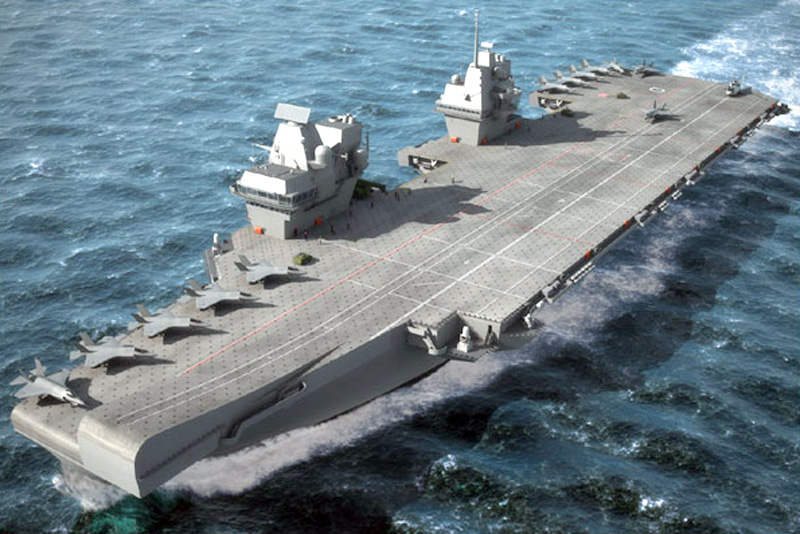
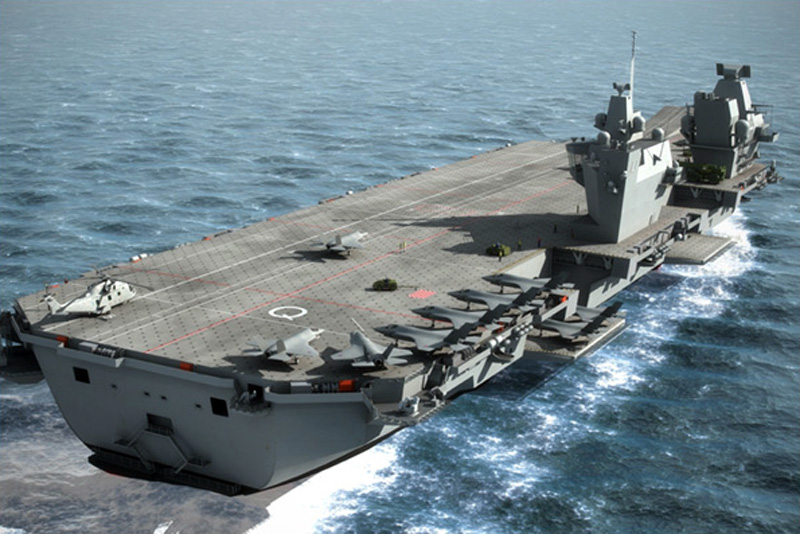
The HMS Prince of Wales was originally intended to be of a conventional design and layout with its island superstructure(s) offset to the right side of the large-area flight deck. It was to follow traditional carrier layout as opposed to the typical British "straight line" approach which does not feature an angled recovery deck. However, in May of 2012, British authorities had announced that its design will follow the straight-line arrangement and that the government will be purchasing the STOVL variant of the Lockheed F-35B Lightning II multirole fighter. As such, take-off will be assisted by a ski-type ramp at the bow. A pair of hangar elevators will service the flight deck with its aircraft. One of these lifts will be located between the main bridge and the flight bridge island superstructures and the other aft of the flight bridge superstructure along the starboard-stern area of the vessel.

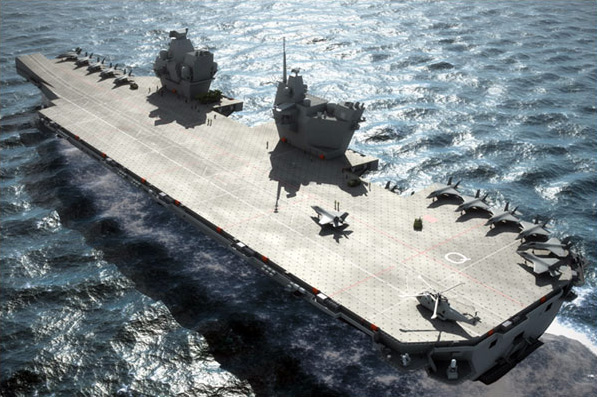
Unique to the design and silhouette of the HMS Prince of Wales (and the entire Queen Elizabeth-class of aircraft carriers) will be its twin island superstructure design. The forward structure will contain the primary bridge facilities whilst the rear-set structure will be home to the flight control section charged with managing the air wing. Both superstructures will be aligned to the starboard side of the vessel, leaving the central and portside areas clear for the launching and recovery of various aircraft types.

The HMS Prince of Wales will be home to approximately 600 Royal Navy personnel including sailors, officers and flight crew. Total capacity in wartime may exceed double that if needed (as many as 1,450 personnel). When completed, the HMS Prince of Wales is expected to be much larger than the Invincible-class carriers it replaces, putting her more in competition with the US Navy's Nimitz-class of nuclear-powered carriers. As such, the HMS Prince of Wales and her sister, the HMS Queen Elizabeth, will become the largest and technologically advanced warships ever constructed for the British Navy. Both are currently under construction as of this writing (November 2011).

Propulsion for the HMS Prince of Wales will be conventional in nature unlike its American counterparts that rely highly on nuclear power. The HMS Prince of Wales will instead rely on electric propulsion through a pair of Rolls-Royce Marine Trent MT30 series gas turbine generator systems yielding 48,000 horsepower tied to four Wartsila Diesel Generator units (2 x of 12,000 horsepower and 2 x of 15,000 horsepower). Total displacement for the vessel is expected to reach 72,300 short tons with a 932 foot running length, 240 foot beam and 36 foot beam. Top speed is listed at 25 knots in ideal conditions.

The HMS Prince of Wales air wing will consist of a combination of fixed-wing and rotary-wing aircraft numbering approximately 40 to include the upcoming Lockheed F-35 Lightning II for multi-role strike and engagement duties. The rotary-win contingent is expected to include British AgustaWestland Lynx Wildcat medium and AgustaWestland Merlin heavy helicopters. Additionally, there will be support for Boeing Chinook tandem-rotor transport helicopters and the Apache attack helicopter as needed. The Royal Navy was initially set to receive the STOVL variant of the F-35 Lightning II ("F-35B") but reports state that this has since given way to procurement of the more conventional F-35C carried-based aircraft which can launch via catapult and be recovered via tow cable. All supported aircraft will be maintained and managed through an integrated below-deck hangar and twin-elevator lift system. Fixed-wing aircraft will launch via catapults at designated areas of the flight deck and recovery will be through conventional tow cables stretched across the aft portion of the deck. There will be enough area across the flight deck of the carrier that she will be able to stock multiple "ready-to-fly" aircraft along the starboard side for quick reaction.

The HMS Prince of Wales will be defensed by a network of weapon systems intended to provide long-range and point defense protection of the vital machine. This will include Phalanx Close-In Weapon Systems as well as 30mm cannons to cover both aerial and surface-minded threats. Interestingly, missile-minded defense is not formally listed as of this writing. Additionally, defense will be supplied from accompanying surface ships and submarines operating within the carrier fleet. The HMS Prince of Wales will rely on a Thales S1850M long-range radar system to track, identify and engage incoming threats. Additional processing will be via the ultra Electronics Series 2500 Electro optical System (EOS) and Glide Path Camera suite.
Text ©2003-2013 www.MilitaryFactory.com • All Rights Reserved • No Reproduction Permitted
MilitaryFactory.com does NOT sell equipment/weaponry. Material presented throughout this website is for historical and entertainment value and should not to be construed as usable for hardware restoration, maintenance or general operation. Please consult manufacturers for such information. Our disclaimer. Email corrections / Comments to MilitaryFactory at Gmail dot com.
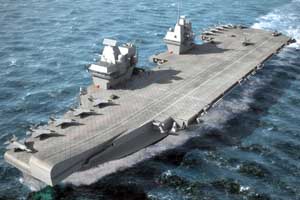
Picture of HMS Prince of Wales (R09)
Pic of the HMS Prince of Wales (R09)
Image of the HMS Prince of Wales (R09)
View All Images (3)

Specifications for the
HMS Prince of Wales (R09)
Aircraft Carrier


Country of Origin: United Kingdom
Initial Year of Service: 2018
Operators: United Kingdom


Crew: 1,450


Length: 932ft (284.07m)
Beam: 239.4ft (72.97m)
Draught: 36ft (10.97m)
Displacement: 72,300tons


Machinery: 2 x Rolls-Royce Marine Trent MT30 gas turbines developing 48,000 horsepower each; 2 x Wartsila Diesel Generators generating 15,000 horsepower each; 2 x Wartsila Diesel Generators generating 12,000 horsepower each.


Surface Speed: 27kts (31mph)
Range: 11,507miles (18,519km)


Armament:
Expected to include Aster surface-to-air missile systems as well as Phalanx CIWS (Close-In Weapon System).


Air Arm: Up to 40 aircraft of various types. To include the Lockheed F-35B Lightning II multi-role STOVL fighter and rotary-wing types.


Ship Class: Queen Elizabeth-class
Number-in-Class: 2
Ships-in-Class: HMS Queen Elizabeth (R08); HMS Prince of Wales (R09)

ALL NAVY SHIP CATEGORIES
Site Disclaimer | Privacy Policy | Site Map | MF Origins


©2013 www.MilitaryFactory.com • Content ©2003-2013 MilitaryFactory.com • All Rights Reserved • Site Contact Email: militaryfactory at gmail dot com. The "Military Factory" name and MilitaryFactory.com logo are registered ® trademarks and protected by all applicable domestic and international intellectual property laws.


Top MF Stuff: 2013 Military Pay Scale | Military Ranks | WW2 Weapons | Sniper Rifles | Kts to Mph | WW1 Aircraft | Automatic Rifles | Aircraft Cockpits | Vietnam War Weapons | Main Battle Tanks | Submachine Guns | Shotguns | French Military Victories


Most photographic images appearing on this site are courtesy of the United States Department of Defense and are approved for public use. Other images acquired through the public domain. Digital art work courtesy of Dan Alex. Business Consulting by Kyle Williams. Material presented throughout this website is for historical and entertainment value and should not to be construed as usable for hardware restoration, maintenance or general operation. Please consult manufacturers for such information.


eXTReMe Tracker