Military Factory
Military Pay Chart
Global Firepower
Military Industrial Complex
Second World War
Home
Military Pay Scale
Military Ranks
Small Arms
Aircraft
Land Systems
Navy
Education
Military Factory Facebook Logo
flag of United States

USS Wasp (LHD-1) Amphibious Assault Support Vessel (1989)

Authored By JR Potts, AUS 173d AB and Dan Alex | Last Updated: 5/9/2013

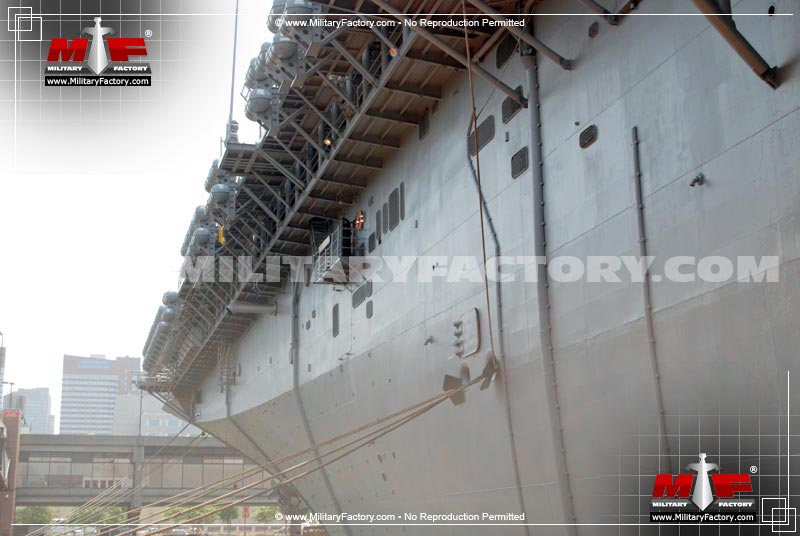
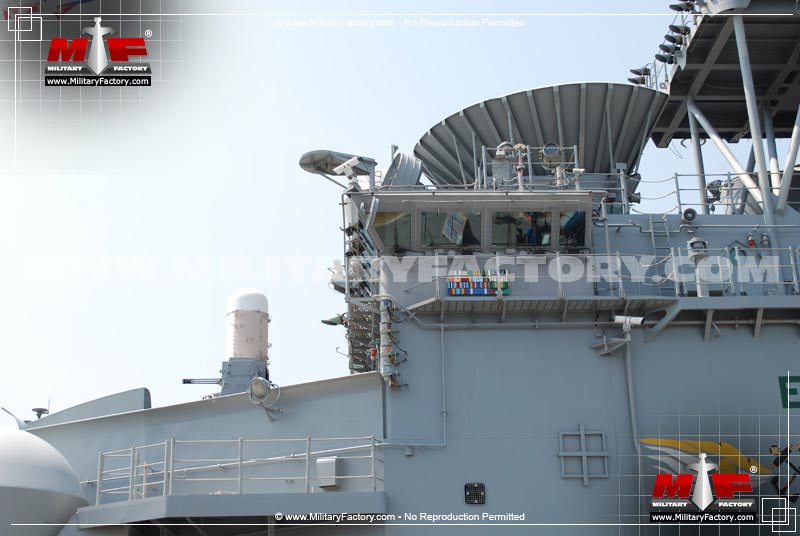
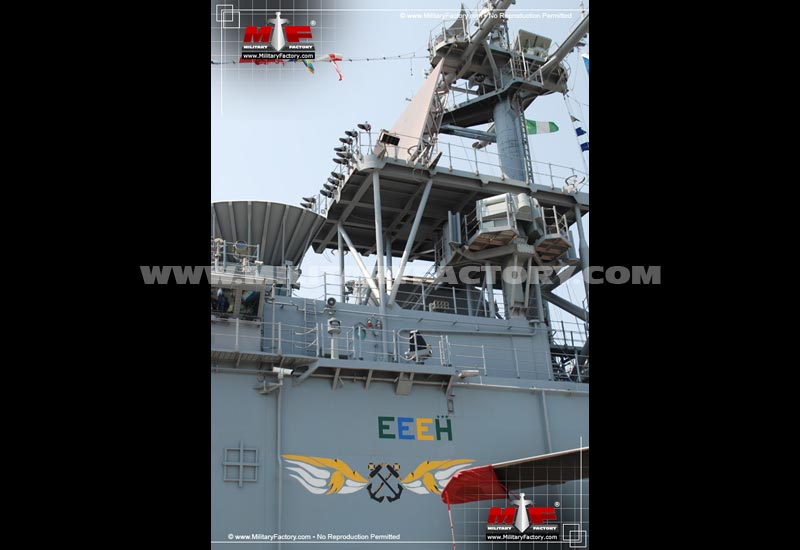
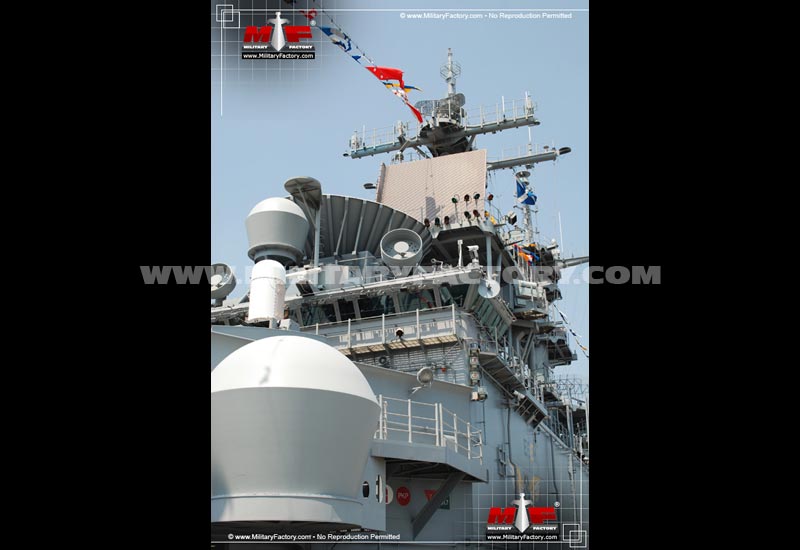
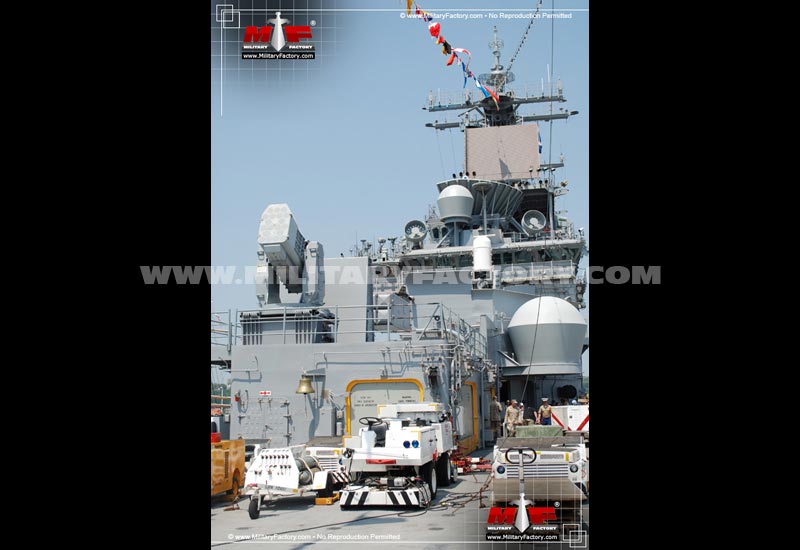
The USS Wasp LHD-1 is the lead ship of her amphibious assault class of warship.

Find a School Near You
Follow Military Factory on Facebook:
Trending on Military Factory:
Recent Articles:
Vessels of the "Landing Helicopter Dock" (LHD) amphibious assault ship program of the US Navy are named after former USN warships as opposed to the traditional naming convention honoring historical USN battles. In naming "LHD-1" the "Wasp", the US Navy honored no fewer than nine previous USN warships dating back to the first such named vessel fighting in the American Revolution (USS Wasp of 1775). Amphibious assault ship USS Wasp (LHD-1) became the lead ship of the Landing Helicopter Deck (LHD) class totaling eight similar vessels, each costing approximately $822 million to procure. The USS Wasp measures just 24 feet shorter than the USS Wasp (CV-18) Essex-class aircraft carrier commissioned in 1943 though the LHD-1 is 5,000 tons heavier and has mission capabilities not imagined during World War 2. Her keel was laid down by Ingalls Shipbuilding on May 30th, 1985.

The primary of the USS Wasp LHD-1 mission dedicated to housing and assisting marine force elements using Landing Craft, Air Cushion (LCAC) watercraft. Additionally, her capabilities require her to land material for "over-the-beach" assaults, intended to survive the threats posed by hostile shorelines. Air support for beachhead landings are also provided "in-house", this by way of onboard McDonnell Douglas AV-8B Harrier II (AV-8B) Vertical/Short Take-Off and Landing (V/STOL) aircraft which supply the close air support (CAS) air arm required of such operations. The vessel also carries a full complement of medical staff capable of providing intensive frontline medical care for up to 600 military casualties or regular patients. As such, the Wasp can be called upon to undertake humanitarian roles whenever and wherever needed.

The USS Wasp currently (2012) makes her homeport out of Norfolk, Virginia which gives her instant access to the vast waters of the Atlantic Ocean. She measures a running length of 843 feet (257 meters) with a beam of 105 feet (32 meters) while having a draft of 27 feet (8.23 meters). Wasp is built from a relatively new advanced hull design that maximizes the vessels internal space to promote spacious volume while still remaining dimensionally compact. What this has done is eliminate the need for additional troop and hospital ships accompanying the main fleet all the while allowing for rather comfortable living spaces concerning the ships basic crew, her air wing detachment and marines force. During World War 1, World War 2 and the Korea War, American assault missions required various (and numerous) types of surface ships to include battleships, aircraft carriers, troop ships and landing craft. Support ships needed to be close to volatile and dangerous shorelines in order to land their assault troops and were thusly put within range of enemy artillery and air attack. The LHD ships now allows the US Navy and Marine Corps the ability to enact over-the-horizon assaults that reduce the chance of attack on the Navy's greatest assets - its ships and crews. This concept further allows the Wasp the chance of an uncontested beach landing.

The Wasp class required, and was fitted with, sophisticated communications systems and advanced command-and-control for complex missions management concerning simultaneous air and sea deployments. She was also given capable self-defense weaponry as well as state-of-the-art electronics which, when combined, serve to support the US Navy and Marine helicopters, landing craft and amphibious assault vehicles needed to land Marine Expeditionary Unit (MEU) elements. The marine detachment alone can number up to 2,200 combat-ready, gear-laden marines. The US Navy also required their new LHD vessels to field improvements found lacking in the preceding Tarawa-class LHA-type ships. While the two classes utilized the same basic hull design and propulsion system, the Wasp has given a larger well deck that allowed her to carry 3 x LCACs versus 1 x LCAC in the preceding LHA series. The flight deck space and elevators were enlarged to allow the carrying of more helicopters per lift than the LHA class before it. Additional improvements over the LHA class included an LSD/LPD-type large powered stern loading gate and a longer, narrower docking well which could alternatively hold up to 12 x LCM 6, 6 x LCM 8 or 2 x LCUs units. The USS Wasp can transport up to 2,860 square meters (30,800 sq ft) of cargo and another 1,858 square meters (20,000 sq ft) is allocated for MEU vehicles. Based on mission requirements, the Wasp has vehicle space to accommodate up to 5 x USMC M1 Abrams Main Battle Tanks, 25 x AAVs, 8 x M198 towed howitzers, 68 x supply trucks plus twelve additional support-type vehicles. An internal monorail system is used to move cargo from the various holds to the well deck as needed.

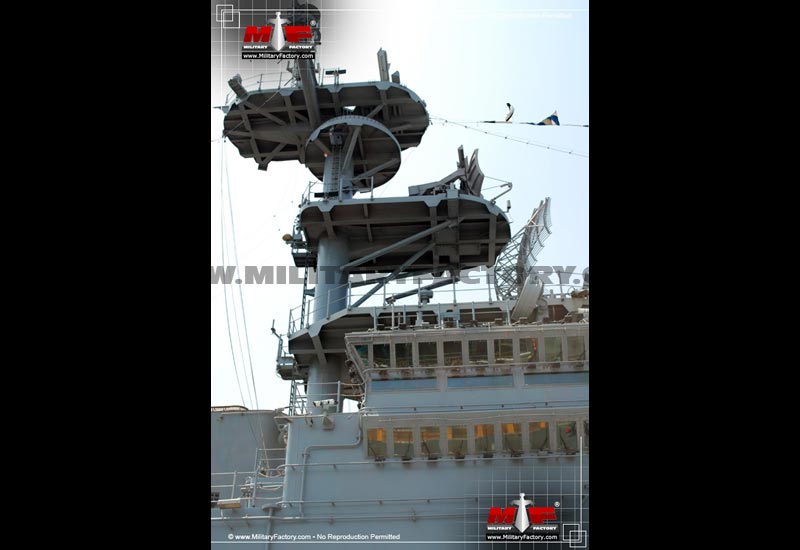
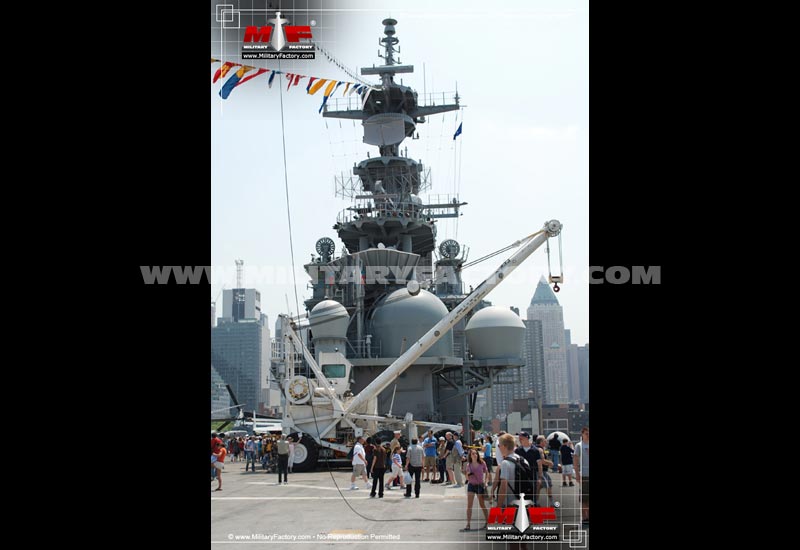
Radar for the USS Wasp was added at the bulbous forefoot of the bow as were larger bilge keels. 5"/54 caliber guns were removed allowing the flight deck to be squared-off forward. This additional space allowed the spotting of additional CH-53E helicopters simultaneously while increasing the number of assault troops lifted per assault wave. This improvement naturally required a stronger flight deck to support the additional weight so HY100 steel was used in the construction. To reduce air accidents, a lower, narrower, and longer island superstructure was constructed. This also reduced her radar signature and side profiles. USS Wasp also manages the largest conventional steam propulsion plants currently in USN service. The two powerplants develop 70,000 shaft horsepower to two shafts allowing the ship to reach speeds greater than 20 knots in ideal conditions. Electrical generators provide power for the various shipboard systems. Two pumping stations are needed to move the stored aircraft and vehicle fuel while fresh water for the 3,000 plus personnel is brought about via distilling plants providing 200,000 gallons of fresh water per day. The well deck carries four LCPLs and two utility boats. When launching or recovering the aft gate is down, thusly allowing more than 15,000 tons of seawater to enter the well deck needed for the landing craft's flotation. Wasp is designed to take on this additional tonnage of sea water. The LHD does not feature the requisite "ski-jump" ramp found on similar British vessels used when launching the AV-8B Harrier in a conventional manner. The hangar deck can accommodate a dozen CH-46 Sea Knight tandem-rotor transport helicopters.

The LHD-1 class ships are built as five giant, pre-constructed modules each weighing thousands of tons and ultimately fitted together at the shipyard, forming the ship's hull. The subassemblies are constructed at the same time by separate contractors and, overall, construction of the ship requires the services of hundreds of individual contractors providing the hardware, piping, ventilation ducting as well as the main propulsion equipment, generators, electrical wiring and panels. This parallel construction effort allows the vessel to be roughly 74% complete at launch. When the five modules and subsets are completed and joined, the vessel is rolled from her construction stands to a floating dry-dock area. The dry-dock is purposefully positioned over a "water pit" ultimately allowing the ship to float free under her own displacement.
Continue to Page 2 (of 2) >>
Text ©2003-2013 www.MilitaryFactory.com • All Rights Reserved • No Reproduction Permitted
MilitaryFactory.com does NOT sell equipment/weaponry. Material presented throughout this website is for historical and entertainment value and should not to be construed as usable for hardware restoration, maintenance or general operation. Please consult manufacturers for such information. Our disclaimer. Email corrections / Comments to MilitaryFactory at Gmail dot com.
Picture of USS Wasp (LHD-1)
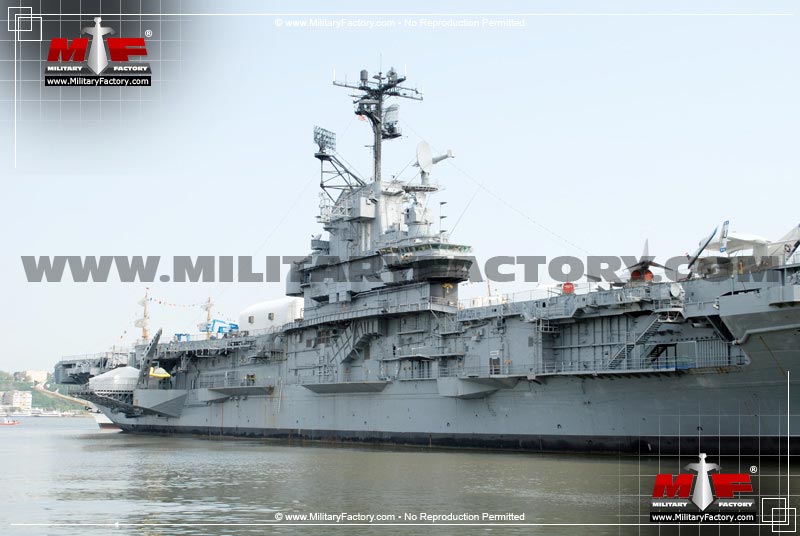
Pic of the USS Wasp (LHD-1)
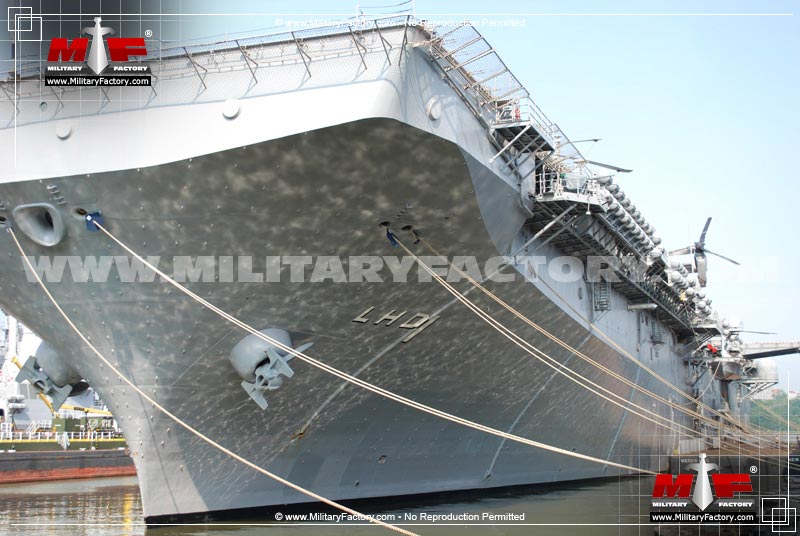
Image of the USS Wasp (LHD-1)
View All Images (9)

Specifications for the
USS Wasp (LHD-1)
Amphibious Assault Support Vessel


Country of Origin: United States
Initial Year of Service: 1989
Operators: United States


Crew: 3,275


Length: 844ft (257.25m)
Beam: 106ft (32.31m)
Draught: 26.5ft (8.08m)
Displacement: 41,182tons


Machinery: 2 x boilers with 2 x Westinghouse geared steam turbines delivering 70,000 shaft horsepower to 2 x shafts.

Surface Speed: 23kts (26mph)
Range: 10,932miles (17,593km)


Armament:
2 x MK 29 launchers for Sea Sparrow SAM medium-range anti-aircraft missile launchers.
2 x RAM short-range anti-aircraft missile systems.
2 x 20mm Phalanx CIWS (Close-In Weapon System) anti-aircraft/anti-missile systems.
4 x 12.7mm (0.50 caliber) anti-aircraft machine guns in single mounts.


Air Arm: 12 x CH-46 Sea Knight transport helicopters OR 10 x MV-22 Osprey tilt-rotor transport helicopters.
6 x AV-8B Harrier II strike aircraft
4 x CH-53E Super Stallion transport helicopters
4 x AH-1Z Viper attack helicopters
3 x UH-1N Huey transport helicopters


Ship Class: Wasp-class
Number-in-Class: 8
Ships-in-Class: USS Wasp (LHD-1); USS Essex (LHD-2); USS Kearsarge (LHD-3); USS Boxer (LHD-4); USS Bataan (LHD-5); USS Bonhomme Richard (LHD-6); USS Iwo Jima (LHD-7); USS Makin Island (LHD-8)

ALL NAVY SHIP CATEGORIES
Site Disclaimer | Privacy Policy | Site Map | MF Origins


©2013 www.MilitaryFactory.com • Content ©2003-2013 MilitaryFactory.com • All Rights Reserved • Site Contact Email: militaryfactory at gmail dot com. The "Military Factory" name and MilitaryFactory.com logo are registered ® trademarks and protected by all applicable domestic and international intellectual property laws.


Top MF Stuff: 2013 Military Pay Scale | Military Ranks | WW2 Weapons | Sniper Rifles | Kts to Mph | WW1 Aircraft | Automatic Rifles | Aircraft Cockpits | Vietnam War Weapons | Main Battle Tanks | Submachine Guns | Shotguns | French Military Victories


Most photographic images appearing on this site are courtesy of the United States Department of Defense and are approved for public use. Other images acquired through the public domain. Digital art work courtesy of Dan Alex. Business Consulting by Kyle Williams. Material presented throughout this website is for historical and entertainment value and should not to be construed as usable for hardware restoration, maintenance or general operation. Please consult manufacturers for such information.


eXTReMe Tracker