Military Factory
Military Pay Chart
Global Firepower
Military Industrial Complex
Second World War
Home
Military Pay Scale
Military Ranks
Small Arms
Aircraft
Land Systems
Navy
Education
Military Factory Facebook Logo
flag of Israel

IMI Galil ARM / SAR Assault Rifle / Carbine / Submachine Gun / Designated Marksman Rifle (1973)

Authored By Staff Writer | Last Updated: 2/21/2012

The competing Soviet AK-47 was a good start for the Israelis when developing their Galil assault rifle.

Find a School Near You
Follow Military Factory on Facebook:
Trending on Military Factory:
Recent Articles:
In the post-World War 2 world, the United Nations partitioned Palestine in 1947. In 1948, the nation of Israel was declared and war soon inevitably followed against neighboring Arab states beginning the 1948 Arab-Israeli War (also the Israeli "War of Independence"). The war certainly would not be the last conflict in the region but the first of many, forcing Israel to arm itself rather quickly and efficiently. Using their extensive combat experiences over the ensuing decades, the Israelis have gone on to develop specialized tactics and doctrine suitable for the available terrain and have appropriately stocked their inventories with suitable weapons - relying less and less on foreign support.

In the 1950s, the Israeli Army took on stocks of the excellent Belgian Fabrique Nationale FN FAL, a gas-operated "Battle Rifle" chambered for the 7.62x51mm NATO cartridge. Over 2 million of its kind were produced and over 90 countries eventually fielded the type in large numbers. In 1967, Israel launched surprise offensives against its Arab neighbors, sparking the "Six Day War". While the war - which lasted just five days in June - proved a decisive Israeli victory, the FN FAL began to show its limitations on the then-modern battlefield. Her foes utilized the trusted and true Kalashnikov AK-47 in great numbers to which the Israelis captured thousands during the war and were able to successful evaluate. The Soviet design proved highly reliable and robust, capable of enduring the worst a battlefield could heap upon it and it was a lighter design suitable for the long haul when compared to the Belgian design in Israeli hands. As such, Israeli authorities sought to procure - or indigenously design - a new automatic rifle around the pattern of the AK-47 for the assault rifle role.

Several foreign weapons were submitted for evaluation in an effort to become the Israeli Army's standard-issue assault rifle - a lucrative deal to say the least. The Americans showcased their improved M16A1 model and the Stoner 63 series while the Soviet AK-47 itself was also in contention, the latter having already established a ridiculous foothold across the world - particularly in the inventories of Israel's enemies. The German HK33 was an interesting submission from a firm that had produced several noteworthy products to date and this proposed model was based on the proven G3 Battle Rifle. Two indigenous designs were also submitted, one coming from Uziel Gal (whom the UZI submachine gun is named after) and the other from Yisrael Galili, a British Army veteran of World War 2.

The Galili automatic rifle submission was based largely on the Finnish M62 (RK 62) assault rifle model which was nothing more than a Finnish modernized form of the Soviet AK-47. The internal functionality of the original Kalashnikov pattern was held intact while the Finns largely reworked the external appearance of the rifle to include a tubular steel butt, revised forestock and relocated rear sight. This gave birth to the Valmet "M60" to which the Valmet "M62 (RK 62)" became a refined form. As such, the Galili approach, more or less, retained much of the reliable functionality of the Kalashnikov pattern - ensuring an automatic weapon designed for the rigors of the battlefield. Of note here is the M62's use of the Soviet 7.62x39mm cartridge for the Galili design instead relied on the smaller caliber 5.56x45mm NATO standard cartridge and, thusly, the internal working components of the Kalashnikov pattern were reworked to accept the NATO standard cartridge.

Testing of the weapons lasted throughout the end of the 1960s until 1973, to which the Galili design was formally adopted as the next Israeli Army assault rifle. The rifle took on the name of "Galil" after its designer and development and production was attributed to Israeli Military Industries, otherwise abbreviated as "IMI". However, the arrival of the Yom Kippur War in October of that year inevitably delayed entry of the new rifle for some time. The Galil would serve to replace the aged Belgian FN FALs upon inception and early production forms would even utilized Finnish Valmet M62 receivers.

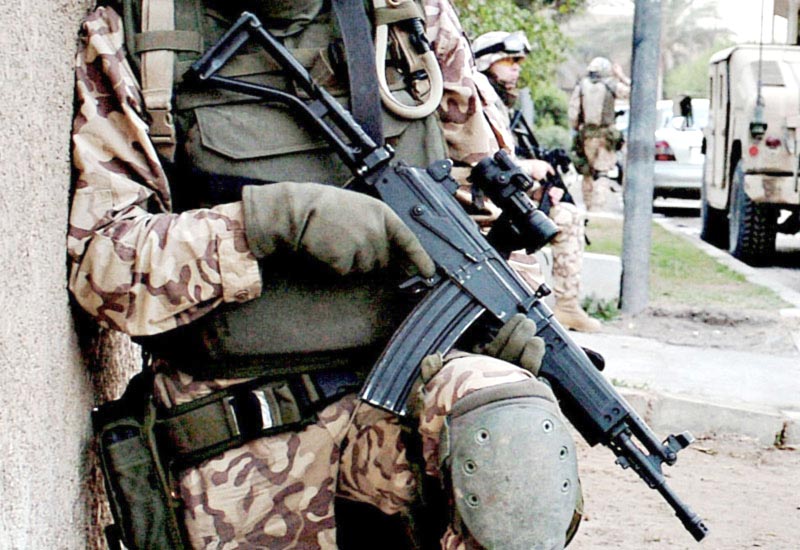
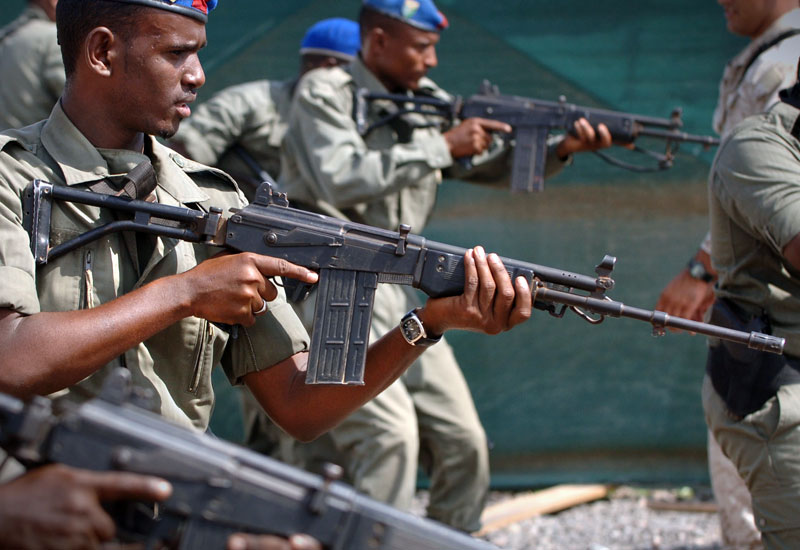
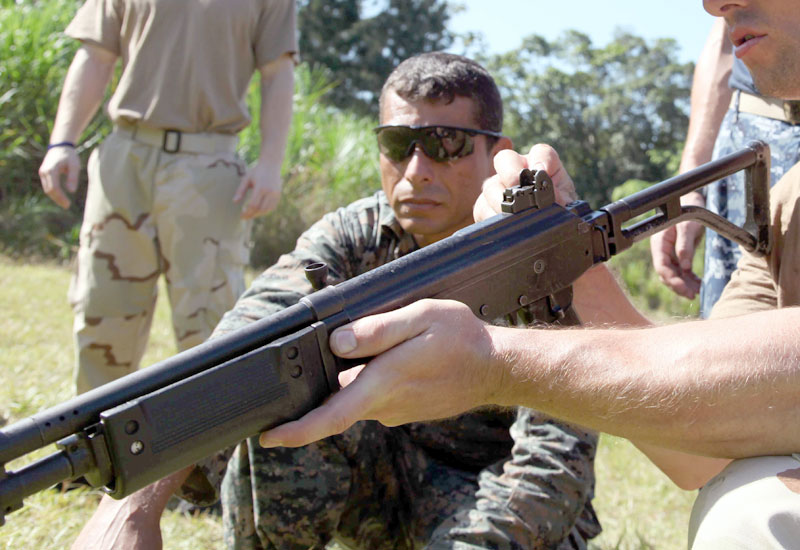
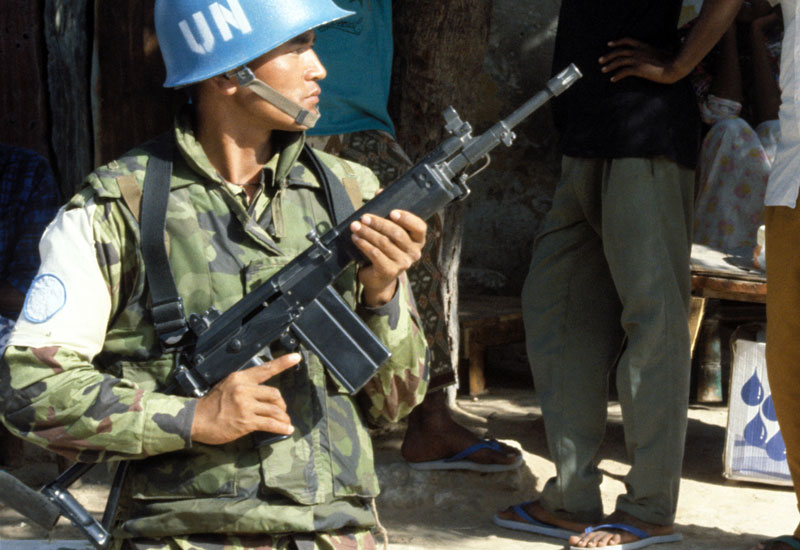
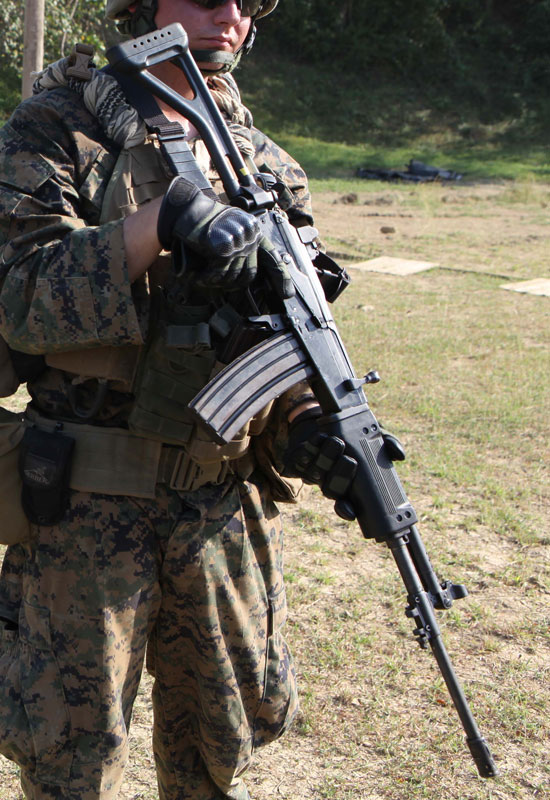
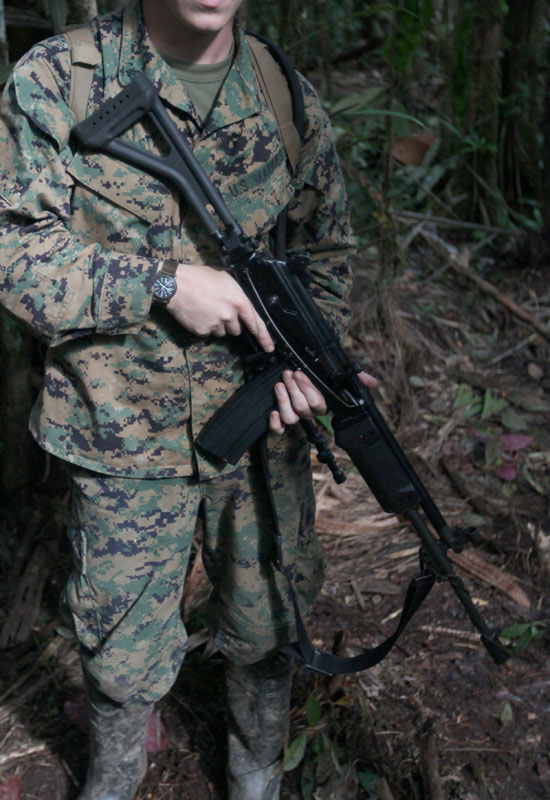
Overall, the Galil bears a passing external resemblance to the AK family. The receiver certainly takes on the same rectangular boxy shape sporting clean straight lines and is also home to an ambidextrous Kalashnikov-style fire selector which permits semi-automatic and full-automatic fire modes. The charging handle and ejection port are all set to the right side of the body though the charging handle is not like those featured in rival Kalashnikovs. The pistol grip, trigger unit and magazine catch are all reminiscent of the AK series as is the curved detachable box magazine fitted ahead of the trigger group. However, the magazine manages the smaller 5.56mm cartridge and can thusly hold 35 such rounds in a stacked format (as opposed to the 30-round limit of the 7.62mm magazines). The firing action itself is also more consistent with that of the American M1 Garand self-loading rifle of World War 2. The stock consists of a twin-strut tubular steel assembly that folds over the right side of the weapon, keeping all firing functions intact. The Dural-lined wooden foregrip is decidedly Israeli with its rectangular cover which houses the top-mounted gas cylinder and low-set barrel assembly. The barrel is capped by a slotted flash hider which can accept rifle grenades. A collapsible wire carrying handle is set to the left side of the body. There are basic iron sights located at the rear of the receiver and at the end of the gas cylinder and night-assist is standard through illumination and optics are optional. The Galil also makes use of a bipod which doubles as a wire cutter and a bayonet can be affixed under the barrel. The Galil is formed largely of machining with the exception of the stamped steel breech cover.

The basic Galil is the Galil ARM which represents the "Assault Rifle / Machine gun" version. The shortened carbine form is the Galil SAR which identifies the weapon as the "Short Assault Rifle". The Galil MAR is also known as the "Micro-Galil' and is the "Micro Assault Rifle" form which is highly suitable for paratroopers, vehicle crews and special forces elements as the internal function and chambering remain the same as in the basic Galil rifle. Only the barrel and foregrip are shortened to make for a dimensionally smaller, more compact form - a design more akin to a submachine gun but still firing the rifle-caliber 5.56mm cartridge (as opposed to the 9mm pistol/submachine gun round). The Marksman's Assault Rifle Mark 1 appeared in 1996 and is intended for Designated Markmen Rifle (DMR) elements at the squad level where repeating, accurate ranged firepower is required without the need for a dedicated sniper element. This weapon is, likewise, chambered for the 5.56x45mm cartridge, features a padded folding tubular steel stock and a standard-issue scope mounted along the left side of the gun body.

Perhaps the most unique of the Galil developments is the Galil Sniper Rifle ("Galatz") which, as its name implies, is intended for true dedicated sniper units. Taking the Galil automatic weapon as the starting point, the sniper version was engineered to chamber the 7.62x51mm NATO cartridge - a cartridge well-suited for long-range work. The full-automatic fire option was dropped and limited to only semi-automatic repeating fire through a two-stage trigger element. Additionally, the design incorporated a heavier barrel assembly, an adjustable bipod and a powerful telescopic sight (the Nimrod 6x40). The barrel can be capped by a muzzle compensator/brake or silencer, the latter for clandestine work. Like other Galils, the sniper variant has a folding metal butt. The Galil Sniper has since been modernized to become the "SR-99".

Other lesser-known variants include the "Magal" which is a Galil MAR model chambered for the 7.62x33mm (.30 Carbine) pistol/carbine cartridge. The "Golan" is the civilian version of the militarized Galil with semi-automatic fire only in an all-new receiver component.

Key to the success of the Galil series is the adaptability of the basic weapon which allows for several varying degrees of configuration to suit battlefield roles. Not only is this an economical measure, it makes use of existing ammunition supplies, tools and training. This has helped to evolve the Galil beyond its original assault rifle role and has now come to include a carbine and sniper form. This sort of adaptability has made it a popular in the foreign market where a special export version chambered for the 7.62x51mm cartridge has made its mark. Notable foreign operators included Brazil, Colombia, Georgia, Indonesia, Italy, Mexico, Philippines and South Africa (as the R4 under license) to name a few. Production has since gone global through localized license-manufacture to include Bernardelli of Italy, Indumil of Colombia and Lyttleton/Denel of South Africa. Columbia has extended the usefulness of their aging Galils with the introduction of the "Galil ACE" which incorporates Picatinny rail support for various sights and accessories, lower maintenance requirements and chambering for the 5.56x45mm NATO, 7.62x39mm Russian and 7.62x51mm NATO cartridges.
Text ©2003-2013 www.MilitaryFactory.com • All Rights Reserved • No Reproduction Permitted
MilitaryFactory.com does NOT sell equipment/weaponry. Material presented throughout this website is for historical and entertainment value and should not to be construed as usable for hardware restoration, maintenance or general operation. Please consult manufacturers for such information. Our disclaimer. Email corrections / Comments to MilitaryFactory at Gmail dot com.
Picture of IMI Galil ARM / SAR
Pic of the IMI Galil ARM / SAR
Image of the IMI Galil ARM / SAR
View All Images (6)

Specifications for the
IMI Galil ARM / SAR
Assault Rifle / Carbine / Submachine Gun / Designated Marksman Rifle


Country of Origin: Israel
Manufacturer: Israeli Military Industries (IMI) - Israel
Initial Year of Service: 1973


Overall Length: 979mm (38.54in)
Barrel Length: 460.00mm (18.11in)
Weight (Empty): 8.71lbs (3.95kg)


Cartridge: 5.56x45mm; 7.62x51mm
Action: Gas-Operated; Rotating Bolt
Feed: 25-, 35- or 50-Round Detachable Box
Muzzle Velocity: 3,117ft/sec (950m/sec)
Rate-of-Fire: 630 rounds per minute
Range: 1,804ft (550m; 601yds)
Sights: Adjustable Iron; Optional Optics


Variants:
Galil ARM - Assault Rifle / Machine Gun Version; base production model.


Galil SAR - Short Assault Rifle; carbine form with shortened barrel and forend.

Galil MAR - Micro-Assault Rifle; submachine gun form with shortened barrel and forend.

Galil Sniper ("Galatz") - Specialized variant with heavier barrel, adjustable bipod and standard telescopic sight.

Magal - Police Variant chambered for .30 Carbine round.

SR-99 - Modernized Galil Sniper

Golan - Civilian Variant; revised receiver; semi-automatic fire only.

Galil ACE - Updated Colombian production models with Picatinny rail support; tool-less design.

R4 - South African locally-produced versin of the Galil.


Operators: Bahamas; Bolivia; Botswana; Brazil; Colombia; Costa Rica; Democratic Republic of Congo; Djibouti; El Salvador; Estonia; Georgia; Guatemala; Haiti; India; Indonesia; Israel; Italy; Lesotho; Mexico; Nicaragua; Peru; Philippines; Portugal; Rwanda; South Africa; Swaziland; Trinidad and Tobago

ALL SMALL ARMS CATEGORIES

BY YEAR:


1700 to 1799
1800 to 1899
1900 to 1909
1910 to 1919
1920 to 1929
1930 to 1939
1940 to 1949
1950 to 1959
1960 to 1969
1970 to 1979
1980 to 1989
1990 to 1999
2000 to 2009
2010 to 2019
VIEW ALL
Compare Guns


BY TYPE:


Anti-Aircraft Weapons
Anti-Material Rifles
Anti-Tank Weapons
Automatic Rifles
Bolt-Action Rifles
Carbine Guns
Flamethrowers
Flintlock Guns
Grenade Launchers
Hand Grenades
Lever-Action Rifles
Machine Guns
Mortars
Musket Guns
Pistols / Handguns
Recoilless Rifles
Revolvers
Rocket Launchers
Shotguns
Silenced Guns
Sniper Rifles
Special Weapon Systems
Submachine Guns
VIEW ALL


SPECIAL:


18th Century Warfare
3 Soldiers Statue
Battle of Mogadishu
Chainmail Armor
Firearm Types Defined
French Military Victories
Medieval Crossbow
Medieval Longbow
Vietnam War Casualties
Vietnam War Memorial

WORLD WAR 2:


British Guns
French Guns
German Guns (ALL)
German Rifles
Italian Guns
Japanese Guns
Soviet Guns
US Guns
US Infantry Regiment-Level Guns
Machine Guns
Pistols
Rifles
Submachine Guns
Sniper Rifles
VIEW ALL


WORLD WAR 1:

Pistols
Rifles
Machine Guns
Mortars
US Guns
VIEW ALL


KOREAN WAR:

Machine Guns
VIEW ALL


VIETNAM WAR:

Mortars
VIEW ALL


COLLECTIONS:


Ancient Weapons
British SAS Weapons
Civil War Guns
Colt Guns
Glock Guns
GROM Polish Special Forces
Guns of Libya
Guns of North Korea
Guns of Syria
Guns of WW1 & WW2
Heckler & Koch Guns
Kalashnikov Guns
Modern Russian Guns
Navy SEAL Weapons
Spetsnaz Weapons
Weapons of Desert Storm
Wild West Guns
Winchester Guns


HOLLYWOOD/GAMES:


Guns of the Walking Dead

Site Disclaimer | Privacy Policy | Site Map | MF Origins


©2013 www.MilitaryFactory.com • Content ©2003-2013 MilitaryFactory.com • All Rights Reserved • Site Contact Email: militaryfactory at gmail dot com. The "Military Factory" name and MilitaryFactory.com logo are registered ® trademarks and protected by all applicable domestic and international intellectual property laws.


Top MF Stuff: 2013 Military Pay Scale | Military Ranks | WW2 Weapons | Sniper Rifles | Kts to Mph | WW1 Aircraft | Automatic Rifles | Aircraft Cockpits | Vietnam War Weapons | Main Battle Tanks | Submachine Guns | Shotguns | French Military Victories


Most photographic images appearing on this site are courtesy of the United States Department of Defense and are approved for public use. Other images acquired through the public domain. Digital art work courtesy of Dan Alex. Business Consulting by Kyle Williams. Material presented throughout this website is for historical and entertainment value and should not to be construed as usable for hardware restoration, maintenance or general operation. Please consult manufacturers for such information.


eXTReMe Tracker