Military Factory
Military Pay Chart
Global Firepower
Military Industrial Complex
Second World War
Home
Military Pay Scale
Military Ranks
Small Arms
Aircraft
Land Systems
Navy
Education
Military Factory Facebook Logo
flag of United States

Burnside Carbine Breech-Loading Carbine Rifle (1856)

Authored By Dan Alex | Last Updated: 3/23/2011

The Burnside Carbine found its way onto many battlefields of the Civil War, utilizing a special .54 caliber cartridge designed specifically for the weapon itself.

Find a School Near You
Follow Military Factory on Facebook:
Trending on Military Factory:
Recent Articles:
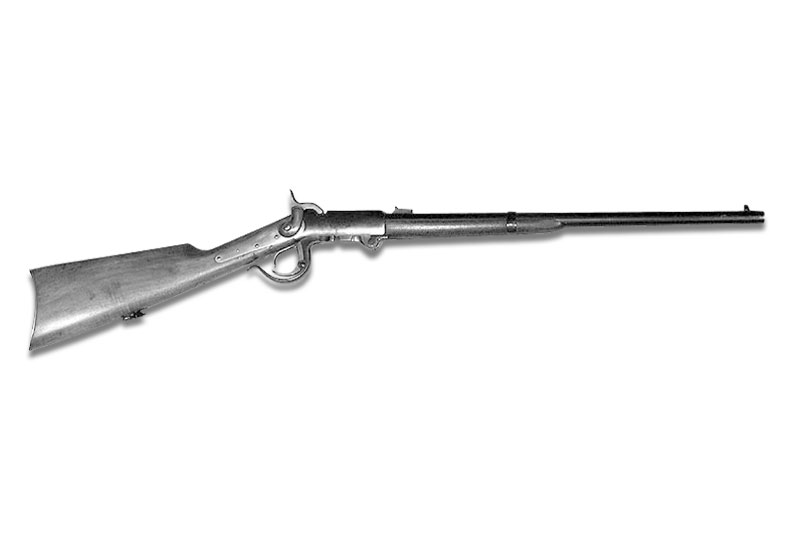
The Burnside Carbine was a popular carbine rifle fielded across all of the major battlefronts of the American Civil War. The weapon was developed by Ambrose E. Burnside from whence the carbine received its name. Burnside was a part of the US Army but gave up his position in order to concentrate on developing the gun in whole. The Burnside Carbine made use of a specially-designed cartridge, this being a brass .54 caliber cartridge developed by Burnside himself. His new weapon and corresponding cartridge did much to eliminate the leaked hot gasses that were common when firing other breech-loading weapons of the time. In the Burnside Carbine, the cartridge itself sealed the barrel from the breech thanks to its specialized design, in effect creating a seal to contain the gasses. In the end, the Burnside Carbine was only rivaled by the Spencer and Sharps types as the most important and quantitative carbine of the American Civil War. The Burnside Carbine was used by both sides in the conflict - a testament to its quality design and engineering.

The Burnside Carbine made use of the breech-loading concept. This allowed the operator the capability to reload his weapon from the rear of the gun body as oppose to jamming a cartridge and propellant down the muzzle (muzzle-loading) by way of a ramrod as was common in muskets. The carbine made use of two trigger guards which were pressed to open the breech block. The open breech block was now made ready to accept a fresh .54 cartridge. Once a cartridge was inserted and the breech block closed, the operator was free to fire the gun. As a percussion-based system, the operator cocked the hammer back via the hammer spur. The pulling of the trigger activated the hammer to which the hammer head struck a percussion cap. The cap sparked and ignited the black powder contained in the cartridge and propelled the bullet out of the barrel. The firing system was fitted along the right side of the body, consistent with musket rifles of the day.

The weapon weighed in at 7lbs and featured a muzzle velocity of 950 feet per second. Effective range was listed out to 200 yards.

What made a carbine "a carbine" was its shortened barrel length when compared to that of a contract rifle. The Burnside Carbine had a barrel measuring in at 21 inches with an overall length of 39.5 inches - suitable for specialized battlefield elements such as cavalry - essentially infantrymen on horseback and trained in the use of the sabre and powerful mounted-charges. The barrel was situated into a wooden frame and single-banded along the foregrip. A forward sight was fitted just aft of the muzzle. The metal body contained the trigger group and hammer action as well as the breech. A rifle-style handgrip was provided as was a curved stock capped with a metal buttplate. The trigger was fitted under the rifle handgrip and ringed by the dual trigger guards.

Burnside fielded his carbine in a West Point competition against some seventeen other carbine designs in 1857 and came out victorious. Initial government orders were slow to follow, however, and it was only the advent of full-blown war in America that pushed orders into the thousands. Union cavalry were among the largest groups operating the handy little weapon. Production of the carbine ran from 1857 to 1865 and was handled by the Burnside Rifle Company and the Bristol Firearms Company of Providence, Rhode Island. Despite appearing in five differing models and having the design improved upon by George P. Foster, the Burnside Carbine was eventually superseded in production by the Spencer Carbine by the end of the war - Burnside facilities were converted to handle government production of the Spencer brand. Ambrose Burnside eventually sold his interest in the company in order to become the Union Army of the Potomac commander.

Despite Burnside's engineering successes with his carbine, he proved to be something of an incompetent officer in the field - leading Union forces to defeat at both the Battle of Fredericksburg and the Battle of the Crater. Nevertheless, his carbine went on to become the stuff of legend made possible by the war.
Text ©2003-2013 www.MilitaryFactory.com • All Rights Reserved • No Reproduction Permitted
MilitaryFactory.com does NOT sell equipment/weaponry. Material presented throughout this website is for historical and entertainment value and should not to be construed as usable for hardware restoration, maintenance or general operation. Please consult manufacturers for such information. Our disclaimer. Email corrections / Comments to MilitaryFactory at Gmail dot com.
Picture of Burnside Carbine
View All Images (1)

Specifications for the
Burnside Carbine
Breech-Loading Carbine Rifle


Country of Origin: United States
Manufacturer: Burnside Rifle Company; Bristol Firearms Company - USA
Initial Year of Service: 1856


Overall Length: 1003mm (39.49in)
Barrel Length: 533.00mm (20.98in)
Weight (Empty): 7.05lbs (3.20kg)


Cartridge: .54
Action: Hammer-Actuated Percussion
Feed: Single-Shot
Muzzle Velocity: 950ft/sec (290m/sec)
Range: 600ft (183m; 200yds)
Sights: Rear and Front


Variants:
Burnside Carbine - Base Series Designation; produced from 1857 to 1865.


Operators:
United States

ALL SMALL ARMS CATEGORIES

BY YEAR:


1700 to 1799
1800 to 1899
1900 to 1909
1910 to 1919
1920 to 1929
1930 to 1939
1940 to 1949
1950 to 1959
1960 to 1969
1970 to 1979
1980 to 1989
1990 to 1999
2000 to 2009
2010 to 2019
VIEW ALL
Compare Guns


BY TYPE:


Anti-Aircraft Weapons
Anti-Material Rifles
Anti-Tank Weapons
Automatic Rifles
Bolt-Action Rifles
Carbine Guns
Flamethrowers
Flintlock Guns
Grenade Launchers
Hand Grenades
Lever-Action Rifles
Machine Guns
Mortars
Musket Guns
Pistols / Handguns
Recoilless Rifles
Revolvers
Rocket Launchers
Shotguns
Silenced Guns
Sniper Rifles
Special Weapon Systems
Submachine Guns
VIEW ALL


SPECIAL:


18th Century Warfare
3 Soldiers Statue
Battle of Mogadishu
Chainmail Armor
Firearm Types Defined
French Military Victories
Medieval Crossbow
Medieval Longbow
Vietnam War Casualties
Vietnam War Memorial

WORLD WAR 2:


Australia
Britain
France
Germany (ALL)
German Rifles
Italy
Japan
Soviet Union
United States
US Infantry Regiment Guns
Machine Guns
Pistols and Handguns
Rifles
Submachine Guns
Sniper Rifles
VIEW ALL


WORLD WAR 1:

Pistols
Rifles
Machine Guns
Mortars
US Guns
VIEW ALL


KOREAN WAR:

Machine Guns
VIEW ALL


VIETNAM WAR:

Mortars
VIEW ALL


COLLECTIONS:


Ancient Weapons
British SAS Weapons
Civil War Guns (ALL)
Civil War Pistols
Colt Guns
Glock Guns
GROM Polish Special Forces
Guns of Libya
Guns of North Korea
Guns of Syria
Guns of WW1 & WW2
Heckler & Koch Guns
Kalashnikov Guns
Modern Russian Guns
Navy SEAL Weapons
Spetsnaz Weapons
Weapons of Desert Storm
Wild West Guns
Winchester Guns


HOLLYWOOD/GAMES:


Guns of the Walking Dead

Site Disclaimer | Privacy Policy | Site Map | MF Origins


©2013 www.MilitaryFactory.com • Content ©2003-2013 MilitaryFactory.com • All Rights Reserved • Site Contact Email: militaryfactory at gmail dot com. The "Military Factory" name and MilitaryFactory.com logo are registered ® trademarks and protected by all applicable domestic and international intellectual property laws.


Top MF Stuff: 2013 Military Pay Scale | Military Ranks | WW2 Weapons | Sniper Rifles | Kts to Mph | WW1 Aircraft | Automatic Rifles | Aircraft Cockpits | Vietnam War Weapons | Main Battle Tanks | Submachine Guns | Shotguns | French Military Victories


Most photographic images appearing on this site are courtesy of the United States Department of Defense and are approved for public use. Other images acquired through the public domain. Digital art work courtesy of Dan Alex. Business Consulting by Kyle Williams. Material presented throughout this website is for historical and entertainment value and should not to be construed as usable for hardware restoration, maintenance or general operation. Please consult manufacturers for such information.


eXTReMe Tracker