Military Factory
Military Pay Chart
Global Firepower
Military Industrial Complex
Second World War
Home
Military Pay Scale
Military Ranks
Small Arms
Aircraft
Land Systems
Navy
Education
Military Factory Facebook Logo
flag of Nazi Germany

MP38 (Maschinenpistole 38) Submachine Gun (1938)

Authored By Staff Writer | Last Updated: 11/16/2012

The MP38 submachine gun set the mold for future submachine gun designs to follow.

Find a School Near You
Follow Military Factory on Facebook:
Trending on Military Factory:
Recent Articles:
The MP38 served as the predecessor to the well known MP40 series of mass-produced submachine guns developed by the Germans in World War 2. The type was revolutionary principally in its construction which broke from the practiced norms of the time. However, the MP38 was eventually deemed too expensive to produce in the large numbers required for the German Army, resulting in the creation of its simplified sister design - the MP40 of 1940 - which utilized steel pressings and welds while keeping machining to a minimum.

The submachine gun had gained steam in the interwar years following World War 1 as an interim firearm for use by general infantry, special forces and vehicle crews requiring self-defense. Submachine guns could be fired from the confines of a tank and even a non-combat detachment could arm themselves when traversing across hostile territory. For special forces groups or special units such as paratroopers, the submachine gun was portable and suitable for Close-Quarters Battle (CQB) and, with general infantry, it served well alongside established rifle units and machine gun elements in nearly any environment. In any case, the submachine gun remains just as important to the modern army today as it did in World War 2.

Development of the MP38 originated from an Oberkommando der Wehrmacht requirement for a submachine gun to stock the inventory of the fast-moving German Army. The German Army was fine-tuning the concept of Blitzkrieg to prove the value of fast-moving mechanized forces operating in conjunction with air support. The construction process of the new MP38 called upon sheet metal stampings and die-casting while incorporating use of plastics in the furniture instead of wood. A folding bare metal butt made the design and allowed for maximum portability during marches and maximum stability when firing. Upon completing the requisite trials, the MP38 entered production in 1938 out of the Erfurter Maschinenfabrik B. Geipel GmbH (Erma-Werke) facility at Erfurt.

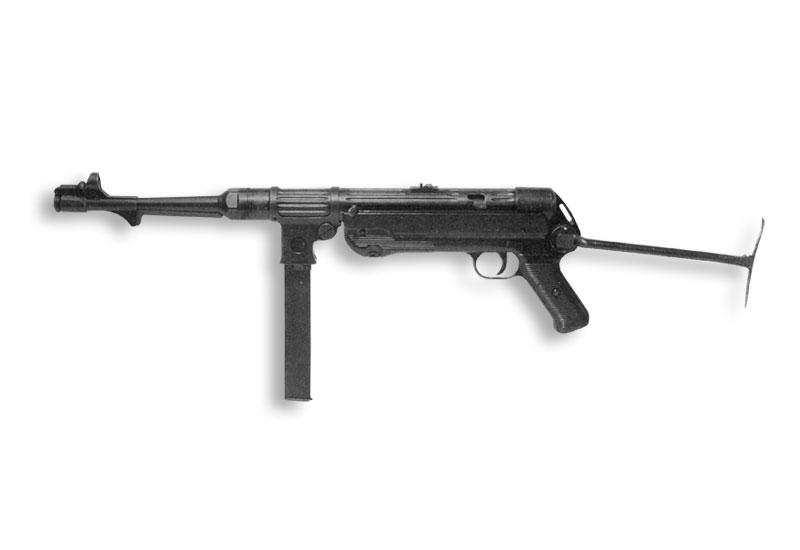
Overall, the MP38 featured a running length of 32.75 inches with the butt fully extended and a length of 24.76 inches with the butt fully collapsed - a savings of nearly 8 inches. The butt looped downwards to collapse along the underside of the gun body along a two-point pivoting assembly at the rear of the receiver. This feature was taken from the preceding 9mm MP "Erma" submachine gun design which was the first such firearm to sport this space-saving quality. The receiver contained all of the critical internal working components including the recoil spring (housed within a telescoping casing) running half the length of the weapon. In essence, the magazine feed coupled with a spring-loaded magazine simply served to set the next available round ahead of the firing pin in the firing chamber in automatic fashion. The barrel measured 9.72 inches in length and unloaded weight of the gun system was just over 9lbs. The MP38 was fed from a 32-round, single column detachable box magazine which, while serving as a forward vertical handgrip, also served to give the MP38 submachine gun (and its future kin) its unique profile. The weapon was chambered for the 9mm Parabellum cartridge. The receiver was very industrial in its display with the cocking handle set to the left side of the body. The barrel protruded ahead a short distance from the body and fore (tunnel) and aft sights were noted. Under the barrel there appeared a "lip", or "resting bar", designed to latch onto the sides of vehicle walls to help support the barrel-end of the weapon when firing and keep the recoil from driving the weapon back inside the vehicle's fighting compartment. A "cooling fin" was machined under the barrel length to help dissipate heat. The curved trigger unit sat within a strong oblong ring which was attached to the angled pistol grip, the latter made from Balkelite plastic to save on weight and steel use - a first for a submachine gun. Despite its somewhat distinct design, the internal workings of the MP38 were rather conventional, the firing operation making use of the blowback principle with a bolt. There was no built-in safety mode selector and firing was only limited to full-automatic, requiring a firm, two-handed hold.

Once in practice during the Polish Campaign of 1939, the MP38 soon shown limitations - some even lethal to its owners. Chiefly, her manufacturing process was rather inefficient considering the requirement for steel in wartime Germany leading German authorities to request a cheaper mass-production model following the same design form - this became the famous MP40 series. The two guns were differentiated visibly by the MP38's corrugated steel receiver exterior, machined grip and a perforation to the magazine housing. Another drawback in the MP submachine gun family line was the single-column feed mechanism which proved prone to jamming. Still another fault lay in the bolt assembly that, when cocked and the weapon accidentally knocked, could cause the bolt to move forward, initiating the firing process and allowing the weapon to fire on its own. To solve this unintentional firing issue, a safety catch was instituted into the design and MP38s modified in this way became known by the designation of "MP38/40". MP38s were typically issued to Non-Commissioned Officers of the German Army governing machine gun emplacements allowing them to fight on at shorter ranges than their machine guns would allow.

The MP38 submachine gun is often referred to as the "Schmeisser" after engineer Hugo Schmeisser though he had nil to do with the development of the MP38, making his association with the firearm technically incorrect - the MP38's design is actually formally attributed to Heinrich Vollmer. Regardless, the Allies knew the weapon as the "Schmeisser". Even Allied soldiers appreciated the MP series enough to acquire them and use them against their former owners when possible. As can be expected, the MP series also proved a favorite among various partisan groups.
Text ©2003-2013 www.MilitaryFactory.com • All Rights Reserved • No Reproduction Permitted
MilitaryFactory.com does NOT sell equipment/weaponry. Material presented throughout this website is for historical and entertainment value and should not to be construed as usable for hardware restoration, maintenance or general operation. Please consult manufacturers for such information. Our disclaimer. Email corrections / Comments to MilitaryFactory at Gmail dot com.
Picture of MP38 (Maschinenpistole 38)
View All Images (1)

Specifications for the
MP38 (Maschinenpistole 38)
Submachine Gun


Country of Origin: Nazi Germany
Manufacturer: Erma-Werke - Nazi Germany
Initial Year of Service: 1938


Overall Length: 832mm (32.76in)
Barrel Length: 247.00mm (9.72in)
Weight (Empty): 9.13lbs (4.14kg)


Cartridge: 9mm Parabellum
Action: Blowback; Full-Automatic Only
Feed: 32-round detachable box magazine
Muzzle Velocity: 1,250ft/sec (381m/sec)
Rate-of-Fire: 500 rounds per minute
Sights: Front Tunnel and Rear


Variants:
MP38 - Base Series Designation


MP38/40 - Safety Catch installed to prevent unintended fire.

MP40 - Simplified production variant


Operators: Austria; Bulgaria; Denmark; Finland; Greece; Indonesia; Hungary; Malaysia; Netherlands; Nazi Germany; Norway; Romania; Philippines; Poland; Spain; United States; West Germany; Yugoslavia; North Vietnam; Soviet Union

ALL SMALL ARMS CATEGORIES

BY YEAR:


1700 to 1799
1800 to 1899
1900 to 1909
1910 to 1919
1920 to 1929
1930 to 1939
1940 to 1949
1950 to 1959
1960 to 1969
1970 to 1979
1980 to 1989
1990 to 1999
2000 to 2009
2010 to 2019
VIEW ALL
Compare Guns


BY TYPE:


Anti-Aircraft Weapons
Anti-Material Rifles
Anti-Tank Weapons
Automatic Rifles
Bolt-Action Rifles
Carbine Guns
Flamethrowers
Flintlock Guns
Grenade Launchers
Hand Grenades
Lever-Action Rifles
Machine Guns
Mortars
Musket Guns
Pistols / Handguns
Recoilless Rifles
Revolvers
Rocket Launchers
Shotguns
Silenced Guns
Sniper Rifles
Special Weapon Systems
Submachine Guns
VIEW ALL


SPECIAL:


18th Century Warfare
3 Soldiers Statue
Battle of Mogadishu
Chainmail Armor
Firearm Types Defined
French Military Victories
Medieval Crossbow
Medieval Longbow
Vietnam War Casualties
Vietnam War Memorial

WORLD WAR 2:


British Guns
French Guns
German Guns (ALL)
German Rifles
Italian Guns
Japanese Guns
Soviet Guns
US Guns
US Infantry Regiment-Level Guns
Machine Guns
Pistols
Rifles
Submachine Guns
Sniper Rifles
VIEW ALL


WORLD WAR 1:

Pistols
Rifles
Machine Guns
Mortars
US Guns
VIEW ALL


KOREAN WAR:

Machine Guns
VIEW ALL


VIETNAM WAR:

Mortars
VIEW ALL


COLLECTIONS:


Ancient Weapons
British SAS Weapons
Civil War Guns
Colt Guns
Glock Guns
GROM Polish Special Forces
Guns of Libya
Guns of North Korea
Guns of Syria
Guns of WW1 & WW2
Heckler & Koch Guns
Kalashnikov Guns
Modern Russian Guns
Navy SEAL Weapons
Spetsnaz Weapons
Weapons of Desert Storm
Wild West Guns
Winchester Guns


HOLLYWOOD/GAMES:


Guns of the Walking Dead

Site Disclaimer | Privacy Policy | Site Map | MF Origins


©2013 www.MilitaryFactory.com • Content ©2003-2013 MilitaryFactory.com • All Rights Reserved • Site Contact Email: militaryfactory at gmail dot com. The "Military Factory" name and MilitaryFactory.com logo are registered ® trademarks and protected by all applicable domestic and international intellectual property laws.


Top MF Stuff: 2013 Military Pay Scale | Military Ranks | WW2 Weapons | Sniper Rifles | Kts to Mph | WW1 Aircraft | Automatic Rifles | Aircraft Cockpits | Vietnam War Weapons | Main Battle Tanks | Submachine Guns | Shotguns | French Military Victories


Most photographic images appearing on this site are courtesy of the United States Department of Defense and are approved for public use. Other images acquired through the public domain. Digital art work courtesy of Dan Alex. Business Consulting by Kyle Williams. Material presented throughout this website is for historical and entertainment value and should not to be construed as usable for hardware restoration, maintenance or general operation. Please consult manufacturers for such information.


eXTReMe Tracker