Military Factory
Military Pay Chart
Global Firepower
Military Industrial Complex
Second World War
Home
Military Pay Scale
Military Ranks
Small Arms
Aircraft
Land Systems
Navy
Education
Military Factory Facebook Logo
flag of United States

Colt Model 1917 Service Revolver (1917)

Authored By Staff Writer | Last Updated: 11/19/2012

Some 150,000 Colt Model 1917 revolvers were produced from 1917 to 1920 to fill the American World War 1 need for arms.

Find a School Near You
Follow Military Factory on Facebook:
Trending on Military Factory:
Recent Articles:
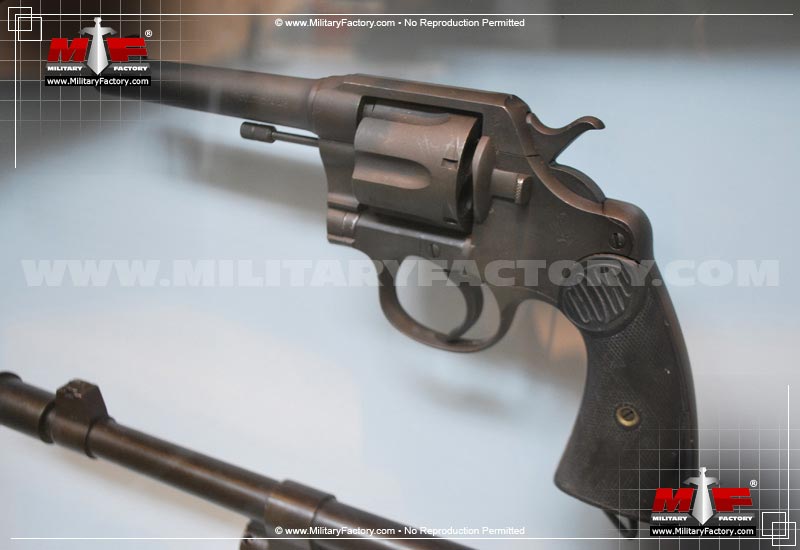
When the Americans formally entered World War 1 in 1917, they lacked much in the way of viable fighting equipment and this included stores of viable military small arms. The United States Army had already adopted the semi-automatic, repeating Colt M1911 pistol designed by John Browning but needed to shore up war-time limitations even when various manufacturers had already committed to production of the M1911. The US Army, therefore, chartered both the Colt and Smith & Wesson concerns to produce a six-shot revolver sidearm under the "M1917" designation and chambered for the .45 ACP cartridge - the same as used in the M1911. Both firms naturally accepted the government contract and each went on to produce slightly different versions of the gun based on each firm's own respective civilian types.

Some years earlier, Colt had already unveiled their civilian-minded "New Service Model" revolver chambered for the ".45 Long Colt" cartridge. Colt was then lucky enough to have the gun accepted into US Army service as the "M1909". It was this revolver that Colt elected to use to fulfill the US Army need and began boring their cylinders to accept the required .45 ACP cartridge. The end result was a serviceable and effective revolver that was very conventional in its base design.

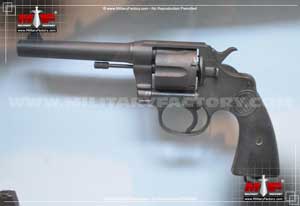
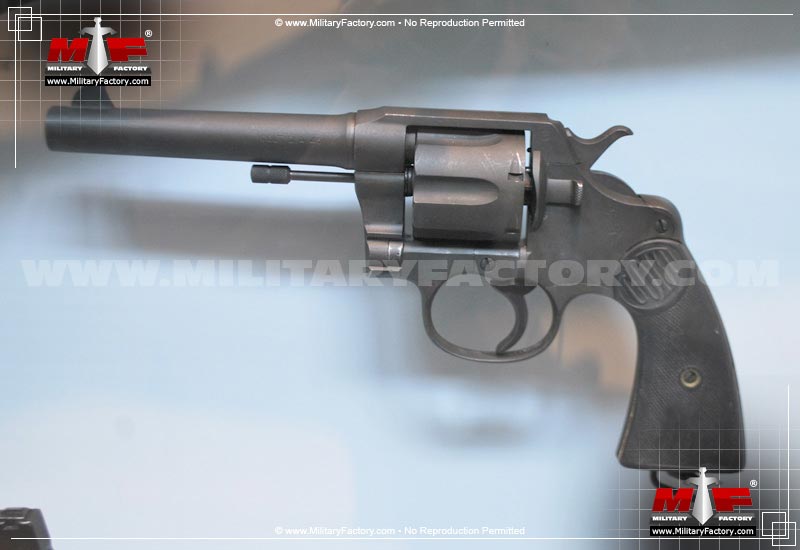
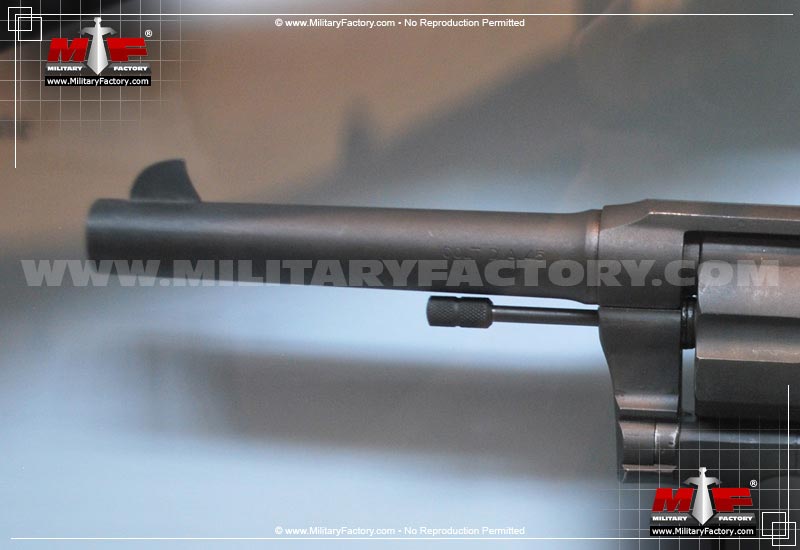
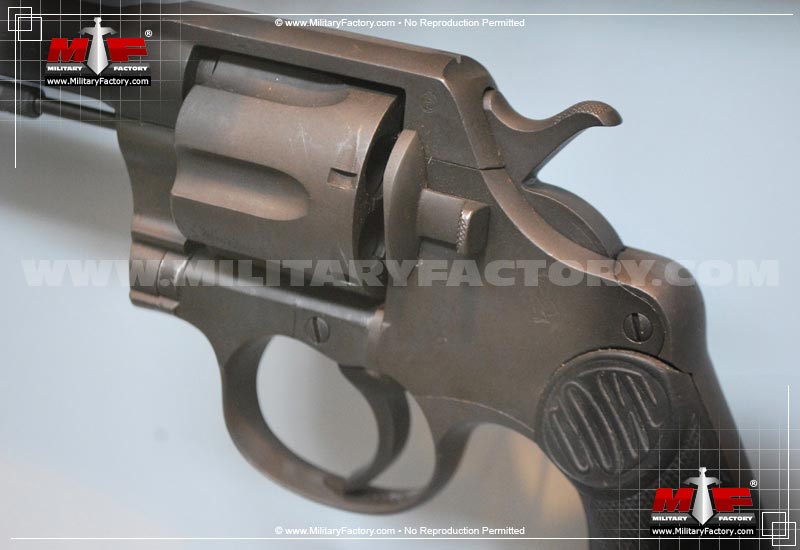
The frame was solid (meaning an integrated "bridge" was fitted over the cylinder for a more durable design) with a smooth barrel protruding forwards and marked with a forward blade sight just aft of the muzzle. The barrel measured a standard length of 5.5 inches while the revolver exhibited an overall length of 10.8 inches. A rear notch sight was also included in the design. The trigger ring was integrated into the receiver itself and managed a curved, double-action trigger assembly. This "double-action" terminology meant that no manually-actuated cocking of the hammer was required on the part of the operator - he need only pull the trigger and the hammer cocked automatically (though it could still be managed manually if so desired). The pistol grip was well-contoured downwards for a firm hand hold and covered over in wooden detail. The exposed hammer spur protruded from the rear of the receiver which allowed for manual cocking if required. An ejector rod was fitted under the barrel ahead of the frame and this was furthermore connected to the cylinder. The cylinder was fluted along its surface and bored to accepted six cartridges of .45 ACP or .45 Auto Rim ammunition, rotating smoothly in its stout frame. For reloading, the cylinder was designed to "swing out" for easy access to each of the available cartridge chambers. Overall weight was 2.5lbs while muzzle velocity was rated at 760 feet per second.

Production of the M1917 revolver began in 1917 and spanned into 1920. All told, some 300,000 of the type were produced with Smith & Wesson managing 150,000 of their own version (these based on the Second model .44 Hand Ejector - now chambered for .45 ACP). The M1917 could be loaded by the operator with individual .45 ACP cartridges or make use of the Smith & Wesson-inspired, three-round "half-moon" cartridge clips. These cartridge clips allowed for quicker loading of up to three .45 cartridges at a time and made extraction of spent cartridges easier in the heat of battle (as opposed to manually reloading/extracting single rounds).The US Army lobbied Smith & Wesson to allow Colt the use of these cartridge clips and was ultimately granted permission. Therefore, the Colt M1917 could make use of the Smith & Wesson patented technology without any cost to itself or legal recourse from Smith & Wesson.

The M1917 survived in service into 1954. Its circulation in number ensured that the weapon saw action in every major American conflict of the century including World War 1, World War 2, the Korean War and the Vietnam War. The US Army and US Marine Corps both made use of the type while other global operators included Brazil and South Vietnam. After official frontline use had ended, the type served well as a cheap and reliable second-line system for non-combat entities and the like.
Text ©2003-2013 www.MilitaryFactory.com • All Rights Reserved • No Reproduction Permitted
MilitaryFactory.com does NOT sell equipment/weaponry. Material presented throughout this website is for historical and entertainment value and should not to be construed as usable for hardware restoration, maintenance or general operation. Please consult manufacturers for such information. Our disclaimer. Email corrections / Comments to MilitaryFactory at Gmail dot com.
Picture of Colt Model 1917
View All Images (1)

Specifications for the
Colt Model 1917
Service Revolver


Country of Origin: United States
Manufacturer: Colt / Smith & Wesson - USA
Initial Year of Service: 1917


Overall Length: 270mm (10.63in)
Barrel Length: 140.00mm (5.51in)
Weight (Empty): 2.43lbs (1.10kg)


Cartridge: .45 ACP; .45 Auto Rim
Action: Double-Action; Rotating Cylinder
Feed: 6-shot revolving cylinder (3-round Moon Clips)
Muzzle Velocity: 760ft/sec (232m/sec)
Rate-of-Fire: 15 rounds per minute
Sights: Notched Rear; Front Blade Post


Variants:
M1917 - Base Series Designation; based on the M1909 US Army revolver which itself was based on the Colt New Service Model revolver.


Operators: Brazil; South Vietnam; United States

ALL SMALL ARMS CATEGORIES

BY YEAR:


1700 to 1799
1800 to 1899
1900 to 1909
1910 to 1919
1920 to 1929
1930 to 1939
1940 to 1949
1950 to 1959
1960 to 1969
1970 to 1979
1980 to 1989
1990 to 1999
2000 to 2009
2010 to 2019
VIEW ALL
Compare Guns


BY TYPE:


Anti-Aircraft Weapons
Anti-Material Rifles
Anti-Tank Weapons
Automatic Rifles
Bolt-Action Rifles
Carbine Guns
Flamethrowers
Flintlock Guns
Grenade Launchers
Hand Grenades
Lever-Action Rifles
Machine Guns
Mortars
Musket Guns
Pistols / Handguns
Recoilless Rifles
Revolvers
Rocket Launchers
Shotguns
Silenced Guns
Sniper Rifles
Special Weapon Systems
Submachine Guns
VIEW ALL


SPECIAL:


18th Century Warfare
3 Soldiers Statue
Battle of Mogadishu
Chainmail Armor
Firearm Types Defined
French Military Victories
Medieval Crossbow
Medieval Longbow
Vietnam War Casualties
Vietnam War Memorial

WORLD WAR 2:


British Guns
French Guns
German Guns (ALL)
German Rifles
Italian Guns
Japanese Guns
Soviet Guns
US Guns
US Infantry Regiment-Level Guns
Machine Guns
Pistols
Submachine Guns
Sniper Rifles
VIEW ALL


WORLD WAR 1:

Pistols
Rifles
Machine Guns
Mortars
US Guns
VIEW ALL


KOREAN WAR:

Machine Guns
VIEW ALL


VIETNAM WAR:

Mortars
VIEW ALL


COLLECTIONS:


Ancient Weapons
British SAS Weapons
Civil War Guns
Colt Guns
Glock Guns
GROM Polish Special Forces
Guns of Libya
Guns of North Korea
Guns of Syria
Guns of WW1 & WW2
Heckler & Koch Guns
Kalashnikov Guns
Modern Russian Guns
Navy SEAL Weapons
Spetsnaz Weapons
Weapons of Desert Storm
Wild West Guns
Winchester Guns


HOLLYWOOD/GAMES:


Guns of the Walking Dead

Site Disclaimer | Privacy Policy | Site Map | MF Origins


©2013 www.MilitaryFactory.com • Content ©2003-2013 MilitaryFactory.com • All Rights Reserved • Site Contact Email: militaryfactory at gmail dot com. The "Military Factory" name and MilitaryFactory.com logo are registered ® trademarks and protected by all applicable domestic and international intellectual property laws.


Top MF Stuff: 2013 Military Pay Scale | Military Ranks | WW2 Weapons | Sniper Rifles | Kts to Mph | WW1 Aircraft | Automatic Rifles | Aircraft Cockpits | Vietnam War Weapons | Main Battle Tanks | Submachine Guns | Shotguns | French Military Victories


Most photographic images appearing on this site are courtesy of the United States Department of Defense and are approved for public use. Other images acquired through the public domain. Digital art work courtesy of Dan Alex. Business Consulting by Kyle Williams. Material presented throughout this website is for historical and entertainment value and should not to be construed as usable for hardware restoration, maintenance or general operation. Please consult manufacturers for such information.


eXTReMe Tracker