Military Factory
Military Pay Chart
Global Firepower
Military Industrial Complex
Second World War
Home
Military Pay Scale
Military Ranks
Small Arms
Aircraft
Land Systems
Navy
Education
Military Factory Facebook Logo
flag of United States

Ingram MAC-10 (M10) Submachine Gun (1970)

Authored By Staff Writer | Last Updated: 8/17/2012

The Ingram MAC-10 has seen periods of service with a handful of operators worldwide including special forces elements of the United States.

Find a School Near You
Follow Military Factory on Facebook:
Trending on Military Factory:
Recent Articles:
The Ingram MAC-10 (M10) was a short-lived, compact submachine gun foray seeing limited production and equally-limited action across the globe. While introducing some impressive and interesting concepts, the weapon system failed to materialize as a serious contender within the established submachine market and was soon overtaken by other factor out of her control. The weapon system was not helped by the American military's decision to pass on full production orders and her future was ultimately decided for her with the collapse of her host company, Military Armament Corporation (MAC - hence the "MAC-10" designation). Despite the widely-accepted designation of "MAC-10", the submachine gun was officially marketed as the "M10" and the former identifier was never used in any official capacity. However, it has since become universally accepted as the "MAC-10" and nothing more.

MAC-10 Origins

Design of the MAC-10 began as early as 1964 by Gordon B. Ingram. Ingram was a former associate at the Police Ordnance Corporation before leaving to develop the MAC-10. He partnered with Mitchell Werbell III, a former OSS and CIA operative and founder of SIONICS (Studies In the Operational Negation of Insurgents and Counter-Subversion) - a firm centering on the development and sales of firearm-capable suppressors and silencers and their partnership produced the Military Armament Corporation (MAC). Their joint venture and flagship product was to become the MAC-10 with the ultimate hope being quantitative sales to the US military during the ongoing Vietnam War.

To the casual observer, the MAC-10 showcased a design not unlike the Israeli-made UZI series (as well as other submachine guns that have mimicked this general design layout). The submachine gun was characterized by a rectangular receiver fitting a simple straight pistol grip that doubled as the magazine feed. There was a rounded-rectangle trigger ring ahead of the pistol grip and below the forward portion of the receiver. The safety catch was set to the right of the trigger guard. Construction was of steel stampings and the bolt was of a wrap-around - or telescoping - design, essentially "wrapping around" the barrel and allowing the MAC-10 to achieve such a short receiver length and thus remain a compact weapon system. These design elements made for a steady gun platform, concentrating the firing action balance just over the pistol grip. The cocking handle was situated along the stop of the receiver and accessible by either hand. Interestingly, there was a notch cut through the handle to ensure an unfettered line-of-sight between the operator, the weapon and his target. The cocking handle also doubled as a safety for it could be turned in a 90-degree action to lock the bolt and serve as a visual indicator that the weapon was made safe and unready to fire. The firing action was accomplished through an open bolt, blow-back operated design. A rather large ejection port opening was fitted along the right side of the receiver, corresponding to the placement of the magazine beneath it. A short sling could be attached to a hook at the front panel of the receiver.

The base MAC-10 model was chambered to fire the powerful man-stopping .45 ACP cartridge and could do so by way of a 30-round detachable box magazine. Muzzle velocity was rated at 919 feet per second with the heavy bullet and rate-of-fire was an impressive 1,145 rounds per minute. The removable wire stock was fully collapsible to allow for an ever more compact design. Overall length was 1 foot, 9.6 inches with the stock extended but the system could maintain an incredible length of just 10.7 inches with the stock completely removed. The length was increased to 2 feet, 7.4 inches with the addition of the sound suppressor (detailed below). Unloaded weight registered at 2.84 kilograms sans the suppressor.

It's All in the Barrel

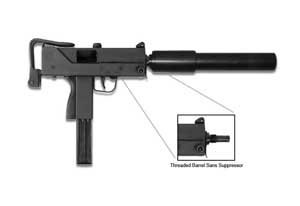
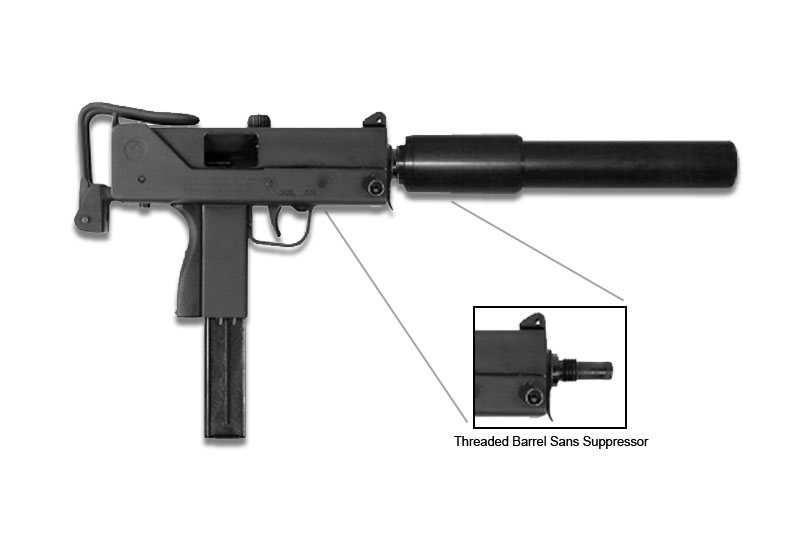
Perhaps the most unique of all the MAC-10 features was its threaded barrel. The thread - similar to a bottle's top - was clearly visible just passed the forward portion of the receiver front and aft of the short protruding barrel. This was to support the Werbell-designed sound suppressor (a device different than a silencer). The sound suppressor could simply be screwed on over the threads for a tight fitting and allowed the operator to fire his weapon without the bullet velocity loss, a drawback inherent in a silencer. While not truly a "silenced" weapon, the firing action of a suppressed MAC-10 was akin to that of small "crack" sound, helping the operator still maintain some element of surprise or concealment from an alert enemy.

The suppressor used in the MAC-10 had a two-stage design clearly seen in available photography. The first stage offered a large cylinder that fed into a longer, slimmer cylinder. The resulting design proved a very quite sound suppressor when in practice and could efficiently double as a foregrip in adding additional close-quarters, two-handed stability to the submachine gun. Weighing in at just 1.20 pounds, the 11.44-inch suppressor system did not increase the weight of the MAC-10 by much, making the complete system quite manageable to handle, even if firing the weapon with one hand.

The MAC-11

The MAC-11 existed as a near-identical version of the base MAC-10 save for its overall smaller dimensions and its chambering for the 9mm "Short" cartridge. The intent with this design was to market it for interested police and security forces already making use of the 9mm Parabellum cartridge but in need of the firepower inherent in a compact submachine gun body. The MAC-11 fired the smaller caliber cartridge through a 32-round detachable box magazine. Muzzle velocity was reported at 1,201 feet per second while rate-of-fire was roughly 1,090 rounds per minute.


Success Proves Elusive

Success for the MAC-10, as a series, proved quite elusive during her tenure. The submachine gun was showcased by a few, usually special, groups around the globe including the United States Navy SEALs during the Vietnam War from 1970 to 1976. Military Armament Corporation proved to be underfunded for the venture and soon went into bankruptcy. Additionally, recent restrictions were placed on the exporting of sound suppressors to foreign markets. Since the suppression capabilities of the MAC-10 were one of its major selling points, interest parties on the global stage soon backed away from potential purchases and some orders in process were cancelled outright once the export restrictions were announced. Military Armament Company went out of business in 1976. The MAC-10 design, however, lived on as it was passed from firm to firm, each attempting - in turn - to profit from the unique submachine gun. None were able to save the MAC-10 and production of the system concluded in 1986.

While an innovative weapon in its own right, and the unaccredited star of several Hollywood productions (including several television appearances), the real-life MAC-10 failed to have the commercial impact that was expected despite her popularity in premiere circles.
Text ©2003-2013 www.MilitaryFactory.com • All Rights Reserved • No Reproduction Permitted
MilitaryFactory.com does NOT sell equipment/weaponry. Material presented throughout this website is for historical and entertainment value and should not to be construed as usable for hardware restoration, maintenance or general operation. Please consult manufacturers for such information. Our disclaimer. Email corrections / Comments to MilitaryFactory at Gmail dot com.
Picture of Ingram MAC-10 (M10)
View All Images (1)

Specifications for the
Ingram MAC-10 (M10)
Submachine Gun


Country of Origin: United States
Manufacturer: Military Armament Corporation - USA
Initial Year of Service: 1970


Overall Length: 269mm (10.59in)
Barrel Length: 146.00mm (5.75in)
Weight (Empty): 6.26lbs (2.84kg)


Cartridge: .45 ACP; 9x19mm Parabellum; .380 ACP
Action: Blowback-Operation; Full-Automatic Fire
Feed: 30- or 32-round detachable box magazine
Muzzle Velocity: 919ft/sec (280m/sec)
Rate-of-Fire: 1,146 rounds per minute
Range: 164ft (50m; 55yds)
Sights: Iron; Optional Scope Mount


Variants:
MAC-10 "Military Armament Corporation Model 10" - Base Designation.


MAC-10/9 - Chambered to fire the 9mm cartridge; based on the MAC-10.

MAC-11 - Smaller version of the MAC-10; chambered to fire the .380 ACP cartridge.

MAC-11/9 - Lengthened receiver; based on the MAC-11; chambered to fire the 9mm cartridge.

M10 - Official Company Designation of the MAC-10

M11 - Official Company Designation of the MAC-11


Operators: Chile; Colombia; Dominican Republic; Saudi Arabia; Spain; United Kingdom; United States

ALL SMALL ARMS CATEGORIES

BY YEAR:


1700 to 1799
1800 to 1899
1900 to 1909
1910 to 1919
1920 to 1929
1930 to 1939
1940 to 1949
1950 to 1959
1960 to 1969
1970 to 1979
1980 to 1989
1990 to 1999
2000 to 2009
2010 to 2019
VIEW ALL
Compare Guns


BY TYPE:


Anti-Aircraft Weapons
Anti-Material Rifles
Anti-Tank Weapons
Automatic Rifles
Bolt-Action Rifles
Carbine Guns
Flamethrowers
Flintlock Guns
Grenade Launchers
Hand Grenades
Lever-Action Rifles
Machine Guns
Mortars
Musket Guns
Pistols / Handguns
Recoilless Rifles
Revolvers
Rocket Launchers
Shotguns
Silenced Guns
Sniper Rifles
Special Weapon Systems
Submachine Guns
VIEW ALL


SPECIAL:


18th Century Warfare
3 Soldiers Statue
Battle of Mogadishu
Chainmail Armor
Firearm Types Defined
French Military Victories
Medieval Crossbow
Medieval Longbow
Vietnam War Casualties
Vietnam War Memorial

WORLD WAR 2:


British Guns
French Guns
German Guns (ALL)
German Rifles
Italian Guns
Japanese Guns
Soviet Guns
US Guns
US Infantry Regiment-Level Guns
Machine Guns
Pistols
Rifles
Submachine Guns
Sniper Rifles
VIEW ALL


WORLD WAR 1:

Pistols
Rifles
Machine Guns
Mortars
US Guns
VIEW ALL


KOREAN WAR:

Machine Guns
VIEW ALL


VIETNAM WAR:

Mortars
VIEW ALL


COLLECTIONS:


Ancient Weapons
British SAS Weapons
Civil War Guns
Colt Guns
Glock Guns
GROM Polish Special Forces
Guns of Libya
Guns of North Korea
Guns of Syria
Guns of WW1 & WW2
Heckler & Koch Guns
Kalashnikov Guns
Modern Russian Guns
Navy SEAL Weapons
Spetsnaz Weapons
Weapons of Desert Storm
Wild West Guns
Winchester Guns


HOLLYWOOD/GAMES:


Guns of the Walking Dead

Site Disclaimer | Privacy Policy | Site Map | MF Origins


©2013 www.MilitaryFactory.com • Content ©2003-2013 MilitaryFactory.com • All Rights Reserved • Site Contact Email: militaryfactory at gmail dot com. The "Military Factory" name and MilitaryFactory.com logo are registered ® trademarks and protected by all applicable domestic and international intellectual property laws.


Top MF Stuff: 2013 Military Pay Scale | Military Ranks | WW2 Weapons | Sniper Rifles | Kts to Mph | WW1 Aircraft | Automatic Rifles | Aircraft Cockpits | Vietnam War Weapons | Main Battle Tanks | Submachine Guns | Shotguns | French Military Victories


Most photographic images appearing on this site are courtesy of the United States Department of Defense and are approved for public use. Other images acquired through the public domain. Digital art work courtesy of Dan Alex. Business Consulting by Kyle Williams. Material presented throughout this website is for historical and entertainment value and should not to be construed as usable for hardware restoration, maintenance or general operation. Please consult manufacturers for such information.


eXTReMe Tracker