Military Factory
Military Pay Chart
Global Firepower
Military Industrial Complex
Second World War
Home
Military Pay Scale
Military Ranks
Small Arms
Aircraft
Land Systems
Navy
Education
Military Factory Facebook Logo
flag of Germany

Heckler & Koch HK G36 Assault Rifle / Assault Carbine (1996)

Authored By Staff Writer | Last Updated: 8/18/2012

The Heckler & Koch HK G36 assault rifle is the standard frontline service gun of the Germany Army.

Find a School Near You
Follow Military Factory on Facebook:
Trending on Military Factory:
Recent Articles:
The Heckler & Koch HK G36 series assault rifle was designed and developed to an exacting German Army requirement of the 1990s intended to replace the outgoing 7.62x51mm HK G3 series battle rifles - the standard German Army service rifle of the time. The 7.62mm cartridge held tremendous man-stopping capabilities and inherently good range but conformance to a NATO standard weapon firing the 5.56x45mm cartridge was in order. Heckler & Koch had given up the 4.7x33mm HK G11 "caseless" system after the collapse of the Soviet Union (funding and interest appropriately dried up). For a time, it was seen that the G11 could be paired with the 5.56x45mm HK G41 as the newest German Army additions, the G11 being fielded with frontline forces while the G41 stocked second line units. The measure was rather optimistic and would have undoubtedly proved an expensive short-term/long-term commitment as well as a logistical nightmare. Now that fate had intervened, the German Army was forced to quickly evaluate an all-new new HK design against that of the bullpup Steyr AUG. The HK design was selected as the winner and inducted into the German Army inventory as the "G36" in 1996.

The G36 was something of a departure for HK considering their previous designs centered primarily on the use of the tried-and-true roller-locked delayed blowback system. However, the German Army sought a lighter, less expensive solution so a new automatic system based on the proven gas-operated, rotating bolt action was developed utilizing plastics where possible. The result was a very modern-looking assault rifle that has since proven reliable, robust and adaptable. Design work on the G36 project spanned from 1990 to 1995 before seeing formal adoption into service.

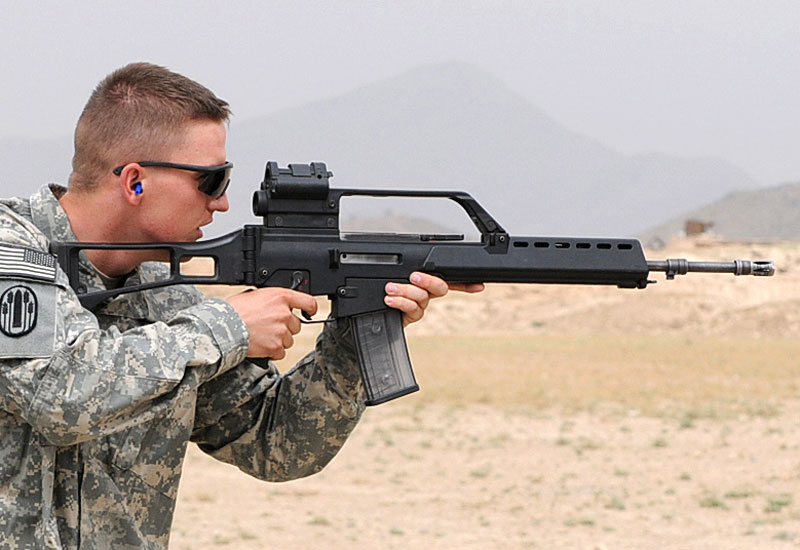
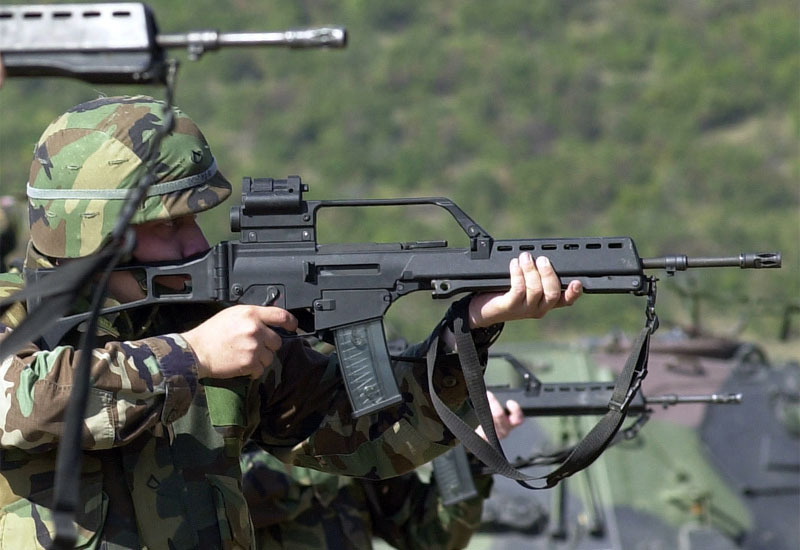
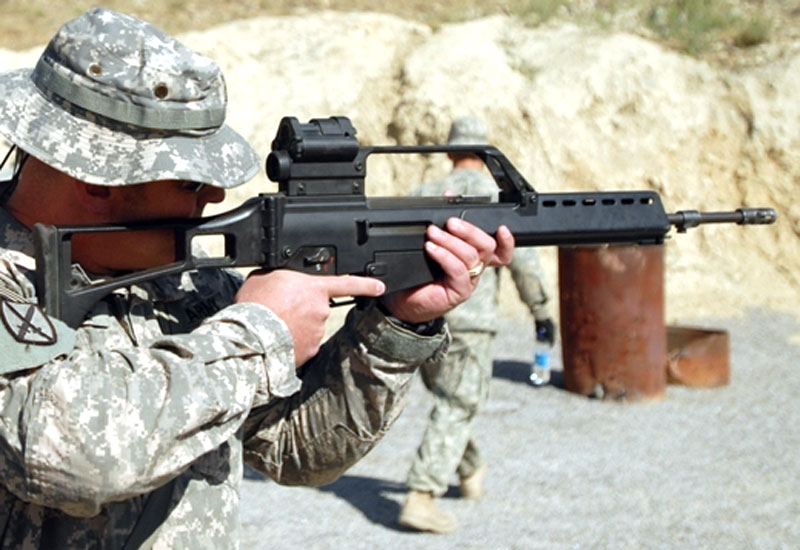
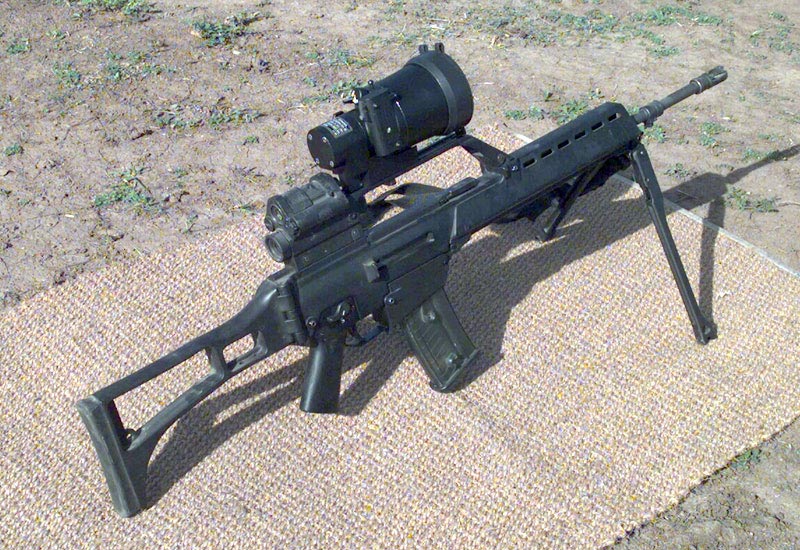
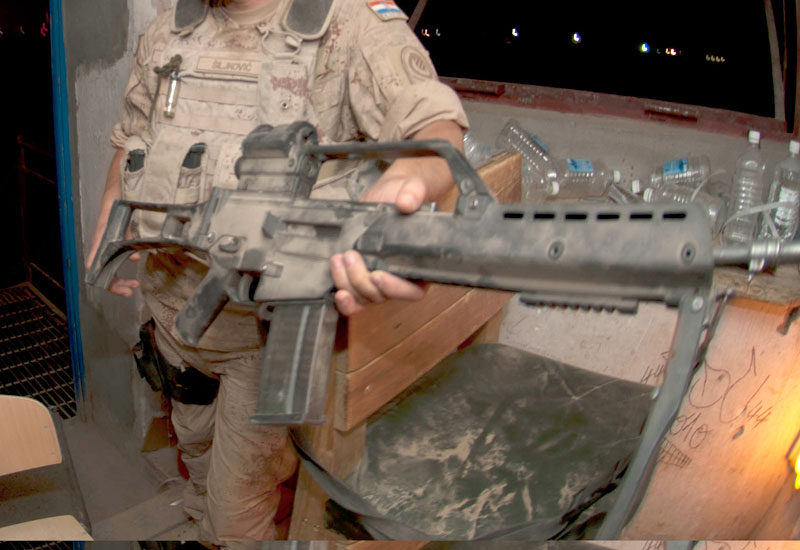
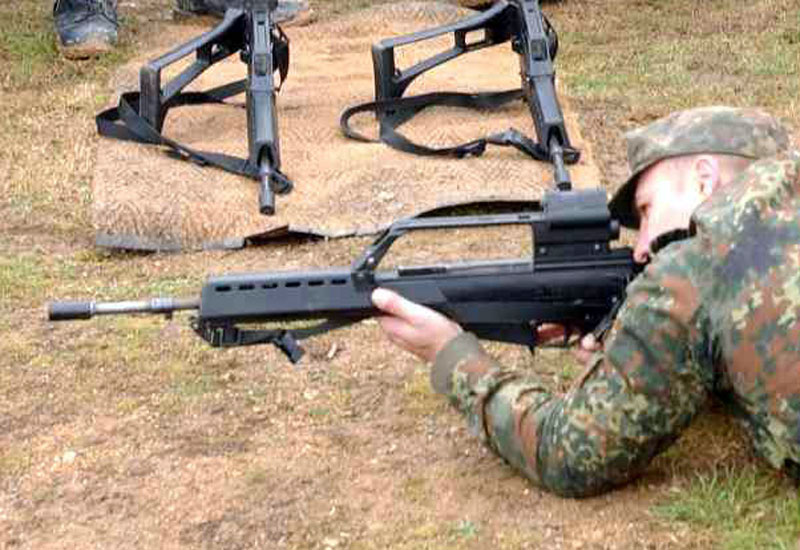
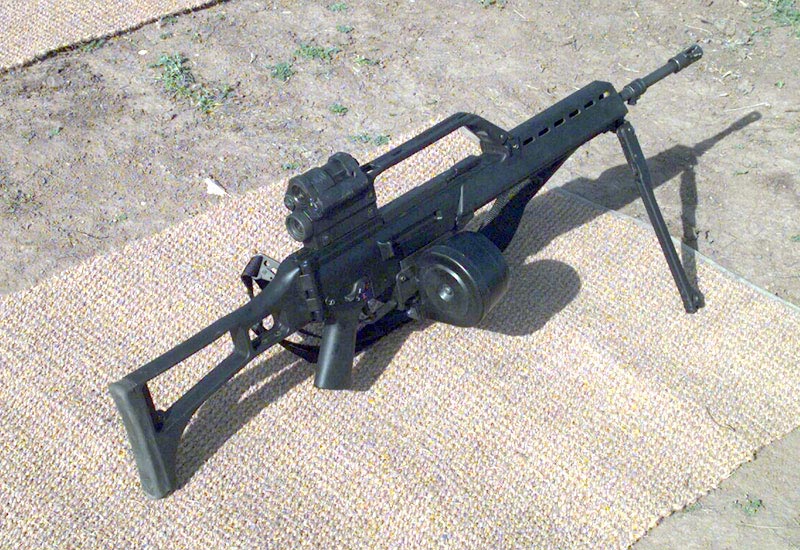
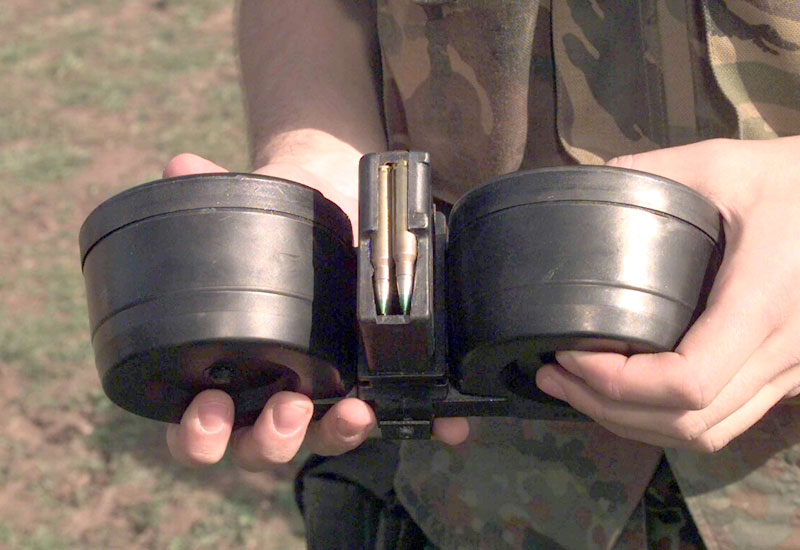
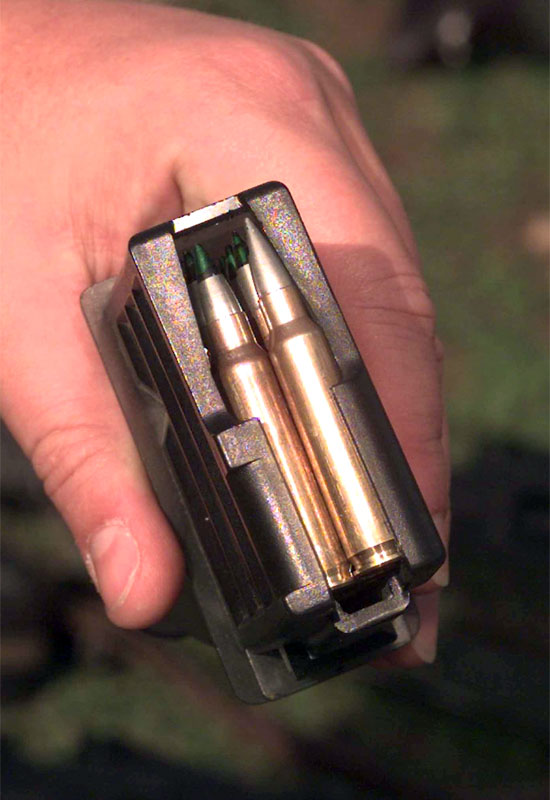
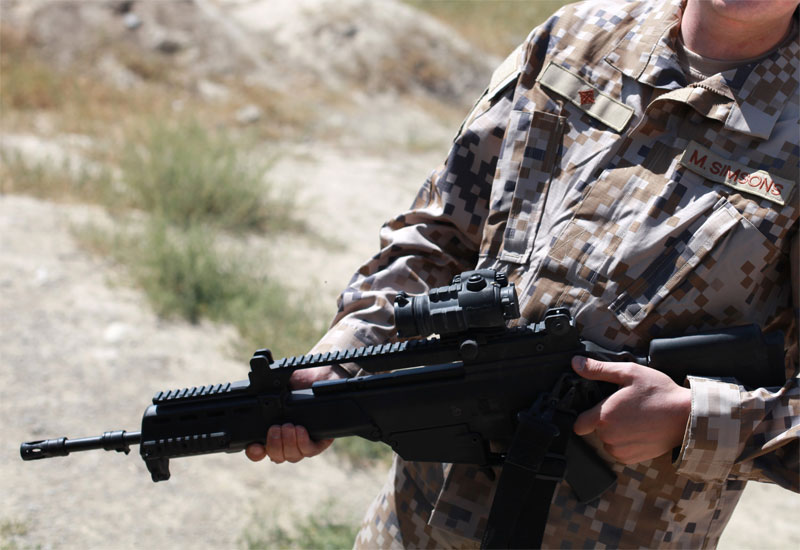
Design of the G36 was decidedly Heckler & Koch with its all-black finish, steel and plastic construction and slab-sided - nearly featureless - receiver. The gas cylinder was fitted over the barrel assembly in a traditional fashion and shrouded over with an angular perforated heat shield/hand guard, the barrel protruding a short distance ahead. The barrel was capped by a slotted flash suppressor and could accept rifle grenades as normal, taking full advantage of the gas-powered firing action. The receiver held the major internal working components while the weapon featured a conventional pistol grip sans finger grooves with connected trigger guard encompassing a curved trigger assembly. The weapon fed from curved polymer magazines into a well fitted ahead of the trigger with the release/catch identified just aft of the well. The weapon fired the 5.56x45mm cartridge from an HK-standardized 30-round curved detachable box magazine though a 100-round Beta C-Mag double-drum magazine could be substituted for the heavy fire/suppression role (thusly becoming the "MG36 Light Support Weapon" with applicable heavy barrel and bipod installed). Of note is that the G36 was not designed to be compatible with STANAG magazines served by NATO, the HK polymer magazines being wholly proprietary which, in some cases, limited its foreign appeal. A large HK-style firing selector was fitted above both sides of the pistol grip (ambidextrous) and within easy reach of the firing hand's thumb for quick reaction. Fire modes included a safety, semi-automatic (single-shot) and full-automatic modes to suit the situation. The stock was hollowed out to reduce weight and cost and designed to fold over the right side of the receiver without impeding the firing function - this proving useful for airborne, special forces and vehicle troops who could appreciate a more compact size. The G36 was completed with a sighting block assembly incorporating a standard 3x optical sight for ranged firing as well as an integrated collimating reflex sight for quick-reaction firing within 120 meters. From this assembly, an integral carrying handle was devised running across the top of the receiver to its front end. The charging handle was situated inside of the carry handle's opening and accessible with either hand - another ambidextrous quality.

The G36 has since been modernized for the German Army under the "G36A2" designation. This form introduced a quick-detaching collimating sight device mated to a Picatinny accessories rail. The handguard was redesigned from aluminum with four accessory install points while the stock was of a more compact nature.

After introduction of the base G36 assault model, HK introduced the "G36E" for export (hence the "E" in the designation). However, this designation was eventually superseded by "G36V" (V = "Variant") some time later. The G36E/V marks were essentially the same German Army G36 service assault rifles with the exception of a NATO-standard bayonet mounting and a more limited 1.5x optical scope while also lacking the collimating reflex sight.

The "MG36" was a light machine gun modification of the base G36 system which fired from a 100-round Beta C-Mag dual-drum magazine. For the sustained fire role required of this type of weapon, a heavy duty barrel was utilized to counter the effects of overheating (deformation or cracking of the barrel assembly). The MG36 was of course offered for export as the "MG36E" though both have since been discontinued in production.

It was only natural to develop the G36 long gun into a shortened carbine as the G36K (K = "Kurz", meaning "short"). This compact weapon retained the key qualities of its assault rifle brethren save for a shorter barrel and forend assembly which reduced overall length. The resulting shorter barrel, however, lost the capability to fire rifle grenades though this could be offset by installation of the 40x46mm HK AG36 underslung grenade launcher. An accessories rail ran across the bottom of the forend to which various tactical accessories (foregrip, laser aimers, flashlights, etc...) could be fitted. Two versions of the G36K were eventually produced and these were differentiated from one another by one lacking the over-receiver carrying handle (iron sights with rail accessories support being fitted instead). The carbine variant existed in the export-minded G36KV (KV = "Kurz Variant") form.

A further evolution of the already-compact G36K produced the G36C (C = "Compact") which included an even shorter barrel and forend design while lacking the over-receiver carrying handle. A Picatinny rail was added for accessories mounting along the top of the receiver (as well as the sides and underside of the hand guard) and iron sights were used to compensate for the lack of integral sighting devices.

Since its inception, the G36 has proven globally popular and its use has gone beyond military-minded customers to include special forces, police and security forces. Beyond Germany, the G36 is actively operated by Australia, Belgium, Brazil, Canada, Croatia, the Czech Republic, Egypt, Finland, Georgia, Greece, Hong Kong, Iceland, Indonesia, Italy, Jordan, South Korea, Kosovo, Latvia, Lebanon, Libya, Lithuania, Malaysia, Mexico, Montenegro, Norway, Philippines, Poland, Portugal, Saudi Arabia, Serbia, Slovakia, Spain, Sweden, the United Kingdom and the United Sates. By many accounts, the HK G36 is a highly-regarded automatic weapon system.
Text ©2003-2013 www.MilitaryFactory.com • All Rights Reserved • No Reproduction Permitted
MilitaryFactory.com does NOT sell equipment/weaponry. Material presented throughout this website is for historical and entertainment value and should not to be construed as usable for hardware restoration, maintenance or general operation. Please consult manufacturers for such information. Our disclaimer. Email corrections / Comments to MilitaryFactory at Gmail dot com.
Picture of Heckler & Koch HK G36
Pic of the Heckler & Koch HK G36
Image of the Heckler & Koch HK G36
View All Images (14)

Specifications for the
Heckler & Koch HK G36
Assault Rifle / Assault Carbine


Country of Origin: Germany
Manufacturer: Heckler & Koch GmbH - Germany
Initial Year of Service: 1996


Overall Length: 999mm (39.33in)
Barrel Length: 480.00mm (18.90in)
Weight (Empty): 8.00lbs (3.63kg)


Cartridge: 5.56x45mm NATO
Action: Gas-Operated, Rotating Bolt
Feed: 30-Round Detachable Box; 100-round Beta C-Mag dual drum magazine
Muzzle Velocity: 3,000ft/sec (914m/sec)
Rate-of-Fire: 750 rounds per minute
Range: 2,853ft (870m; 951yds)
Sights: 1x or 3x Optical Sight w Collimating Sight; backup iron sights


Variants:
G36 - Base Assault Rifle Model of the German Army.


G36A2 - Modernized G36 production model; quick-release reflex dot sighting device; Picatinny rail accessories support; G36C-style stock.

G36E - Export variant; featuring 1.5 x optical sight; sans collimating sight; NATO-standard bayonet mounting; redesignated to G36V.

G36V - Redesignation of G36E production models.

G36K ("Kurz") - Carbine with shorter barrel and handguard; accessories support; AG36 grenade launcher support.

G36KE - Export version of the G36K carbine model; redesignated to G36KV.

G36KV - Redesignation of G36KE

MG36 - Light Machine Gun modification; heavy barrel.

MG36E - Export variant of the MG36 LMG

G36C ("Compact") - Improved compact form of the G36K carbine; shorter barrel and handguard; reworked internals to compensate for shorter length; Picatinny accessories rail support; four point handguard accessories support.


Operators: Australia; Belgium; Brazil; Canada; Croatia; Czech Republic; Egypt; Finland; Germany; Georgia; Greece; Hong Kong; Iceland; Indonesia; Italy; Jordan; South Korea; Kosovo; Latvia; Lebanon; Libya; Lithuania; Malaysia; Mexico; Montenegro; Norway; Philippines; Poland; Portugal; Saudi Arabia; Serbia; Slovakia; Spain; Sweden; United Kingdom; United States

ALL SMALL ARMS CATEGORIES

BY YEAR:


1700 to 1799
1800 to 1899
1900 to 1909
1910 to 1919
1920 to 1929
1930 to 1939
1940 to 1949
1950 to 1959
1960 to 1969
1970 to 1979
1980 to 1989
1990 to 1999
2000 to 2009
2010 to 2019
VIEW ALL
Compare Guns


BY TYPE:


Anti-Aircraft Weapons
Anti-Material Rifles
Anti-Tank Weapons
Automatic Rifles
Bolt-Action Rifles
Carbine Guns
Flamethrowers
Flintlock Guns
Grenade Launchers
Hand Grenades
Lever-Action Rifles
Machine Guns
Mortars
Musket Guns
Pistols / Handguns
Recoilless Rifles
Revolvers
Rocket Launchers
Shotguns
Silenced Guns
Sniper Rifles
Special Weapon Systems
Submachine Guns
VIEW ALL


SPECIAL:


18th Century Warfare
3 Soldiers Statue
Battle of Mogadishu
Chainmail Armor
Firearm Types Defined
French Military Victories
Medieval Crossbow
Medieval Longbow
Vietnam War Casualties
Vietnam War Memorial

WORLD WAR 2:


British Guns
French Guns
German Guns (ALL)
German Rifles
Italian Guns
Japanese Guns
Soviet Guns
US Guns
US Infantry Regiment-Level Guns
Machine Guns
Pistols
Submachine Guns
Sniper Rifles
VIEW ALL


WORLD WAR 1:

Pistols
Rifles
Machine Guns
Mortars
US Guns
VIEW ALL


KOREAN WAR:

Machine Guns
VIEW ALL


VIETNAM WAR:

Mortars
VIEW ALL


COLLECTIONS:


Ancient Weapons
British SAS Weapons
Civil War Guns
Colt Guns
Glock Guns
GROM Polish Special Forces
Guns of Libya
Guns of North Korea
Guns of Syria
Guns of WW1 & WW2
Heckler & Koch Guns
Kalashnikov Guns
Modern Russian Guns
Navy SEAL Weapons
Spetsnaz Weapons
Weapons of Desert Storm
Wild West Guns
Winchester Guns


HOLLYWOOD/GAMES:


Guns of the Walking Dead

Site Disclaimer | Privacy Policy | Site Map | MF Origins


©2013 www.MilitaryFactory.com • Content ©2003-2013 MilitaryFactory.com • All Rights Reserved • Site Contact Email: militaryfactory at gmail dot com. The "Military Factory" name and MilitaryFactory.com logo are registered ® trademarks and protected by all applicable domestic and international intellectual property laws.


Top MF Stuff: 2013 Military Pay Scale | Military Ranks | WW2 Weapons | Sniper Rifles | Kts to Mph | WW1 Aircraft | Automatic Rifles | Aircraft Cockpits | Vietnam War Weapons | Main Battle Tanks | Submachine Guns | Shotguns | French Military Victories


Most photographic images appearing on this site are courtesy of the United States Department of Defense and are approved for public use. Other images acquired through the public domain. Digital art work courtesy of Dan Alex. Business Consulting by Kyle Williams. Material presented throughout this website is for historical and entertainment value and should not to be construed as usable for hardware restoration, maintenance or general operation. Please consult manufacturers for such information.


eXTReMe Tracker